TipRanks Smart Growth Portfolio #69: Borderline Genius

Dear Investors,
In this edition of the Smart Growth Portfolio and Newsletter, we spotlight a company making geography negotiable. But first, some news and updates.
1
Portfolio News
❖ Micron (MU) soared, adding to its 860%+ gain over the past year, with its market valuation inching closer to overtaking Meta Platforms and Tesla. The memory maker delivered one of the strongest earnings reports of the AI cycle, with fiscal Q3 results and Q4 guidance both crushing consensus estimates. Revenue surged to a record $41.46 billion, up 346% year-over-year, while adjusted EPS jumped to $25.11.
The even bigger story was MU’s margin power. Non-GAAP gross margin reached 84.9%, compared with 39% a year earlier, as tight DRAM and NAND supply, surging AI-driven demand, and higher average selling prices reshaped the economics of the memory business. Operating cash flow reached $25.39 billion, while adjusted free cash flow came in at $18.3 billion, underscoring how dramatically MU’s earnings quality has improved.
Guidance was even stronger. Micron expects fiscal Q4 revenue of about $50 billion and adjusted EPS of $31 at the midpoint, far above analyst expectations. The company also guided for non-GAAP gross margin of approximately 86%, above Q3’s already exceptional level, directly pushing back against fears that profitability had already peaked. Management also said supply-demand conditions for both DRAM and NAND are likely to remain tight beyond calendar 2027, with no clear line of sight yet to when memory supply will catch up with demand.
Micron’s new wave of Strategic Customer Agreements was a key strategic development. The company has now signed 16 multi-year take-or-pay agreements covering roughly 20% of DRAM volume and one-third of NAND volume through 2030, with price floors designed to support margins even if market conditions soften. Management said the signed agreements carry about $100 billion of minimum-price revenue and $22 billion in customer deposits and related commitments.
Wall Street reacted exuberantly. Analysts broadly raised price targets, with Melius lifting its target to $2,200, while Susquehanna, Barclays, and D.A. Davidson moved to $2,000. RBC, J.P. Morgan, BofA, and others also emphasized the same core message: memory is no longer being viewed as a normal boom-and-bust chip cycle, but as a critical AI infrastructure bottleneck.
That has implications beyond Micron. The report strengthened sentiment across memory, storage, and AI hardware stocks, helping ease bubble fears and reinforcing the view that the accelerating AI buildout continues to be increasingly supply-constrained.
1
❖ Ondas (ONDS) is tentatively recovering after tumbling nearly 20% over the past week. The stock was hit by a confluence of macro and market headwinds, which weighed on sentiment as investors absorbed the news of the $125 million Cyberhawk acquisition.
Meanwhile, company-specific news flow continues to be overwhelmingly positive. Lockheed Martin announced a collaboration with Ondas’ counter-drone technology subsidiary Sentrycs, with its Cyber-over-RF technology slated to be integrated into the aviation giant’s next-generation counter-drone system Sanctum, which is designed to protect military forces, homeland security, and critical assets against evolving unmanned aerial threats. The news underscores ONDS’ growing defense credibility.
Additionally, Ondas reported that it has secured more than $40 million in new orders during June for autonomous defense systems, bringing its Q2-to-date order activity to more than $150 million. The June awards include orders for counter-unmanned aerial systems, loitering munition systems, and integrated autonomous defense capabilities from government and defense customers across multiple international markets. The new orders build on the more than $30 million secured during May, reflecting accelerating demand for Ondas’ integrated autonomous defense platform across Europe and the U.S.
1
1

1
This Week’s Top Growth Pick: Global-e Online (GLBE)
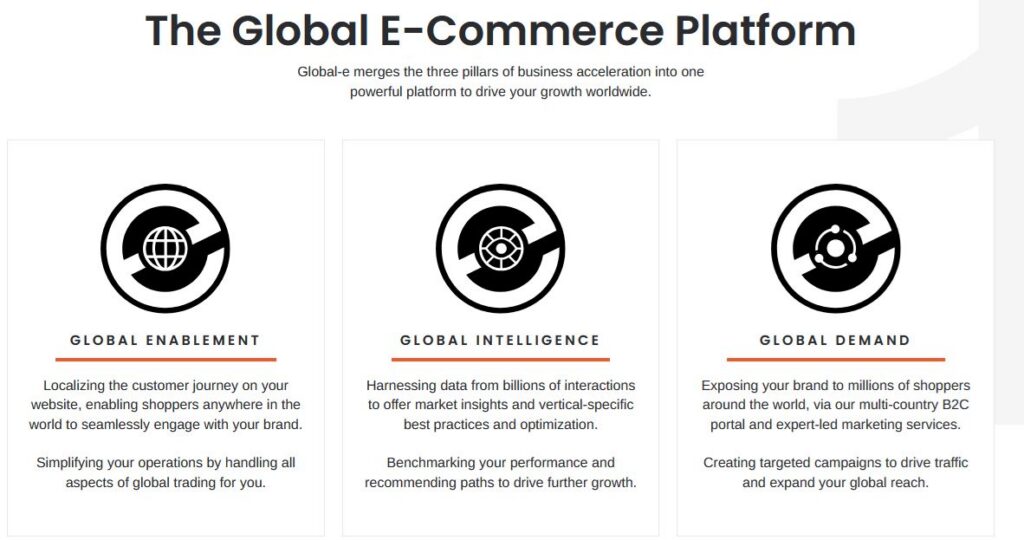
Global-e Online operates at the intersection of e-commerce, technology, and cross-border trade, helping brands and retailers sell to customers around the world with the same ease as a domestic transaction. Its platform manages the complexities of cross-border commerce, including localization, payments, logistics, compliance, and customer experience. As consumers increasingly discover products through global digital channels, geographic boundaries are becoming less relevant while operational challenges grow more demanding. Global-e sits in the middle of that shift, providing the infrastructure that enables merchants to expand internationally without rebuilding their operations country by country. In doing so, the company has become a key enabler of global digital commerce, connecting brands with international demand through a technology layer designed for scale.
Source: Global-E Online Ltd. website
1
Locally Global
Global-e was founded in Israel in 2013 to solve one of e-commerce’s most persistent friction points: cross-border selling. Digital storefronts made brands visible worldwide, and payment networks made international transactions easier, but merchants still faced a larger operating problem: how to localize pricing, duties, taxes, checkout, shipping, returns, fraud controls, and compliance across many markets without rebuilding the business country by country.
That problem became even more relevant as e-commerce matured. By the mid-2020s, merchants could accept global payments more easily, but the hard part shifted to improving conversion and protecting margins across dozens of local markets. Shoppers expected local payment methods, transparent duties, familiar delivery options, simple returns, and pricing that made sense in their own currency. At the same time, tariffs, tax rules, consumer regulations, and fulfillment costs became more volatile. GLBE’s advantage developed around handling those moving parts in one operating layer, turning cross-border commerce from a patchwork of vendors into a managed growth channel.
The company’s 2021 IPO gave it more capital and visibility, just as brands were pushing harder into direct international e-commerce. The most consequential growth driver came through Shopify, which invested in Global-e in 2021 and expanded the partnership over time. In 2025, the companies renewed their strategic agreement for three years, with GLBE remaining the exclusive merchant-of-record provider for Shopify’s branded Managed Markets solution.
Global-e also expanded through acquisitions and platform integrations. In early 2022, it completed the acquisition of Flow Commerce, strengthening its cross-border technology, merchant relationships, and U.S. presence. Later that year, it acquired Borderfree from Pitney Bowes, adding enterprise merchants, global brand relationships, and deeper cross-border retail expertise. In 2026, GLBE agreed to acquire Passport for $350 million, adding an asset-light, multi-carrier logistics network across cross-border, domestic, and last-mile delivery, while also expanding its reach into merchants that need cross-border logistics without a full merchant-of-record solution.
Partnerships and integrations with Salesforce Commerce Cloud, Google, SAP Commerce Cloud, Adobe Commerce, and Meta further widened its merchant access. With customers including Victoria’s Secret, Marks & Spencer, Ralph Lauren, Hugo Boss, Steve Madden, and Spanx, Global-e has evolved from a specialist in international checkout into a broader commerce infrastructure platform embedded in how major brands pursue international growth.
1
Cart Blanche
Global-e helps brands sell internationally without building a separate operating structure for every country they enter. The company sits between merchants and shoppers, handling the layers of commerce that become more complicated once a transaction crosses borders: localization, duties, taxes, compliance, payments, shipping, returns, and customer experience. GLBE typically earns money through transaction-based fees and merchant services tied to the volume flowing through its platform.
That role has become more important over time, as the challenges have moved far beyond accepting and processing international payments – which have become relatively straightforward. Now, the hardest part of global commerce centers on scaling profitable operations across multiple markets. Consumers expect local currencies, familiar payment methods, transparent duties, predictable delivery, and easy returns. Meanwhile, merchants face shifting tariffs, tax regimes, compliance requirements, and logistics costs. GLBE’s merchant-of-record infrastructure absorbs much of that complexity, allowing brands to expand internationally through a single platform.
The company’s largest growth engine is Shopify. Global-e powers Shopify Managed Markets – Shopify’s international commerce solution – helping merchants sell globally without managing cross-border operations themselves. The relationship gives GLBE privileged access to the world’s largest independent e-commerce ecosystem. Shopify powers roughly 29% of U.S. e-commerce websites, and merchants operating on the platform account for approximately 14% of total U.S. e-commerce sales. Managed Markets remains in the early stages of adoption, with rollout expanding geographically and analysts expecting transaction volumes to grow substantially over the next several years.
Global-e is also building extra profit levers around the checkout. Duty Drawback goes after one of cross-border commerce’s least visible leaks: import duties that merchants pay, then often lose when goods are returned or re-exported. GLBE uses its transaction data and tracking systems to help recover part of that money, keeping more economics inside the merchant relationship. Borderfree.com works from the other side of the funnel, acting as a discovery channel for international shoppers. The platform directs them to Global-e merchants, turning a platform built for conversion into an additional source of demand. AI is increasingly embedded across product development, compliance, customer support, and merchant services, with the company gearing up for an AI- and agentic-led future of shopping.
The recent acquisition of Passport extends the platform further into logistics, notably widening GLBE’s moat. Passport brings an asset-light, multi-carrier shipping network, post-purchase capabilities, and a non-merchant-of-record offering that broadens GLBE’s reach across different merchant segments. More importantly, it gives the company greater control over fulfillment, delivery, returns, customs workflows, and the post-purchase experience – turning logistics from a third-party handoff into part of Global-e’s own value proposition.
The Iran war provided a real-world stress test of Global-e’s operational resilience. Gulf markets, which account for about 5% of the company’s inbound gross merchandise volume, experienced a temporary slowdown as the conflict disrupted regional commerce. However, demand largely recovered within weeks, highlighting the benefits of Global-e’s geographic diversification and broad merchant base.
The opportunity remains large. GLBE’s business is inherently land-and-expand, as existing customers frequently add countries and brands or adopt new services, increasing revenue from merchants already on the platform. In parallel, there is a massive expansion runway: cross-border e-commerce continues to grow much faster than overall retail, while Global-e serves only a small portion of the global market. The company now supports more than 1,500 brands, with recent growth increasingly driven by Europe and Asia-Pacific, where merchant adoption is accelerating.
GLBE’s growth opportunities are substantial, although the setup still carries clear execution risk. The company needs continued Shopify momentum, smooth Passport integration, broader adoption of newer services, and disciplined navigation of tariffs, shipping costs, and changing trade rules. Still, these risks also point to the larger opportunity. Global-e is no longer just helping merchants process cross-border orders – it is building toward an international shopping platform that connects discovery, localized checkout, compliance, fulfillment, returns, and merchant economics in one operating layer.
1
Hauling It In
Global-e continues to pair rapid expansion with rising profitability – a combination that reinforces the quality of its growth. The company has now beaten revenue expectations for at least eight consecutive quarters, while adjusted earnings per share have not fallen short of consensus since late 2022. This consistency reflects GLBE’s ability to expand the platform while also lifting profitability, separating durable growth from growth bought through heavier spending.
The momentum continued in the first quarter of 2026. Gross merchandise volume1 (GMV) climbed 40% year-over-year to $1.74 billion, driving 33% revenue growth – with both metrics above the company’s guidance midpoint and revenue exceeding Wall Street expectations. Strong same-store sales, successful merchant launches, and continued adoption of higher-value services all contributed to the acceleration. Europe and Asia-Pacific remained the fastest-growing regions, illustrating that Global-e’s expansion is becoming increasingly diversified geographically.
Profitability strengthened alongside volume growth. Non-GAAP gross profit rose 37%, with gross margin expanding to 47% from 45.4% a year earlier. Non-GAAP net income surged nearly 45% year-over-year to $46.9 million. Adjusted EBITDA grew even faster than revenue, climbing 59% to $50.2 million, with margin expanding to 19.9% from 16.6%. GAAP results also crossed an important line, as net income reached $30.4 million after a prior-year loss. For a company still investing aggressively in merchant acquisition, Shopify, Passport, AI tools, and value-added services, reaching sustained profitability while continuing to expand is an encouraging combination. Meanwhile, AI-driven productivity gains are already helping improve R&D efficiency and operating leverage, allowing expenses to grow considerably slower than transaction volume.
Management’s outlook reinforces that trajectory. The company’s Q2 guidance came in ahead of analyst expectations, outlining expectations of roughly 35% year-over-year expansion in GMV and 31% growth in revenue, with adjusted EBITDA of $55-58 million implying another quarter of roughly 20% margins. Moreover, the strong start to the year was followed by a full-year 2026 guidance raise – despite temporary disruption from the Iran conflict and an expectation that foreign-exchange tailwinds will diminish significantly after the first quarter. Global-e now expects 2026 GMV of $8.53-8.88 billion, implying 32.5% year-over-year growth at the midpoint. Revenue is projected at $1.22-1.28 billion, representing roughly 30% growth, while adjusted EBITDA is expected to reach $264.5-289.5 million, implying margin expansion to more than 22%.
The balance sheet remains a source of flexibility. GLBE ended the quarter with approximately $553 million in cash, deposits, and marketable securities, while Q1 free cash flow reflected a seasonal working-capital outflow, consistent with prior-year patterns. In contrast to many growth companies, Global-e has essentially no debt. This balance-sheet strength gives the company ample capacity to fund acquisitions, product development, and international expansion while remaining resilient through macroeconomic volatility.
There are real risks, but they appear manageable. Take rates2 can be pressured by merchant mix, and Passport still needs to integrate smoothly. Customer concentration looks moderate, with no single merchant accounting for more than 8.5% of 2025 GMV, but it is worth tracking as larger enterprise merchants scale on the platform. Still, these risks are outweighed by stronger forces: durable volume growth, expanding margins, a debt-free balance sheet, rising guidance, and multiple new growth engines beginning to scale alongside the core cross-border business.
—
1 – GMV is the total value of goods sold through Global-e’s platform before fees and adjustments.
2 – Take rate is the percentage of GMV that Global-e retains as revenue.
—

Source: The Fly, based on Global-E Online data
1
Going Places
Global-e occupies a specialized corner of e-commerce infrastructure, sitting at the intersection of cross-border commerce, merchant enablement, localized payments, and international transaction orchestration. No public company mirrors its merchant-of-record model exactly, so the most meaningful comparisons come from adjacent platforms solving similar international commerce challenges. Shopify serves as the strategic anchor, sharing GLBE’s focus on merchant enablement while underpinning one of the company’s largest growth engines through Managed Markets. dLocal provides the closest operational comparison, helping global merchants navigate localized payments, currencies, and regulatory complexity. Flywire completes the group with its software-driven platform for managing complex cross-border transactions, offering a useful benchmark for scalable international payments infrastructure.
Over the past year, Global-e’s stock has trailed Flywire and dLocal, while modestly outperforming Shopify – a reflection of the market’s caution toward cross-border e-commerce despite the company’s consistently strong execution. The past six weeks, however, have told a different story. While all four stocks in the group have recovered since mid-May as geopolitical tensions eased, GLBE has emerged as the clear leader. Beyond stronger investor confidence around cross-border commerce, Global-e’s beat-and-raise earnings report provided fresh evidence that the company’s growth story is more resilient than the stock had implied. GLBE’s recent outperformance suggests the market is increasingly rewarding its execution. Wall Street forecasts an average upside of more than 20% for the Strong Buy-rated stock, with the more optimistic analysts – including UBS, Needham, and Piper Sandler – seeing 30%+ potential gains.
Global-e’s valuation may appear demanding in isolation, but it looks much more reasonable when weighed against its fast growth and improving profitability. The stock trades at 22.7x forward non-GAAP earnings, falling to 17.8x in FY2 and 13.2x in FY3, showing how quickly the multiple compresses as earnings continue to ramp. It is more expensive than dLocal and Flywire on sales and EBITDA, but it also offers a cleaner mix of revenue growth, margin expansion, debt-free flexibility, and platform depth. Against Shopify, the gap remains wide: GLBE trades at less than half SHOP’s forward EV/Sales and roughly one-third of its forward EV/EBITDA, while already approaching or surpassing Shopify on several profitability metrics. A forward PEG below 1 gives GLBE one of the cleaner growth-adjusted valuation profiles in the group.
The company’s strengthening finances have allowed it to expand its buyback authorization. Global-e’s board approved its first-ever share repurchase program of up to $200 million in September 2025. After completing approximately 80% of that plan, GLBE approved an additional $500 million authorization on June 4, 2026. The new program – like the earlier one – relies purely on organic financial health, with management saying it will fund the buybacks using cash on hand and future operational cash flows. CFO Ofer Koren framed it as part of the company’s capital allocation strategy, calling repurchases an important lever while Global-e continues to invest in strategic initiatives. Notably, the buyback was announced shortly after the Passport acquisition, underscoring Global-e’s capacity to fund M&A, product development, and shareholder returns at once.

1
To Sum It All Up
Global-e is becoming an increasingly important infrastructure layer behind international online shopping. As brands look beyond their home markets, the challenge is no longer attracting overseas customers but operating locally across currencies, regulations, taxes, logistics, and customer expectations. Global-e has positioned itself at the center of that complexity, turning cross-border commerce into a scalable platform rather than a series of country-specific projects. The expanding partnership with Shopify, growing portfolio of merchant services, Passport acquisition, and AI-driven automation all deepen that position while creating additional avenues for growth beyond the checkout itself. Combined with accelerating profitability, a debt-free balance sheet, and significant room to expand within a large and still underpenetrated market, Global-e appears well placed to continue gaining share as international e-commerce becomes increasingly borderless.
1
1
Smart Growth Portfolio
|
—-
***Vistance Networks (VISN) apparent stock-price decline is not a real economic loss. Shares plunged roughly 50% on April 27 because they began trading ex-dividend after a $10 special cash distribution, meaning value was mechanically transferred from the stock price to shareholders as cash. Since then, VISN is up roughly 27%, reflecting strong investor confidence in the remaining business. Another similar value-transfer event is likely ahead: Vistance agreed to sell RUCKUS to Belden for $1.846 billion in cash, with most of the roughly $1.7 billion in net proceeds to be distributed to shareholders after closing. The deal is expected to be completed in the second half of 2026.
1
1
Disclaimer
The information contained in this article represents the views and opinions of the writer only, and not the views or opinions of TipRanks or its affiliates and should be considered for informational purposes only. TipRanks makes no warranties about the completeness, accuracy, or reliability of such information. Nothing in this article should be taken as a recommendation or solicitation to purchase or sell securities. Nothing in the article constitutes legal, professional, investment and/or financial advice and/or takes into account the specific needs and/or requirements of an individual, nor does any information in the article constitute a comprehensive or complete statement of the matters or subject discussed therein. TipRanks and its affiliates disclaim all liability or responsibility with respect to the content of the article, and any action taken upon the information in the article is at your own and sole risk. The link to this article does not constitute an endorsement or recommendation by TipRanks or its affiliates. Past performance is not indicative of future results, prices, or performance.
