TipRanks Smart Growth Portfolio #28: Byte Guard

Dear Investors,
Welcome to the 28th edition of the Smart Growth Portfolio and Newsletter.
1
1
Portfolio News
❖ Applied Digital Corporation (APLD) – our newest Growth Portfolio addition – has seen its stock jump over 12% this past week. Part of the lift comes from overall AI-infrastructure euphoria spurred by big infrastructure deals like Microsoft’s with Nebius, which have heightened demand expectations for high-performance computing (HPC) infrastructure. APLD-specific news added fuel: it announced a 150 MW lease with CoreWeave at its Polaris Forge 1 Campus in North Dakota, taking total committed lease revenue to about $11 billion (up from $7 billion), and total contracted capacity at the campus to 400 MW across three long-term agreements.
1
❖ Micron (MU) has seen notable analyst activity ahead of its fiscal Q4 report on September 23. Both Citi and Mizuho lifted their price targets from $150 to $175 while reiterating Buy ratings, helping fuel the stock’s recent strength. Analysts largely expect an in-line quarter, but firmer DRAM and NAND pricing are seen as catalysts for a guidance upgrade – reinforcing the view that Micron remains a prime beneficiary of AI and data center demand. In addition, Washington lent a helping hand, with recent U.S. restrictions on semiconductor equipment exports to China – affecting South Korean giants Samsung and SK Hynix – expected to benefit U.S.-focused MU.
1
❖ Fidelity National Financial has teamed up with Clear Secure (YOU) to tackle the growing threat of real estate fraud. The partnership integrates Clear’s biometric identity platform, Clear1, into FNF’s digital platform to verify buyer and seller identities during title and escrow. Fraud in property sales – from impersonation to wire scams – has surged in recent years, exposing the market to mounting financial risks. The first rollout of Clear1 began in July across select markets, with broader deployment planned after testing. The deal extends Clear’s identity verification services into a new vertical beyond travel and hospitality, highlighting the scalability of its platform and opening an additional growth channel in real estate.
1
❖ Citi put MKS Inc. (MKSI) on a 30-day “upside catalyst watch” ahead of October’s Semicon West show – expected to spark momentum for wafer fab equipment stocks. The firm argues AI-driven demand inflection should lift spending across all end markets, with memory seeing the sharpest pickup. Citi reiterated a “Buy” rating on MKSI.
1
❖ Nutanix (NTNX) climbed more than 20% over the past week, propelled by the S&P Dow Jones Indices announcement of its inclusion in the S&P MidCap 400 as part of the quarterly rebalancing on September 22. Beyond the headline, the move brings mechanical buying from index funds and ETFs that track the benchmark – adding liquidity and broadening NTNX’s shareholder base at a time when momentum around hybrid cloud demand remains strong.
1
1
Under Review
❖ We are removing Innodata (INOD) from our “Under Review” bracket after a decisive shift in both fundamentals and sentiment.
What began as a fragile rebound following its steep post-earnings drop has now become a durable uptrend supported by execution, catalysts, and renewed investor conviction.
The company continues to post exceptional growth, with revenue up nearly 80% in its latest quarter and adjusted EBITDA climbing more than threefold. Gross margin expansion and positive free cash flow reinforce the operating leverage in its model, while a net cash balance sheet provides ample flexibility to keep scaling without financial strain.
Crucially, concerns around customer concentration are beginning to ease. Management secured a $10 million expansion from an existing client in H2 2025 and is now benefiting from the migration of major accounts away from Scale AI following Meta’s controversial stake in that competitor. These developments validate Innodata’s positioning as a neutral, high-quality provider of domain-specific training data – an advantage as enterprises demand greater security and accuracy in their AI workflows.
The broader narrative has also turned in its favor. Recent results from Broadcom and Oracle offered validation from the old guard of enterprise tech, with both companies underscoring sustained AI demand and infrastructure build-out. That endorsement helps remove lingering doubts and adds weight to Innodata’s long-term opportunity set.
Strategic partnerships add further momentum. Recent integration with a hyperscale cloud platform significantly broadens market access, while ongoing ties with NVIDIA and Palantir strengthen credibility in generative and agentic AI. Analysts have taken note, with multiple firms reiterating Buy ratings and setting price targets well above current levels. Institutional investors are also increasing stakes, signaling confidence in the rerating story.
Taken together, Innodata has moved past the uncertainty that justified its “Under Review” status. With accelerating growth, diversification underway, and structural demand tailwinds from Big Tech’s AI capex, we now view the company as firmly back in the Growth bracket.
1
❖ We are keeping Clearwater Analytics (CWAN) under review, , as integration risks and weak sector sentiment continue to overshadow strong fundamentals.
The Q2 report on August 6 showed near-flawless execution: revenue and adjusted EBITDA both up more than 70%, ARR growth of 83%, retention steady at 98%, and non-GAAP gross margin at 77%. Management reaffirmed a bullish Q3 outlook, guiding for mid-70% revenue growth. Yet despite those results, the stock sold off on fears over its debt-heavy acquisition strategy. Integration of Enfusion, Beacon, and BISTRO remains the near-term challenge, with leverage elevated and the market waiting to see how quickly Clearwater can turn scale into durable profitability.
While those execution risks explain some hesitation, recent trading suggests a broader sector effect. Over the past week, Clearwater and its closest peers have all drifted lower or sideways, reflecting investors’ rotation into “pure AI” names after Oracle’s recent results reignited AI exuberance. Growth stocks outside that immediate narrative – even those with AI adjacency – have been marked down. Viewed over a longer lens, however, Clearwater has outperformed its peer set this past month, highlighting that the latest dip has little to do with fundamentals.
Momentum underneath remains constructive. Bloomberg’s integration of Clearwater’s platform into its enterprise suite is a major validator, while strong free cash flow enabled a $100 million buyback program to offset dilution. Balance sheet leverage is elevated, but management is balancing debt reduction with shareholder returns. With retention near-perfect, ARR climbing fast, and large customer wins continuing, the core growth story is intact.
For now, we remain cautious but not bearish. CWAN’s execution has been strong, but the stock needs a sentiment shift to re-rate. Until integration progress is clearer and sector flows normalize, we keep it under review.
1
1

1
This Week’s Top Growth Pick: SentinelOne (S)
SentinelOne, Inc. is a next-generation cybersecurity firm building an autonomous protection platform that defends endpoints, cloud workloads, identities, and data. Its Singularity platform uses machine learning, behavioral AI, and real-time threat intelligence to detect, prevent, and respond to attacks without constant human oversight. Designed for enterprise scale, its tools unify endpoint detection & response, identity threat monitoring, cloud security, and data protection under a single framework. Whether an organization is operating on-premises, in the cloud, or across hybrid environments, SentinelOne aims to make security more proactive, less fragmented, and faster to adapt. As cyberattacks grow in frequency and complexity, the company offers enterprises a way to strengthen defenses while reducing reliance on manual intervention.
1
Autonomy Rising
SentinelOne was founded in 2013 by Tomer Weingarten, Almog Cohen, and Ehud “Udi” Shamir with the aim of moving past signature-based antivirus toward machine-learning systems that could recognize malicious behavior in real time. At the time, most security products still relied on static libraries of known threats, leaving organizations exposed to zero-day exploits and novel attack methods. By focusing on behavior rather than signatures, SentinelOne introduced a way to spot malicious activity as it unfolded – an approach that made protection adaptive instead of reactive and set the company apart from entrenched incumbents.
For several years the company built credibility as a challenger in endpoint protection, but the real acceleration came in June 2021 when it went public on the NYSE in one of the largest cybersecurity IPOs to date. The $1.2 billion raise gave SentinelOne the resources to scale its go-to-market reach and build out the Singularity platform – a unified security architecture that began with endpoint protection but has since extended into identity, cloud workloads, and data analytics.
In the years that followed, acquisitions became the engine of expansion. The 2021 purchase of Scalyr brought log management and cloud-scale analytics into the fold, while the 2022 acquisition of Attivo Networks added identity threat detection and lateral-movement defense – an essential growth lever as attackers increasingly targeted credentials. In early 2024, SentinelOne acquired PingSafe, adding cloud-native application protection – known as CNAPP – to secure the full lifecycle of applications running in public and hybrid clouds. Just this past August, it announced a deal to acquire Prompt Security, bringing in safeguards for generative AI systems while they are running – helping enterprises defend against risks like prompt injection and data leakage. That momentum carried into September, when SentinelOne agreed to buy Observo AI, a specialist in real-time data pipelines that feed directly into its AI-driven security information and event management platform (SIEM) – the system that centralizes and analyzes alerts across an organization’s entire digital footprint.
Strategic partnerships have reinforced this growth trajectory. With AWS, SentinelOne has embedded its platform into services like Security Hub and AppFabric and listed Singularity AI SIEM on AWS Marketplace – giving customers a direct feed of cloud activity data for real-time analysis. Its alliance with Google Cloud goes further by pairing that data flow with Gemini AI models to power Purple AI, a set of features that turns security telemetry into natural-language insights and automated investigations. At the same time, SentinelOne has integrated with Microsoft through Azure Active Directory and ensured deployment compatibility with Oracle Cloud Infrastructure (OCI), allowing its agents to secure workloads across all major clouds. Together, these alliances make the platform feel native to the environments where enterprises are concentrating their spending, lowering friction and accelerating adoption.
In less than five years, SentinelOne has evolved from an endpoint challenger into a broader autonomous security platform. By expanding into identity, cloud, and now AI-native risk, the company has positioned itself squarely at the center of the most urgent growth vectors in cybersecurity – setting the stage for continued share gains and long-term opportunity.

Source: SentinelOne FQ2 2026 Earnings Presentation
1
Singularity Defined
SentinelOne delivers autonomous cybersecurity through its Singularity platform – a cloud-native, AI-powered system that unifies endpoint protection, detection and response, identity security, cloud workload defense, and an AI-driven SIEM layer. The business is overwhelmingly subscription-based and SaaS-like, with more than 90% of revenue tied to recurring multi-year contracts, providing high revenue visibility. Professional services play only a minor role, used mainly to accelerate deployment and adoption rather than drive growth.
Revenue still comes primarily from core endpoint and workload protection – the foundation of the Singularity platform – but adoption is broadening quickly. Modules such as Purple AI, which acts as an autonomous analyst, and the Singularity Data Lake, which centralizes security telemetry, are increasingly important contributors. Data, AI, and cloud products together now account for roughly half of new bookings, while 40% of enterprise customers use three or more solution categories and about 20% use four or more. This breadth demonstrates the stickiness of the platform and its ability to expand wallet share within existing accounts.
Independent validation reinforces the story. Gartner placed SentinelOne in the Leaders quadrant for Endpoint Protection Platforms, alongside much larger rivals CrowdStrike and Microsoft. The recognition reflects the platform’s execution strength, maturity of detection and response, and intuitive console experience. What sets it apart is automation at scale – Singularity uses behavioral AI to learn patterns and remediate threats as they unfold, while Purple AI builds on that foundation by allowing analysts to query data in natural language, generate instant summaries, and automate investigation workflows.

Source: Gartner, Inc.
Policy developments also matter. The One Big Beautiful Bill (OBBB) fiscal package restored immediate R&D expensing and extended bonus depreciation – a meaningful benefit for an innovation-driven company that invests heavily in technology development. At the same time, federal cybersecurity budgets under Trump 2.0 are shifting, with new funding streams for critical infrastructure security but also proposed cuts in some agency IT programs. For SentinelOne, the net effect is constructive: tax changes ease the cost of innovation while its growing federal presence positions it to compete for an expanding pool of high-priority contracts.
The market backdrop remains highly favorable. SentinelOne’s addressable market spans endpoint, data analytics, CNAPP, and AI-native security – together worth over $100 billion and growing at a mid-teens pace. With only a mid-single-digit share today overall – and about 10% in endpoint security – the company has significant room to expand. As enterprises consolidate point solutions into unified platforms, SentinelOne’s automation-first architecture and rising module adoption place it in a strong position to capture incremental share in a market that shows no signs of slowing.

Source: SentinelOne FQ2 2026 Earnings Presentation
1
Growing Defense
SentinelOne delivered a milestone quarter in FQ2 2026, marking another step forward in balancing growth with improving efficiency. Annual recurring revenue (ARR) passed the $1 billion milestone – up 24% year-over-year – and record net new ARR growth of more than 20% marked a clear rebound from last year’s slowdown. Quarterly revenue reached $242 million, a 22% increase from the prior year and slightly ahead of expectations. Growth was broad-based, with international revenue rising 27%, highlighting traction outside the U.S. The base of large customers also expanded, with the number of $100,000-plus ARR clients rising 23% to more than 1,500.
Profitability metrics continued to trend in the right direction. SentinelOne achieved positive operating income for the first time, underscoring its ability to scale while investing in innovation. Gross margin remained strong at nearly 79% on a non-GAAP basis, while non-GAAP operating margin reached 2% – an improvement of more than 500 basis points compared to the year-ago quarter. GAAP operating margin also improved, narrowing to –33% from –40%. Although GAAP net income remained negative, adjusted EPS increased sharply for the third consecutive quarter, growing by roughly 300% year-over-year and highlighting the benefits of both scale and tighter expense control.
The product mix is also shifting. While endpoint and workload protection remain the foundation, newer modules are driving momentum. Data, AI, and cloud solutions accounted for roughly half of bookings in the past year, underscoring their growing role in the company’s expansion. The launch of SentinelOne Flex – a new licensing model offering usage-based pricing and modular flexibility – has already produced eight-figure deal value and is expected to accelerate module adoption further.
Cash generation is still uneven. Operating cash flow was flat in Q2 and free cash flow margin held at –3%, but management pointed to steady improvement, supported by disciplined expense management and a debt-free balance sheet. Despite negative FCF, SentinelOne ended the quarter with more than $1.2 billion in cash and equivalents, which, along with the absence of debt, provides ample financial runway to continue investing in R&D and acquisitions without stretching its finances.
Management lifted its guidance for the remainder of the fiscal year. For Q3 FY26, revenue is expected to be about $256 million, representing 22% YoY growth, with a non-GAAP operating margin of roughly 4%. For the full year, revenue is now projected between $998 million and $1.02 billion – also about 22% growth – with an operating margin near 3%. The Prompt Security acquisition will weigh on margin by around 80 basis points, but the overall outlook remains intact.
Together, these results show a company moving steadily along the path to consistent non-GAAP profitability while making progress toward the longer-term goal of GAAP profitability. With strong gross margins, a debt-free balance sheet, and rising recurring revenue, SentinelOne has laid a firmer financial base to support continued expansion.
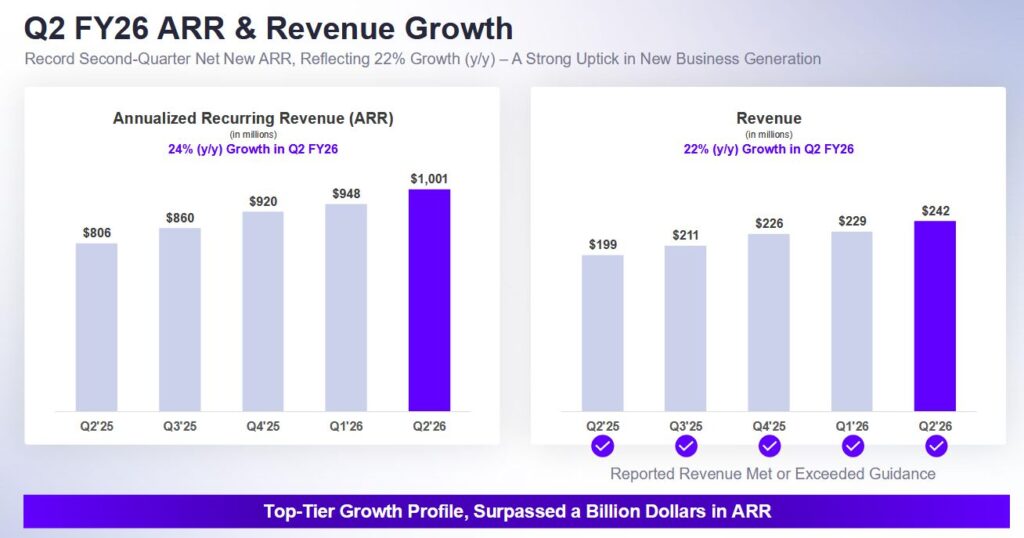
Source: SentinelOne FQ2 2026 Earnings Presentation
1
Watchtower Gains
SentinelOne’s stock, like many others – especially those of smaller, less profitable growth companies – experienced a sharp drop during the “tariff tantrum” market downturn in February to April, which led to an overall year-to-date loss of about 17%. After a period of sideways volatility, SentinelOne’s stock – ticker “S” – began recovering in mid-August thanks to the improvement in broad market sentiment, which helped growth stocks regain investor interest.
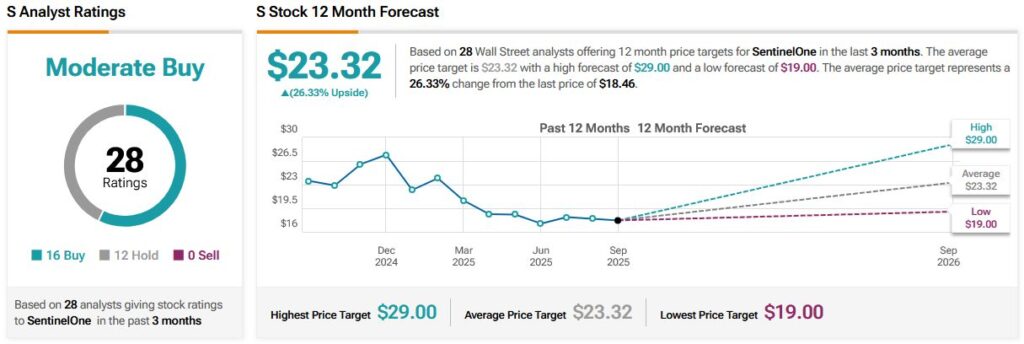
However, the real turning point came with the company’s latest earnings report, posted on August 28. The stock jumped on better-than-expected results and raised guidance, with analysts praising rapid revenue growth and improved operational efficiency. Several analysts – including Barclays, Jefferies, D.A. Davidson, Mizuho Securities, and others – raised their price targets, with the average now implying an upside of over 26% from current levels.
SentinelOne’s stock performance this year has been roughly in the middle of its peer group, which spans a diverse subset of cybersecurity SaaS growth stocks – such as Zscaler, Okta, Tenable, Varonis, and Qualys. The larger names with stronger bottom lines, such as Zscaler, led the pack, while smaller ones like Tenable were punished even more than S. Last month’s rebound, however, was the strongest for SentinelOne – with the stock surging about 16%, more than double the next-best performer in the group, Zscaler. As sentiment improved, investors focused on forward revenue growth – and that’s where SentinelOne shines, outpacing all of its peers.
Still, SentinelOne’s year-to-date loss has left its valuation depressed. It is now trading at about 6x sales, and below 5x on next year’s expected sales – lower than all of its relevant peers. The company’s track record of never missing analysts’ non-GAAP EPS consensus since going public speaks volumes about the credibility of management’s guidance and supports the outlook for further outperformance on guided metrics. Yet its forward non-GAAP P/E sits closer to the middle of the peer valuation scale, suggesting some disparity between price and expected growth. Most striking is the company’s non-GAAP PEG of 0.77 – not only by far the lowest in the group, but also low in absolute terms – signaling a classic GARP (growth at a reasonable price) setup.
In other words, the market continues to price SentinelOne as a risky mid-cap SaaS play, while its financial trajectory looks closer to companies that have already graduated to durable profitability. That gap will not close overnight, but it offers a clear rationale for building a position now.
1
To Sum It All Up
SentinelOne offers a growth investment case built on automation, scale, and mispricing. The company sits at the center of secular demand for cybersecurity – protecting endpoints, cloud workloads, and data pipelines as digital risk expands across industries. Its Singularity platform turns security into a SaaS subscription model, layering AI-driven modules that deepen adoption and stickiness over time. Execution has been consistent, with rapid module uptake, disciplined expense control, and steady progress toward profitability. Yet the stock trades at discounted multiples compared to peers, despite growth rates that lead the group. That mismatch sets up a classic GARP profile – investors can buy above-average growth at below-average prices. With a long runway in AI-native security, SentinelOne is positioned as a compounder still underestimated by the market.
1
1
Smart Growth Portfolio
|
1
1
Disclaimer
The information contained in this article represents the views and opinions of the writer only, and not the views or opinions of TipRanks or its affiliates and should be considered for informational purposes only. TipRanks makes no warranties about the completeness, accuracy, or reliability of such information. Nothing in this article should be taken as a recommendation or solicitation to purchase or sell securities. Nothing in the article constitutes legal, professional, investment and/or financial advice and/or takes into account the specific needs and/or requirements of an individual, nor does any information in the article constitute a comprehensive or complete statement of the matters or subject discussed therein. TipRanks and its affiliates disclaim all liability or responsibility with respect to the content of the article, and any action taken upon the information in the article is at your own and sole risk. The link to this article does not constitute an endorsement or recommendation by TipRanks or its affiliates. Past performance is not indicative of future results, prices, or performance.
