TipRanks Smart Growth Portfolio #29: Swipe Right

Dear Investors,
Welcome to the 29th edition of the Smart Growth Portfolio and Newsletter.
1
1
Portfolio News
❖ On September 17, Monday.com (MNDY) held its 2025 Investor Day – a part of its annual Elevate conference – in NYC. The Investor Day centered on the initiation of a $870 million share buyback program, with the massive authorization reflecting strong confidence in the company’s financial health and growth trajectory.
Beyond that, the annual conference’s discussions focused on further investment in AI and workflow automation as core drivers for platform innovation and customer expansion. Monday reiterated its ongoing commitment to scaling across multiple market segments by leveraging its product suite to boost efficiency and customer value, outlining its transition from a core work management tool toward a full AI-powered execution platform. MNDY announced a new suite of AI-driven products – such as Monday Agents and Monday Sidekick – which are a part of its strategy to hit a new target of $1.8 billion in annual revenue by the end of 2027, implying a CAGR of over 21%.
The stock soared on Thursday amid broad market rally and after the company’s conference sparked Wall Street enthusiasm, with multiple analysts reiterating their optimism about Monday’s strategic direction, long-term growth prospects, and aggressive AI-driven product expansion. Despite several price-target reductions made in the wake of the stock’s previous month’s underperformance, 18 out of 21 analysts following the stock rate it a “Buy,” with the average PT implying an upside of about 30% from current levels.
❖ Micron (MU) continues to attract attention ahead of its fiscal Q4 report on September 23. Several firms – including UBS, Deutsche Bank, Mizuho, Wolfe Research, and Susquehanna – have raised their price targets in the past week in a rush to catch up with the soaring stock, which jumped more than 20% over the same time. Susquehanna, Rosenblatt, and Wedbush now hold the highest Street price target at $200 for MU, implying a potential upside of over 18% from current levels despite the stock’s 101% year-to-date gain. Analysts anticipate Micron’s upcoming report will be a “beat and raise,” noting the market has yet to fully price in MU’s earnings-growth potential.
Micron is one of the most optimally aligned businesses with the U.S. and allied nations’ push for semiconductor dominance, with its minimal exposure to China and expanding U.S. and Japanese production. In mid-September, Japan announced an unprecedented $3.6 billion funding commitment for the expansion of Micron’s Hiroshima DRAM plant, marking its largest-ever semiconductor infrastructure investment. This strategic funding not only reinforces MU’s capacity to lead in advanced memory production but also solidifies its critical role in the AI chip race, underscoring the company’s importance in powering next-generation AI and data center applications.
❖ Clear Secure (YOU) has been initiated as a “Buy” at D.A. Davidson with a Street-high price target of $45, implying a potential upside of over 21% even after a rally of more than 42% year-to-date. The firm’s optimism is based on YOU’s strong moat, with 166 lanes across 59 U.S. airports enabling solid free cash flow generation and expanding operating margins. D.A. Davidson also cited recent B2B and vertical expansion initiatives around Clear Plus as underappreciated opportunities for further revenue growth acceleration.
YOU’s recent announcement about a new integrated identity verification solution with DocuSign provides another strong catalyst for the stock. Earlier this year, the companies launched a strategic partnership. The seamless integration into DocuSign’s widely used agreement workflows strengthens Clear’s competitive moat through scale, user convenience, and high-assurance security. The newly announced solution leverages Clear’s B2B secure identity platform, CLEAR1, and its biometric verification technology, integrating them within the DocuSign agreement experience. This innovation addresses a critical and growing market need: combating identity fraud driven by generative AI.
❖ Applied Digital Corporation (APLD) – our newest Growth Portfolio addition – has continued to build gains over the past week, surging by nearly 25%. The rally was initially sparked by a major AI infrastructure contract with CoreWeave, which raised APLD’s anticipated aggregate rental revenue from this key client to $11 billion. Overall investor optimism about surging demand for HPC infrastructure services, supported by Microsoft’s $18 billion deal with Nebius and Oracle’s staggering cloud revenue projections, also strongly benefited the stock’s performance.
CEO Wes Cummins’ letter to stockholders, released last Friday after hours, added wind to the sails by highlighting several important achievements and strategic goals. The letter revealed that Applied’s Polaris Forge 2 AI factory, slated to begin operations in 2026, has attracted strong interest from a U.S.-based, investment-grade hyperscaler, with whom the company is in advanced negotiations. Securing this second major customer will diversify APLD’s client base, validate its expertise, and reinforce its leadership in AI infrastructure. Financially, Applied Digital aims to achieve $1 billion in net operating income within five years, supported by a multi-gigawatt pipeline, faster build timelines, leading investor commitments, and robust hyperscaler relationships.
1
1
Under Review
❖ We are keeping Clearwater Analytics (CWAN) under review, as integration risks and choppy investor sentiment continue to overshadow strong fundamentals.
The Q2 report on August 6 showed near-flawless execution: revenue and adjusted EBITDA both up more than 70%, ARR growth of 83%, retention steady at 98%, and non-GAAP gross margin at 77%. Management reaffirmed a bullish Q3 outlook, guiding for mid-70% revenue growth. Strong free cash flow enabled a $100 million buyback program, announced in early September. Yet despite these positives, the stock sold off after earnings on fears over its debt-heavy acquisition strategy.
Full integration of CWAN’s acquisitions – Enfusion, Beacon, and BISTRO – remains the near-term challenge, with leverage elevated and the market waiting to see how quickly Clearwater can turn scale into durable profitability. Meanwhile, the company is making significant progress on its vision of creating a unified, cloud-native investment management platform that spans front-office modeling (via Enfusion), risk analytics (via Beacon), and portfolio visualization (via BISTRO), enabling a real-time, comprehensive view across public and private markets. The first wave of integration milestones is already well underway, suggesting that the integration is progressing strongly, even if it may not be fully complete for another year or two.
The company’s underlying business momentum remains strong. The recent Bloomberg integration of Clearwater’s platform into its enterprise suite is a major validator, and the company’s large client roster keeps growing. Just this week, Agile Investment Management – a global fixed income manager – chose CWAN’s integrated risk and performance attribution platform (already featuring Enfusion’s contribution) for its flagship strategies.
Wall Street remains optimistic, with all analysts following the stock rating it a “Buy” and the average price target implying an upside of more than 53%. Recently, RBC Capital confirmed a “Buy” stance with a Street-high PT of $36, citing the company’s strong revenue growth, robust retention metrics, and client base expansion driven by its holistic platform. Among other bullish voices, William Blair also maintained its “Buy” rating, citing CWAN’s strategic positioning and growth potential showcased at the recent Clearwater Connect 2025 conference.
While integration risks remain and balance-sheet leverage is elevated, we believe that Clearwater’s core growth story is intact. However, we are mindful that investor sentiment toward CWAN’s stock remains fragile despite some recent rebound. We are not bearish – but choose to remain on watch until integration progress is clearer and the re-rating is entrenched.
1
1

1
This Week’s Top Growth Pick: Shift4 Payments (FOUR)
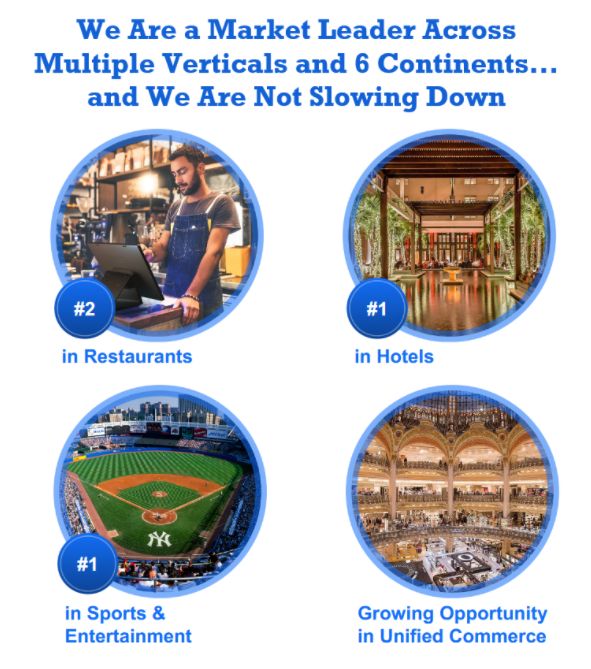
Shift4 Payments, Inc. is a fintech infrastructure company that delivers integrated payment processing and connected software solutions to merchants worldwide. The company’s full-stack commerce platform offers point-of-sale systems, e-commerce tools, mobile payment technology, and cloud-based business intelligence – all designed to unify transactions across channels. With vertical solutions for restaurants, hotels, stadiums, retailers, and e-commerce merchants, Shift4 emphasizes secure payment acceptance, seamless integrations, and flexibility for businesses of every size. The platform is supported by advanced risk management and fraud prevention capabilities, enabling merchants to handle transactions efficiently while maintaining compliance and customer trust. Positioned at the crossroads of payments and software, FOUR continues to expand its reach and influence in digital commerce.

Source: Shift4 Payments, Inc. company website
1
Transaction History
Shift4 Payments traces its origins to 1999, when Jared Isaacman founded the company that would eventually become a force in integrated payments. For years it built credibility with restaurants, hotels, and retail merchants in the U.S., but the real transformation began over the past five years with FOUR going public. The 2020 IPO provided fresh capital and visibility, marking the beginning of a more aggressive push into global markets and adjacent technologies.
The first wave of acceleration came through acquisitions that extended both geographic reach and product depth. The purchase of European acquirer Finaro in 2022-23 gave Shift4 a true foothold across the continent, combining local licensing and risk capabilities with the company’s gateway and platform. Around the same period, it added Givex, strengthening its loyalty, gift card, and value-added services portfolio – an important step in embedding merchants more deeply into its ecosystem.
By 2024, the pace quickened. Shift4 acquired Revel Systems, a point-of-sale provider with thousands of merchant locations, and folded its functionality into SkyTab – the company’s flagship cloud-based POS platform. This moved Shift4 further up the merchant stack – from processing transactions to powering day-to-day operations like ordering, menu management, and customer engagement. That same year it took control of Vectron Systems in Germany, instantly expanding its presence to tens of thousands of merchant sites and hundreds of regional resellers. Vectron added not just processing volume but a full distribution network and local expertise – allowing Shift4 to integrate payments with POS software at scale across Europe. Together, these acquisitions turned the platform into a more comprehensive operating system for merchants rather than a back-end payments utility.
The most transformative development arrived in 2025 with the acquisition of Global Blue, a leader in tax-free shopping and dynamic currency conversion. This deal, valued at about $2.5 billion, reshaped Shift4 into a truly global payments player with exposure to luxury retail, hospitality, and cross-border commerce. Integrating Global Blue’s footprint of hundreds of thousands of merchants positions the company to capture travel-related spending flows and enhance monetization through foreign exchange and premium services.
Also this year, Shift4 announced the acquisition of Smartpay, a payments provider in Australia and New Zealand. While still pending closure, the move extends the company’s reach into Asia-Pacific and adds more than 40,000 merchants across the region – a timely entry into one of the fastest-growing payments markets worldwide.
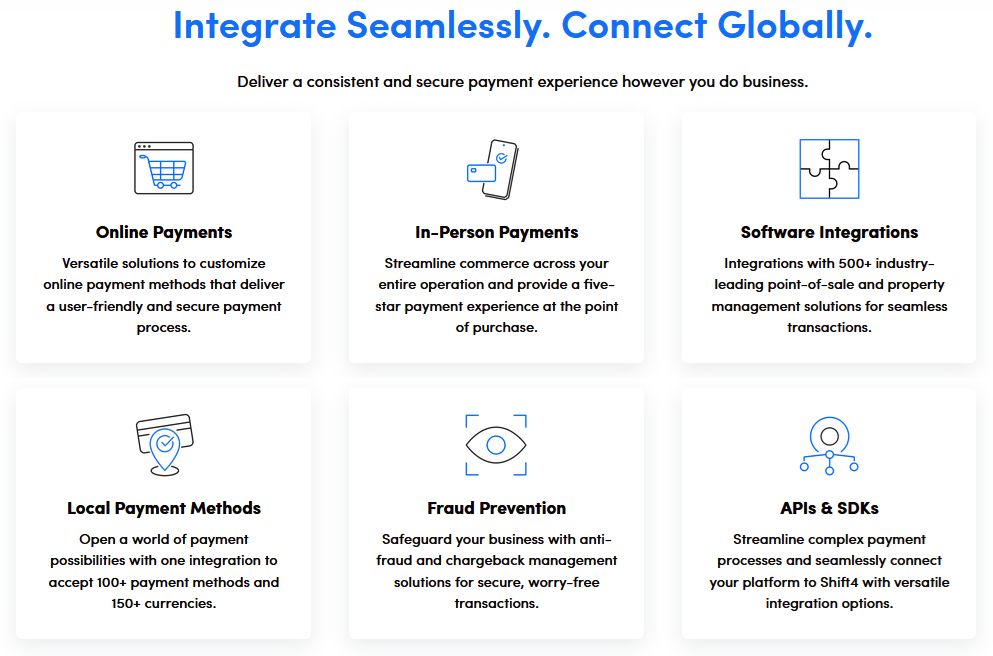
Alongside M&A, partnerships and product innovation have reinforced growth. Integrations with local wallets in various geographies, expanded APIs covering recurring billing, tokenization, fraud controls and alternative payment methods, and risk management enhancements have modernized the technology stack while aligning the platform with regional payment preferences. The result is a company transformed – no longer just a domestic processor, but a fintech infrastructure provider with global scale and multiple levers of growth, processing over $260 billion in annual payment volume.
Source: Shift4 Payments, Inc. company website
1
Beyond the Swipe
Shift4’s business model is built around processing payments, but what turns its strength into scalable growth are value-added tools and vertical depth. About 90% of its revenue comes from payment fees tied to transaction volume. As more merchants join and existing clients process higher volumes, the business scales efficiently – spreading fixed costs across more transactions while funding new product development. These enhancements make the platform more attractive, drawing in additional merchants and partners, which further expands volume. Subscription and other revenues – including software modules, analytics, loyalty, and integrations – are a small part of the company’s total revenue today but are expanding rapidly, bringing higher margins and more predictable renewal momentum.
Where FOUR pulls ahead of many rivals is in verticalization. By embedding its commerce stack into the everyday operations of restaurants, hospitality venues, stadiums, and retail venues, it converts payments from isolated transactions into sticky platform usage. SkyTab isn’t just a payment terminal – it’s a cloud-based POS system that handles orders, menus, and customer engagement, all tied into payments flow. Once a merchant adopts SkyTab or a bundled solution, additional modules such as fraud prevention, tokenization, and loyalty integrate seamlessly, deepening the relationship and increasing long-term value.
Acquisitions have extended Shift4’s role from a U.S.-centric processor into a platform with global reach and broader merchant touchpoints. The expansion into Europe and Asia-Pacific, combined with new vertical capabilities like luxury retail and tax-free shopping, means the company can serve more types of merchants across more geographies within the same integrated system. These moves aren’t just adding customers – they add product breadth, regulatory expertise, and alternative payment rails.
Policy tailwinds matter too. The One Big Beautiful Bill (OBBB) fiscal package restored immediate expensing of R&D and extended bonus depreciation – benefits that reduce tax drag on innovation-led spending. For a platform investing heavily in software, security, fraud, and product enhancements, these changes are enabling more investment per dollar of revenue without unduly hurting cash flow.
The market context underscores the scale of the opportunity. Global digital payments revenue is projected to reach about $5.3 trillion by 2030, growing at ~11-12% annually. The Asia-Pacific market alone is forecast to more than double from roughly $15.8 trillion in 2025 to nearly $29.5 trillion by 2030. Non-cash transactions in APAC are expected to hit $1.5 trillion by 2028, with digital wallets accounting for ~66% of POS payments by 2027. With only a modest share today in many international markets, Shift4 has both runway and levers – product breadth, recurring services, and localized payment rails – to capture share in an ecosystem that is still far from mature.
Source: Shift4 Payments, Inc. company website
1
Payments and Payoffs
Shift4 Payments has built a consistent track record of delivering results above expectations, and Q2 2025 was no exception. The company processed a record $50 billion in payment volume, up 25% year over year, driving gross revenue less network fees to $413 million, a 29% year-over-year increase that topped internal guidance and far outpaced analyst consensus.
Adjusted EBITDA climbed 26% to $205 million, with margins at 49.6% – slightly below potential due to integration costs from Global Blue, but still reflecting strong operating leverage. Subscription and other revenues were a standout, growing 37% YoY to a record $97.7 million, highlighting the accelerating contribution from higher-margin, recurring services. Blended spreads1 came in at 62.6 basis points, ahead of forecasts and a sign of effective pricing discipline.
Earnings have scaled in tandem. Adjusted EPS reached $1.10 versus $0.96 a year ago, marking FOUR’s eighth consecutive quarter of non-GAAP profitability. Still, results came in below the $1.19 analyst consensus, as near-term integration costs from Global Blue and modest same-store sales softness in restaurants compressed margins despite stronger-than-expected revenue. GAAP profitability has not yet been achieved, but losses have narrowed sharply as operating leverage builds.
The company has also delivered multiple quarters of positive adjusted free cash flow – $118 million in Q2, equating to 57% conversion – strengthening the path toward durable GAAP profitability. On the top line, Shift4 has beaten revenue estimates every quarter since 2023, underscoring strong demand and execution. EPS performance has been less uniform – generally ahead of consensus, but with occasional misses such as in Q2 – reflecting the impact of integration costs and margin pressure. This mixed but overall positive record highlights both the scalability of the model and the operational challenges of rapid expansion.

Source: Shift4 Payments, Inc. Q2 2025 Shareholder Letter
Shift4’s balance sheet also evolved meaningfully in the quarter. A $3.3 billion capital raise funded the Global Blue acquisition and allowed the company to retire near-term maturities, leaving it on track to exit 2025 with net leverage of roughly 3.5x. Operating cash flow remained healthy, and management reiterated its target of sustaining free cash flow conversion above 50% for the full year. With liquidity enhanced and maturities extended, the company has both flexibility and discipline in funding expansion.
Guidance was raised across the board. Full-year 2025 gross revenue less network fees is now projected at $1.95-2.035 billion, up 45-50% YoY, while adjusted EBITDA is expected to reach $965-990 million, implying 42-46% growth. Q3 alone is forecast at ~$590 million in gross revenue less network fees and ~$290 million in adjusted EBITDA. Organic revenue growth is expected to exceed 20% for the year, even before Global Blue’s contribution of roughly $300 million in revenue and $125 million in EBITDA during the second half. Management also reaffirmed its medium-term goal of achieving a $1 billion FCF run rate – a milestone that would mark the company’s full transition into consistent cash generation.
—
1 – Blended spreads refer to the average fee Shift4 earns per transaction, expressed in basis points (bps). It combines different pricing across merchant types, card networks, and geographies into one weighted average. Higher spreads generally indicate stronger pricing power and a favorable mix of transaction types.
1
Priced to Shift
Shift4’s peer group spans a diverse set of fintechs and scaled incumbents. These include growth-heavy, recurring-revenue firms, represented by large-cap champion Block and a bill-pay platform challenger Paymentus, along with global restaurant industry facilitator Toast and a small-cap small-business POS platform Lightspeed Commerce. Beside these, lower-growth, established industry leaders Global Payments and Fiserv serve as scale benchmarks in merchant acquiring and commerce tech. While FOUR’s revenue is still more transaction-driven than SaaS-like, its vertical focus, software attach, and international expansion compare well with these firms.
Most stocks – especially those of smaller and less profitable companies – dropped sharply early this year during the “tariff tantrum.” The recovery from April’s lows was uneven, with investors at first favoring large, well-covered leaders or those delivering consistent “beat-and-raise” reports. Companies pursuing aggressive acquisition strategies – often linked to higher debt – were hit harder in a high interest-rate environment marked by macro uncertainty. Since FOUR’s growth story leans heavily on acquisitions, it carries a relatively high – though still manageable – debt load. At the same time, it lacks the multi-year revenue visibility of a SaaS model. Against that backdrop, its middle-of-the-pack stock performance looks like a strong achievement – likely supported by revenue growth that is second only to Paymentus among its peers.
With tariff uncertainty now fading and the Fed firmly back on the easing path, the outlook has improved. Shift4’s revenue trajectory remains strong, with earnings growth expected to move into one of the top spots in the peer table. Profitability metrics such as EBITDA margin and FCF margin already outpace all of its growth-stage peers, while valuation remains moderate compared to most comps. FOUR’s trailing non-GAAP P/E, EV/EBITDA, Price/Sales, and Price/Cash Flow ratios all sit well below growth peers, with EV/Sales near the group average. Forward-looking valuation metrics reinforce the same story: non-GAAP P/E and EV/EBITDA are the lowest among growth comps, while EV/Sales is slightly below average. The clearest signal comes from FOUR’s non-GAAP PEG of 0.71 – by far the lowest in the growth peer set and low in absolute terms – pointing to a classic GARP (growth at a reasonable price) profile.
Although Shift4’s stock has seen several analyst price-target reductions following its post-earnings dip, the stock is rated a “Strong Buy” with an average target implying a potential upside of about 27%. If the company continues to make progress with its long-term financial and business goals, re-rating is likely only a question of time.

1
To Sum It All Up
Shift4 offers a growth investment case built on vertical depth, operating leverage, and valuation disconnect. The company sits at the crossroads of secular demand for digital payments – from hospitality and restaurants to stadiums, retail, and luxury travel – markets where integrated commerce is displacing legacy processors. Its platform strategy embeds payments into software, making customer relationships stickier while expanding monetization through value-added tools. Execution has been steady, with international expansion adding reach and diversification. Yet the stock trades at only moderate valuations compared to peers that often grow slower or carry higher risk. That mismatch creates a textbook GARP setup – investors get above-average growth at below-average prices. With a broadening footprint and rising profitability, Shift4 looks positioned as an underappreciated compounder in fintech infrastructure.
1
1
Smart Growth Portfolio
|
1
1
Disclaimer
The information contained in this article represents the views and opinions of the writer only, and not the views or opinions of TipRanks or its affiliates and should be considered for informational purposes only. TipRanks makes no warranties about the completeness, accuracy, or reliability of such information. Nothing in this article should be taken as a recommendation or solicitation to purchase or sell securities. Nothing in the article constitutes legal, professional, investment and/or financial advice and/or takes into account the specific needs and/or requirements of an individual, nor does any information in the article constitute a comprehensive or complete statement of the matters or subject discussed therein. TipRanks and its affiliates disclaim all liability or responsibility with respect to the content of the article, and any action taken upon the information in the article is at your own and sole risk. The link to this article does not constitute an endorsement or recommendation by TipRanks or its affiliates. Past performance is not indicative of future results, prices, or performance.
