TipRanks Smart Growth Portfolio #44: Connecting The Dots

Dear Investors,
Dear Investors,
Welcome to the 44th edition of the Smart Growth Portfolio and Newsletter, where we spotlight an AI connectivity company growing at hyperscale. But first, some news and updates.
1
1
Portfolio News
Micron (MU) has been featured on several top analysts’ 2026 pick lists. Robert W. Baird analysts named it a top chip pick, along with Nvidia, as they anticipate the surge in AI memory demand to continue. Cantor Fitzgerald forecasts another strong year for the broader semiconductor sector, specifically noting soaring infrastructure demand for memory amid tight supply, supporting MU’s pricing power. Morgan Stanley is equally bullish, saying that the accelerating AI buildout has led to the most severe DRAM and NAND memory shortages in this century. Micron, which continues to gain market share from its competitors, is expected to strongly capitalize on this trend, with earnings growth expected to be near 50% annually in the next three years. Overall, Wall Street is firmly bullish, with the consensus rating a “Strong Buy” and nearly two dozen price-target upgrades during December alone.
1
❖ Applied Digital (APLD) announced it is spinning off its high-growth Cloud GPU business (which rents out AI chips) and merging it into a small, publicly-traded robotics company called Ekso Bionics. The new combined company will be renamed ChronoScale, with Applied retaining a 97% ownership. As a separate company, ChronoScale will be able to raise money and grow faster without being weighed down by the massive costs of building data centers. Meanwhile, the “remaining” APLD will focus purely on being a premier designer and operator of next-generation AI data centers.
Up to now, the Cloud business was hidden inside APLD’s larger data center operations – despite operating 6 GPU clusters and generating annual revenue of about $75 million, over 40% of the company’s total sales – while similar stand-alone firms are worth billions of dollars. According to Lake Street, the spin-out should unlock significant value as the market will now be able to value the Cloud business as a “pure-play” AI company.
Citizens is also optimistic, saying that the deal will allow Applied Digital to focus on improving equity returns in its core business of HPC data center development. Meanwhile, Northland has named Applied Digital as its Top Pick for 2026, citing a favorable strategic position, surging hyperscaler demand, and the ability to execute on schedule.
APLD is scheduled to post its fiscal Q2 2026 earnings on January 7 after hours.
1
❖ While firms like Applied Digital and Micron continue to shine in the spotlight, some less commonly known names also deserve recognition due to their fortunate positions along the AI value chain. Bank of America analysts have identified several such behind-the-scenes AI enablers, including a Smart Growth portfolio holding MKS Instruments (MKSI), which manufactures precision power, vacuum, and process-control systems used in semiconductor fabrication. According to BofA, the total market for AI data center systems could exceed $1.2 trillion by 2030, with about $300 billion expected to flow into the supporting tech like networking, interconnects, and power systems.
1
1

1
This Week’s Top Growth Pick: Credo Technology (CRDO)
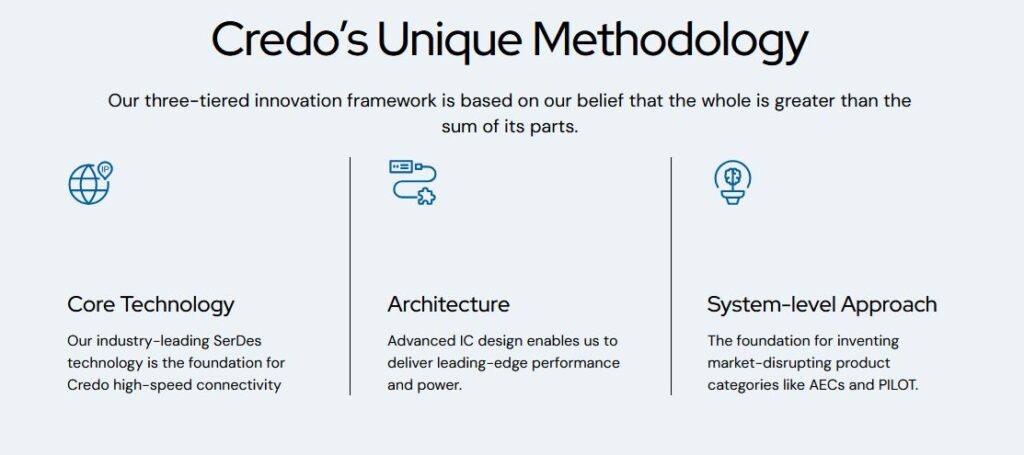
Credo Technology Group Holding Ltd. is a fabless semiconductor company focused on high-speed connectivity solutions that support the rising bandwidth and power-efficiency demands of modern data centers. The company designs advanced physical-layer semiconductor technologies that enable data to move cleanly and efficiently across servers, accelerators, and networking equipment. Its products are built for environments where signal integrity and energy efficiency are becoming as critical as raw performance. By operating at the interconnect layer rather than the system level, Credo plays an enabling role within hyperscale and AI-driven infrastructure. As cloud architectures grow faster and more complex, the company’s technology helps make next-generation connectivity scalable, reliable, and economically viable.
Source: Credo Technology Group Holding Ltd. Website
1
Ahead Of The Signal
Credo Technology was founded in 2008 with a focused mandate: to push the physical limits of high-speed data transmission inside networking hardware. For much of its early life, the company operated behind the scenes, supplying specialized serializer-deserializer1 technology as cloud infrastructure scaled steadily but predictably. That context shifted materially in the late 2010s, when bandwidth growth began colliding with power, thermal, and signal-integrity constraints.
The company’s modern trajectory began to take shape around 2019-2020, as hyperscale data centers moved into a new design phase. Bandwidth alone was no longer the binding constraint – power efficiency became equally decisive. Higher Ethernet speeds, denser server racks, and early AI workloads exposed the limitations of traditional passive interconnects. Credo responded by expanding beyond discrete SerDes into power-efficient active electrical cables and optical digital signal processing, repositioning itself closer to system-level architecture decisions.
From 2020 through 2022, Credo broadened its physical-layer portfolio to support next-generation Ethernet standards and the early scaling of AI-centric infrastructure. Its technology moved upstream in customer design cycles, shaping how data flows across servers, accelerators, and switches rather than entering as a late-stage component. This architectural role directly influenced the company’s roadmap, tightening alignment with emerging AI workloads and higher-speed interconnect requirements. CRDO’s position in the value chain is further reinforced by close engagement with leading hyperscalers and tier-one networking vendors.
The company’s public listing in early 2022 provided the capital base to support its focused expansion in high-speed, power-efficient connectivity and deeper platform-level integration. Credo used the transition to accelerate investment in advanced process nodes, expand engineering depth, and run multiple product generations in parallel. Management maintained a narrow strategic focus, resisting broad diversification in favor of reinforcing its position in high-speed connectivity.
Notably, CRDO’s growth has been almost entirely organic – an outlier in a semiconductor landscape where many peers rely on acquisitions to accelerate relevance and spur growth. The only acquisition it made in recent years was that of Hyperlume in 2024. This small, targeted technology acquisition – focusing on capability expansion, not revenue or market share grab – brought Credo the microLED-based optical interconnect technology, which now underpins its Active LED Cable (ALC) roadmap.
Instead of pursuing large buyouts, the company expanded from a roughly $1.7 billion market capitalization at IPO to over $26 billion today, driven by internal R&D, process-node2 advances, and deeper design wins with hyperscale and networking customers, rather than by buying technology or competitors. In effect, Credo built its position by solving a specific physical-layer problem earlier and more effectively, then scaling alongside the rise of AI-driven data-center architectures. The IPO capital went into engineering depth and product breadth, not balance-sheet expansion.
Over the past several years, this disciplined execution has reshaped Credo from a niche IP supplier into a connectivity specialist aligned with the structural demands of AI-scale data centers. Today’s company reflects that evolution – grounded in early technical depth, refined through long-cycle platform integration, and positioned where data movement efficiency increasingly defines system performance.
—
1 – Serializer-deserializer, or SerDes, is a circuit that converts parallel data into a high-speed serial stream for transmission, then converts it back at the receiving end.
2 – Process node is the manufacturing technology used to produce a chip, with newer nodes enabling higher performance and lower power consumption.
—
Source: Credo Technology Group Holding Ltd. Website
1
Connected Layers
Credo Technology is a high-speed connectivity specialist built around a simple but increasingly critical premise: as AI data centers scale, moving data reliably and efficiently becomes just as important as compute itself. The company designs the physical-layer technologies that sit inside cables, transceivers, and chips, enabling GPUs, CPUs, switches, and memory to communicate at extreme speeds without breaking down under power, thermal, and signal-integrity constraints.
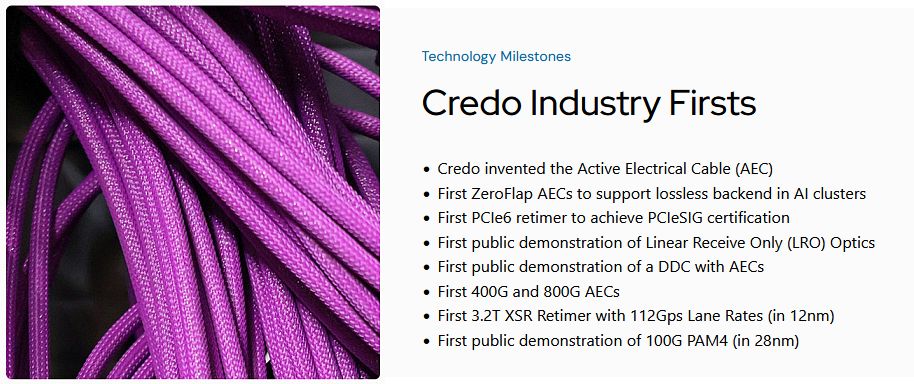
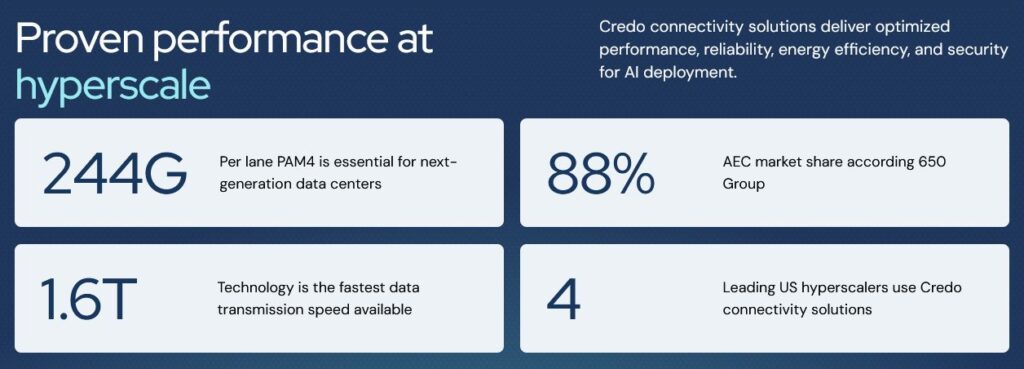
At the core of Credo’s business are Active Electrical Cables (AECs), its flagship product and primary revenue driver. AECs look like copper cables, but embed active electronics – including proprietary SerDes and signal conditioning – inside the connectors. This allows copper links to operate at far higher speeds and distances than passive cables while consuming less power and delivering materially higher reliability than optics at short reach. In large AI clusters, where a single link failure can idle thousands of GPUs, that reliability advantage is decisive. As a result, AECs are widely viewed as the de facto standard for inter-rack connectivity up to roughly seven meters, with industry estimates placing Credo’s AEC market share at nearly 90%. AECs account for the majority of the company’s revenue today and are the foundation of its hyperscaler adoption.
Surrounding AECs is a growing IC and IP business, which includes retimers, optical digital signal processors (DSPs), and SerDes intellectual property. In practice, Credo monetizes this layer in two parallel ways: by selling finished integrated circuits used in optical modules, switches, and line cards, and by licensing the underlying SerDes IP and chiplets to customers designing their own custom silicon. These products support higher Ethernet speeds and longer reach as data centers transition from 100G to 200G per lane and toward 800G and 1.6T ports. While Credo does not disclose segment revenue percentages, management consistently frames the IC business as the second growth engine, with optical DSPs expected to scale meaningfully as AI clusters expand beyond rack-level designs.
In the past year, Credo has broadened its scope beyond cables and components into system-level connectivity. ZeroFlap optical transceivers extend its reliability-first approach into optics by actively monitoring and stabilizing optical links, addressing one of the main failure modes in large clusters. Through the acquisition of Hyperlume, CRDO entered Active LED Cables (ALCs), which use microLED-based optical signaling to bring copper-like efficiency and determinism to longer distances. Management views ALCs as a next-phase opportunity as AI clusters grow from rack-scale to row-scale and cluster-scale architectures, where AECs alone cannot physically reach.
Most recently, Credo expanded into system-level memory connectivity with OmniConnect, a platform built around its Weaver gearbox chip, which allows AI accelerators to connect to much larger pools of external memory at high bandwidth, reducing inference bottlenecks and limiting dependence on costly on-package HBM. This move extends Credo’s role beyond networking and into how AI systems are architected, as memory access increasingly constrains performance in large-scale inference deployments.
At the silicon ecosystem level, CRDO’s participation in the Arm Total Design ecosystem – led by Arm Holdings, the CPU architecture licensor – integrates its SerDes IP and chiplets into Arm-based custom silicon platforms, embedding Credo’s connectivity technology deeper into customer ASIC and chiplet design flows. Rather than selling only finished components, Credo increasingly participates earlier in the design process, tightening alignment with hyperscaler roadmaps and raising switching costs.
Together, these offerings form five connectivity pillars – AECs, IC solutions, ZeroFlap optics, ALCs, and OmniConnect – expanding Credo’s total addressable market to more than $10 billion, more than triple where it stood roughly 18 months ago. Adoption is driven almost entirely by hyperscale customers. While Credo does not formally name them, industry consensus points to Amazon, Microsoft, Meta, Google, and a newly ramping fifth hyperscaler – who many believe to be Oracle – alongside OEM partners that integrate Credo technology into servers and switches.
While customer concentration remains high, it is improving, with the company no longer relying on a single dominant customer like in the past. Competitive risks are real: large incumbents such as Marvell and Broadcom are investing in adjacent connectivity solutions, and hyperscalers are incentivized to develop secondary sources over time. However, Credo currently benefits from technical lead, reliability differentiation, and deep system integration that raise switching costs.
Industry observers increasingly frame Credo as a “picks-and-shovels” provider for AI, supplying the connectivity layer that enables GPU and accelerator scale regardless of which compute architectures or vendors dominate at the chip level. As AI systems grow denser, more distributed, and more uptime-sensitive, Credo’s ability to deliver deterministic performance, power efficiency, and link stability across multiple layers of the data-center stack is what differentiates it – and why its connectivity solutions are increasingly treated as infrastructure, not interchangeable hardware.
Source: Credo Technology Group Holding Ltd. Website
1
Unlimited Bandwidth
Credo’s recent financial performance reflects a company that has moved decisively from early-stage scaling into a phase of profitable hypergrowth, with execution that has consistently outpaced expectations. Over the past two years, results have not merely improved – they have accelerated, quarter after quarter, as hyperscale AI deployments shifted from pilot programs to large-scale production.
That execution shows up clearly in Credo’s track record against the Street. CRDO has beaten analyst consensus on revenue for at least eight consecutive quarters, and on adjusted EPS in every quarter since fiscal Q3 2023, except for two instances of in-line results. This pattern matters because it signals not just demand strength, but improving visibility and operating control in a business often assumed to be volatile.
Fiscal Q2 2026 was Credo’s strongest quarter to date and reinforced that trend. Revenue reached $268 million, up 20% sequentially and 272% year-over-year, materially above both company guidance and analyst forecasts, which had clustered closer to the mid-$230 million range. Growth was driven primarily by Active Electrical Cables, with continued momentum in IC products such as optical DSPs and retimers. While the company does not disclose segment-level revenue, management consistently emphasized that AECs remain the dominant contributor, with ICs providing incremental upside as data-center architectures scale to higher speeds and longer reach.
Profitability scaled alongside revenue. Non-GAAP gross margin reached 67.7%, exceeding guidance and underscoring CRDO’s pricing power in reliability-critical connectivity. Operating leverage was pronounced, with non-GAAP net income of $128 million, rising materially faster than revenue. Adjusted EPS came in well ahead of consensus – $0.67 versus $0.49 expected – reinforcing Credo’s reputation as a serial out-executor. The company has repeatedly demonstrated that it can grow aggressively while sustaining elite margins and a clean balance sheet.
Cash generation further validates the quality of those earnings. Credo generated $61.7 million in operating cash flow and $38.5 million in free cash flow in Q2 alone, building on multiple prior quarters of positive cash generation. This is not a one-off inflection, but a scaling trend as margins widen and revenue grows. The company exited the quarter with a strong net-cash position and no debt, an uncommon profile for a semiconductor company expanding at this pace. That balance sheet strength gives CRDO flexibility to fund elevated R&D investment, support inventory ramps tied to hyperscaler deployments, absorb customer timing variability, and scale production without financial strain.
On a GAAP basis, profitability has also become increasingly consistent, though management continues to emphasize non-GAAP results as the clearest indicator of underlying operating performance in a stock-based-compensation-heavy growth phase. Importantly, Credo reached non-GAAP profitability before its IPO, underscoring that this margin structure was achieved through product economics and scale – not public-market leverage.
Guidance points to further acceleration. For fiscal Q3 2026, Credo projected revenue of $335-345 million, implying roughly 27% sequential growth at the midpoint. Non-GAAP gross margin is guided to 64-66%, reflecting some mix normalization but still exceptional by industry standards. Operating expenses are expected to rise as the company invests in OmniConnect, ALCs, and advanced SerDes platforms. For the full fiscal year, management reiterated expectations for more than 170% year-over-year revenue growth and non-GAAP net margins around 45%, implying that earnings and cash flow should continue compounding faster than revenue.
At this stage, Credo’s financials describe a business that has moved well beyond proof-of-concept profitability into a phase defined by durable margin structure, repeat cash generation, zero leverage, and software-like economics embedded within hardware, positioning it to scale through the next leg of AI infrastructure buildouts from a position of financial strength.

Source: TipRanks
1
Copper At Lightspeed
Credo belongs to a narrow subset of U.S.-listed semiconductor companies whose value is driven by high-speed connectivity inside hyperscale AI data centers. Its most relevant public peers, therefore, skew toward infrastructure-level bottleneck solvers, not diversified chip vendors. Astera Labs stands out as the closest pure-play comparison, given its similar growth stage and focus on removing data-movement constraints inside AI clusters. MACOM Technology provides a useful benchmark for physical-layer connectivity at scale, pairing optical and analog expertise with established profitability. Marvell serves as the scaled incumbent reference, competing across optical DSPs and SerDes at a much broader scope. Rambus complements the group as an IP-centric comparator, reflecting the licensing and chiplet optionality embedded in CRDO’s model.
Stocks in this cohort delivered strong performance over the past year, with one clear exception – Marvell – and the dispersion largely reflects where each company sits in the AI build-out cycle and how much it surprised on earnings. Credo, a critical connectivity bottleneck owner with revenue scaling far faster than the market initially priced in and margins expanding despite rapid growth, finished 2025 up more than 100%. The stock re-rated not only on earnings acceleration, but on growing indispensability. Rambus followed with gains of more than 70%, benefiting from AI-driven memory demand, DDR5 adoption, and its high-margin IP licensing model – though with steadier, less explosive growth. MACOM Technology advanced more than 30%, as rising data-center exposure was partly offset by a slower telecom recovery and softer industrial demand. Astera Labs delivered consistently strong operational results, yet underperformed relative to CRDO as its premium valuation left less room for upside surprises. Marvell, by contrast, was weighed down by exposure to weaker non-AI end markets and China, alongside investor concerns about competitive pressure in custom AI silicon from Broadcom and media reports suggesting the loss of the Amazon business.
Despite the 100%+ gain in 2025, analysts still see potential upside of nearly 50% from CRDO’s current levels. One reason is that valuation metrics have not yet fully adjusted to the company’s growth profile, which – supported by strong balance-sheet health and a critical-juncture position in AI infrastructure – rests on more durable fundamentals than most peers. Headline metrics appear challenging compared to sector medians, but look far more reasonable when discounted for Credo’s exceptional growth in revenue, adjusted EBITDA, and non-GAAP EPS, all of which have expanded at rates that materially outpace the peer group. The closest peer, Astera Labs, saw its revenue expanding by roughly 100%, less than half of CRDO’s pace, while all the others trail well behind despite solid double-digit gains. Viewed in this context, Credo’s valuation appears less stretched than at first glance. Moreover, its forward PEG of roughly 0.76x is low both in absolute terms and versus peers and the broader sector, suggesting that a significant portion of its growth trajectory remains unpriced.
Credo is effectively growing into its valuation rather than outrunning it. While a 100%+ stock gain would typically suggest overheating, CRDO’s revenue and earnings have compounded even faster, leaving the business more affordable today on a growth-adjusted basis than it was a year ago. As AI infrastructure spending broadens and connectivity becomes an increasingly binding constraint, Credo’s role as a critical bottleneck owner positions it to continue compounding fundamentals faster than sentiment. If execution holds, valuation compression is far more likely to come from earnings catching up than from the stock coming down.

1
To Sum It All Up
Credo is a growth story built for an era where data movement, not compute, defines system performance. As AI clusters scale, reliability, power efficiency, and signal integrity have become mission-critical constraints – and that’s exactly where Credo operates. Its technology sits at the physical layer of AI infrastructure, quietly enabling GPUs, switches, and memory to function at full utilization without interruption. What differentiates Credo is not just its speed, but determinism: predictable performance in environments where failure is costly. Adoption has followed that logic, with hyperscalers embedding its solutions deeper into next-generation architectures. As connectivity becomes the gating factor for AI scale, Credo is increasingly positioned not to follow the cycle, but to define it.
1
1
Smart Growth Portfolio
|
1
1
Disclaimer
The information contained in this article represents the views and opinions of the writer only, and not the views or opinions of TipRanks or its affiliates and should be considered for informational purposes only. TipRanks makes no warranties about the completeness, accuracy, or reliability of such information. Nothing in this article should be taken as a recommendation or solicitation to purchase or sell securities. Nothing in the article constitutes legal, professional, investment and/or financial advice and/or takes into account the specific needs and/or requirements of an individual, nor does any information in the article constitute a comprehensive or complete statement of the matters or subject discussed therein. TipRanks and its affiliates disclaim all liability or responsibility with respect to the content of the article, and any action taken upon the information in the article is at your own and sole risk. The link to this article does not constitute an endorsement or recommendation by TipRanks or its affiliates. Past performance is not indicative of future results, prices, or performance.
