TipRanks Smart Growth Portfolio #48: Choose Your Terms

Dear Investors,
Welcome to the 48th edition of the Smart Growth Portfolio and Newsletter, where we spotlight a platform where financial demand meets provider competition. But first, some news and updates.
1
1
Portfolio News
❖ Enova International (ENVA) delivered stellar operational and financial results in Q4 2025. Total revenue increased 15% year-over-year to $839 million, coming in at the top end of guidance and modestly ahead of analyst estimates. Net revenue margin expanded by 300 bp to 60%. Adjusted EPS increased 33% to $3.46, surging past consensus, while adjusted EBITDA grew 21% to $211 million.
Total fourth-quarter originations increased 32% year-over-year to $2.3 billion, with SMB originations surging by 48%. SMB revenue accelerated 34% to $383 million. SMB represented 68% of the portfolio at year-end and exhibited very stable credit, with a net charge-off ratio 4.6%. Consumer originations rebounded during Q4, registering year-over-year growth of 2% and rising to $613 million. Consumer revenue was a record $446 million, up 3% year-over-year. Consolidated net charge-off ratio improved to 8.3% in Q4, down 60 bps year-over-year, while combined loan and finance receivable balances grew 23% to a record of $4.9 billion.
Full-year total revenue increased 19% from 2024 to $3.2 billion, with net revenue margin stable at 58%. Net income surged 47% to $308 million, while adjusted EPS climbed 42% year-over-year to $12.96. Adjusted EBITDA rose by 25% to $821 million. The company ended the year with $1.1 billion in total liquidity, including cash, marketable securities, and available capacity on facilities.
Strong profitability and surging liquidity facilitated the authorization of the largest buyback plan in Enova’s history. The company’s board approved a $400 million program, allowing repurchases of up to 12.5% of its outstanding shares through June 30, 2027.
Looking forward, management highlighted considerable momentum heading into 2026, guiding for 20-25% year-over-year adjusted EPS growth in Q1 and at least 20% EPS growth for the full fiscal year. However, this marks a deceleration from 2025, with the originations growth also slowing to 15%. This slowdown accounts for normalizing market dynamics in fintech lending after exceptional 2025 momentum, prioritizing sustainable scaling over aggressive expansion.
Moreover, ENVA’s outlook deliberately omits the effects of the Grasshopper Bank acquisition, expected to close in H2 2026 pending approvals. Post-close synergies from combining Enova’s AI lending with Grasshopper’s $3 billion deposits and BaaS platform could drive 25%+ EPS accretion longer-term despite near-term dilution potential. Analysts view this as a dilution trade-off for enhanced funding access and market share in underserved consumer and small business segments. Following the release, TD Cowen and Citizens raised their price targets, with several others confirming their “Buy” ratings.
1
❖ Micron (MU) saw its stock surge again over the past week, lifted by bullish industry-wide and company-specific news. NVIDIA’s H200 chip approval from China and strong results from ASML Holding supported sentiment towards AI trade, while surging earnings at fellow memory chipmaker SK Hynix indicated a similar boon for MU’s next earnings report.
Another batch of analysts, including Mizuho and HSBC, lifted their price targets on the stock, citing its central positioning in the AI-driven memory shortage, while others maintained targets but sounded increasingly supportive. William Blair forecasts that persisting supply constraints will drive HBM revenue growth of 164% in fiscal 2026 and an over 275% surge in EPS over the next two years. Mizuho said that NAND prices could spike 330% in 2026 and 50% in 2027, as AI server demand accelerates while no new capacity is expected to come online over the next two years.
The news of Nvidia’s next-gen memory-chip supply agreement with Samsung initially weighed on Micron’s stock, but it quickly returned to rally as investors realized it doesn’t mean a loss of sales for MU, as tech leaders are racing to buy as many HBM memory chips as they can in this tight market. In fact, Micron’s supply of HBM memory chips for 2026 is sold out.
In this context, Micron’s recent $1.8 billion acquisition of a Taiwanese chip fab is seen as a strategic move to address supply constraints and accelerate DRAM production by late 2027, strengthening its position in the AI infrastructure buildout. Additionally, MU recently broke ground on an advanced wafer fabrication facility within its existing NAND manufacturing complex in Singapore to address growing market demand for NAND technology driven by the rapid expansion of AI and data-centric applications. The project represents a planned investment of about $24 billion over 10 years, and production is expected to begin in the second half of 2028.
1
❖ Innodata (INOD) soared on news about a significant partnership with Palantir Technologies to provide specialized training data and data engineering services supporting Palantir’s AI-enabled platforms. Innodata will provide specialized annotation, multimodal data engineering, and generative-AI workflow support for select Palantir programs, with its team working directly within Palantir’s development workflows, processing complex multimodal data. Palantir’s Head of Machine Learning said that INOD’s high-quality data engineering expertise is critical for scaling AI capabilities with the accuracy and operational excellence their customers demand, reinforcing Innodata’s position as a trusted data engineering partner to leading AI companies.
1
1
Portfolio Changes
❖ We are happy to announce the addition of Telos Corporation (TLS) – which was recommended in one of our previous Newsletters – to the Smart Growth Portfolio.
We are moving in now as the market begins to recognize TLS’s execution-led growth, positioning it for quality-driven inflows that could close the valuation gap.
Since our original recommendation in late December, TLS has continued to deliver on its operating targets while drawing growing attention from analysts and institutional investors. Importantly, the stock is up less than 10% since that recommendation, meaning the valuation framework we laid out remains fully intact, even as confidence in the business has strengthened.
Telos operates at the intersection of federal cybersecurity, identity operations, and compliance automation – a niche defined by mandates rather than discretionary spend. Its growth is anchored in long-duration government programs and deeply embedded workflows, with Telos ID now driving scale through nationwide identity programs and Xacta expanding as a software platform aligned with continuous authorization and zero-trust frameworks.
That federal foundation establishes trust, scale, and durability – but it is no longer the company’s only source of validation. Recent developments reinforce this positioning. A $5.4 million commercial cyber GRC (governance, risk, and compliance) renewal with a Fortune 100 technology company demonstrates that Telos’s capabilities extend beyond federal-only use cases. At the same time, TLS’s inclusion in the Missile Defense Agency’s SHIELD IDIQ vehicle further cements its standing inside the most sensitive national security ecosystems. Together, these developments reflect growing recognition across both government and commercial domains – the prerequisite for durable, execution-led growth across Telos’s addressable markets.
Operationally, Telos has already crossed a meaningful inflection point. Revenue growth has accelerated sharply, margins are expanding, cash flow has turned positive, and the balance sheet remains clean. Execution has shifted from uneven to repeatable, reducing the risk premium historically applied to the stock. Analyst coverage is following that progress: ratings skew to “Buy” – with the remaining “Hold” ratings largely protecting against short-term volatility risk following a strong trailing run, rather than questioning the underlying model. There are no “Sell” ratings. TLS’s price targets continue to move higher, and even conservative analysts now embed substantial upside, with the average price target implying more than 53% upside from current levels.
For a long-term concentrated growth portfolio, those short-term considerations are secondary. What matters is that Telos is delivering on revenue growth, meeting or exceeding targets, and still offers meaningful upside over the next 12 months as recognition broadens and inflows build. TLS remains a transition story in market perception, but increasingly looks like a compounding one in fundamentals. We prefer to establish exposure now – before wider consensus forms – rather than wait for the stock to be fully priced.
1
❖ We are selling Backblaze (BLZE) as we suspect its upcoming earnings release will not do much to improve its worsening stock performance.
The fundamental issue is execution risk: while the AI storage opportunity is real and the company’s improving profitability metrics are encouraging, we are concerned about unpredictable customer behavior and slower-than-expected enterprise sales momentum.
The company’s previous quarterly filing knocked the stock down, despite beating both top- and bottom-line guidance and clocking a second consecutive quarter of non-GAAP profitability. The drop was caused by several factors, most of all slower revenue growth in BLZE’s B2 Cloud Storage segment – where investor focus is highest – and reduced guidance after one large customer, which previously drove growth, pulled back spending more than expected. Meanwhile, Backblaze’s legacy segment, Computer Backup – which still makes up nearly half of total revenue – has essentially flatlined, adding further downward pressure on growth.
With sentiment hurt by the fact that a single client can affect the company’s results to such an extent, investors also reacted negatively to Backblaze’s restructuring plan. As the company is striving to move upmarket, the program is aimed at reallocating sales and marketing resources to deepen enterprise capabilities and target AI-driven segments, which could drive growth and scale. However, even if successful, these efforts will bear fruit further down the road, while the restructuring has an immediate price tag of up to $6 million.
At its core, the restructuring is about putting profitability first, marking a shift from a “growth at all costs” phase to a more sustainable operating model. That’s something Backblaze has been working hard to achieve, but despite this progress, “The Rule of 40” remains a distant goal, as its combined growth and profit margin score has only recently reached about 20%.
Meanwhile, competition is heating up, further complicating the picture. To achieve strong growth and consistent profitability, BLZE must compete for AI workflows with the “Big Three” – AWS, Azure, and GCP, alongside OCI – as well as aggressive mid-tier rivals that are flooding the market. Although the company’s offerings are competitively priced for startups and SMBs, this is not a reliable long-term revenue base – while larger customers may be hesitant given BLZE’s somewhat shaky reputation.
We have retained the stock in the portfolio up to now, hoping that the restructuring plan – if paired with disciplined execution – would help it rebound sharply, as it has in the past. As a reminder, BLZE tumbled in April 2025 after a short-seller report flagged accounting issues, only to recover meaningfully as these claims remained unsupported. However, with light coverage and several price-target reductions, there appear to be no catalysts strong enough to jolt the stock back to life. Earnings expectations are low, with little optionality for upside even if BLZE beats Q4 analyst estimates. As such, we increasingly see it as a liability rather than an opportunity, which has driven the decision to remove it from the Portfolio.
1
1

1
This Week’s Top Growth Pick: LendingTree (TREE)
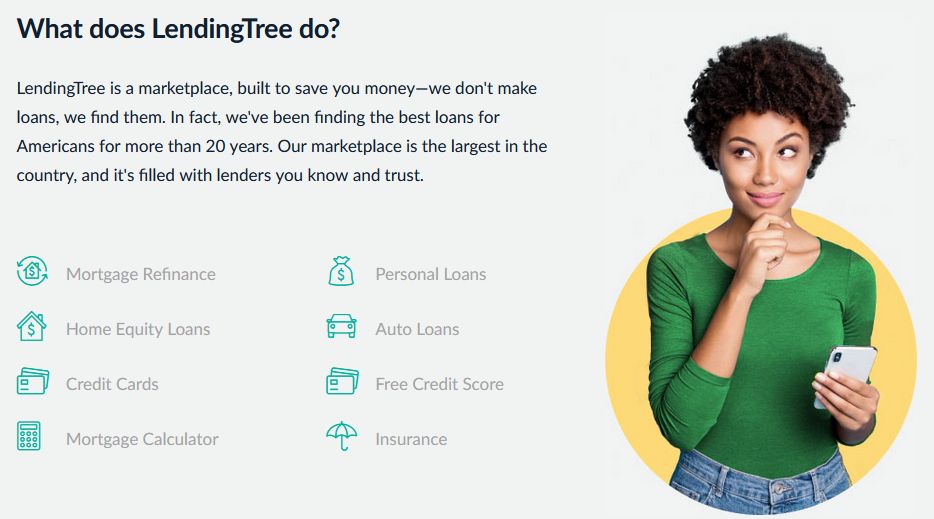
LendingTree, Inc. is a digital marketplace designed to simplify how consumers discover, compare, and choose financial products. Rather than acting as a lender itself, the company connects borrowers with banks, insurers, and other financial providers across categories like loans, credit, and personal finance services. Its platform aggregates consumer demand and routes it to competing offers, helping users navigate complex financial decisions with greater transparency and choice. Positioned at the intersection of fintech, data-driven marketing, and consumer finance, LendingTree monetizes intent rather than balance sheet risk. The model scales through brand trust, proprietary data, and performance-based economics that align lender outcomes with consumer engagement. As financial decision-making continues to shift online, LendingTree operates as an intermediate layer – translating consumer needs into measurable demand for financial institutions while continuously refining the experience through analytics and marketplace optimization.
Source: LendingTree, Inc. Website
1
Money Matchmaker
LendingTree was founded in the late 1990s as an online loan comparison platform. The company spent its early years establishing brand credibility and demonstrating that financial decisions could be sourced and transacted online. That foundation mattered, but the more consequential evolution came in the past several years, as LendingTree deliberately shifted from a single-product comparison site into a broader, multi-category financial marketplace designed for digital-first consumers.
Around 2020, TREE entered a reset phase. Management began repositioning the platform away from heavy dependence on mortgage demand toward a more diversified mix spanning personal loans, credit cards, insurance, and small-business services. This was not just a product expansion – it required reworking how traffic is sourced, how consumer intent is segmented, and how partners are matched in real time. Over the following years, the company invested steadily in data science, marketplace optimization, and automation, refining its ability to route consumers to higher-quality offers with better conversion outcomes.
Technology became a key differentiator. LendingTree deepened its use of proprietary data and machine-learning models to personalize offers, improve lead quality, and enhance lender return on investment. These improvements strengthened relationships with major banks, insurers, and fintech providers, reinforcing the platform’s role as a scalable customer-acquisition channel rather than a simple comparison engine.
Strategic portfolio shaping also played a role. Earlier acquisitions such as CompareCards and QuoteWizard matured into core growth engines, particularly in credit cards and insurance. Over the past several years, management focused less on large headline deals and more on integrating and optimizing these assets, extracting operating leverage and cross-category synergies. As part of this sharpening, LendingTree exited its insurance agency business in 2025, stepping away from policy placement and regulated activity. By shedding the agency business, TREE decoupled itself from the “heavy” side of insurance – trading regulatory friction for the high-margin simplicity of pure marketplace economics. It also clarified Insurance’s role as a performance-based demand platform rather than a hybrid distribution business. The result has been a more cohesive ecosystem where consumers can move across financial products within a single brand environment.
Partnership depth increased alongside platform breadth. LendingTree expanded its roster of national and regional financial institutions, insurers, and digital lenders, positioning itself as a neutral marketplace that benefits from competition among providers rather than dependence on any single partner. That neutrality has become increasingly valuable as financial institutions seek efficient, performance-based marketing channels.
Today’s LendingTree is the product of that transformation – a company shaped less by any one product cycle and more by its role as an intermediary layer in digital consumer finance. Its recent history shows a business that learned from volatility, adapted its model, and emerged more diversified, more data-driven, and better aligned with how consumers now navigate financial decisions online.
1
Intent For Sale
LendingTree is a digital marketplace built around one simple idea – when financial providers compete for a consumer, the consumer wins. The platform connects people actively shopping for financial products with banks, insurers, and lenders – TREE’s partners – competing to win that demand. The company does not lend, underwrite, or take balance-sheet risk. Instead, it generates revenue entirely from its partners, which pay for access to high-intent consumers at different stages of the buying process.
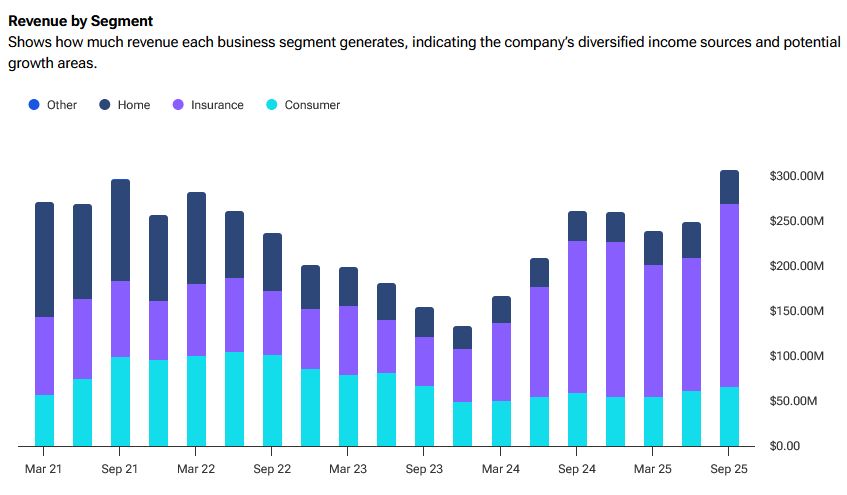
The business is organized across three marketplaces – Insurance, Consumer, and Home – each capturing demand at different moments in the household finance cycle. Insurance has emerged as the core engine, now representing over two-thirds of total revenue. Auto, home, and health insurers use LendingTree to acquire customers through a mix of clicks, leads, and inbound calls. These formats reflect how close a consumer is to making a decision: early-stage clicks carry lower value, while completed forms and live calls signal higher intent and command higher pricing. The platform dynamically routes traffic based on carrier demand, allowing insurers to pay for the level of engagement they want and enabling TREE to maximize total monetization rather than optimize for any single unit metric. Importantly, carrier demand is broadening beyond the largest insurers, with mid-tier carriers materially increasing spend, extending the durability of the insurance cycle into 2026.
The Consumer segment spans personal loans, credit cards, and small-business financing. Here, LendingTree’s advantage comes from execution and conversion quality rather than sheer traffic volume. In small-business lending, the company supplements its automated marketplace with a guided, human-assisted matching process. Borrowers are helped through complex applications and matched more precisely with suitable lenders, increasing close rates and allowing LendingTree to earn higher value per customer despite the added cost. This approach is used selectively, only in categories where improved conversion meaningfully outweighs the expense, and early results have encouraged management to test similar models in adjacent consumer products. Personal loans continue to benefit from debt-consolidation demand, while the credit-card marketplace has stabilized after TREE improved upfront screening and offer matching – ensuring consumers see cards they are more likely to qualify for, reducing failed applications, and restoring issuer engagement.
The Home segment remains sensitive to interest rates, but its mix has adapted. With purchase and refinance activity muted, home-equity products have become the primary growth driver, keeping the marketplace relevant despite a sluggish housing market. Management has been clear that refinance demand is threshold-driven, identifying mortgage rates in the mid-5% range as the point where activity could reaccelerate sharply.
Across all segments, LendingTree’s competitive edge lies in traffic quality and real-time optimization. The company continuously reallocates marketing spend, directing capital toward channels and product categories where expected returns are highest. As free search traffic has become less predictable across financial services, TREE has proven effective at paying for visibility in moments of clear consumer intent – reaching people actively searching for specific financial products and converting that demand into revenue from partners. At the same time, early traffic from LLM- and AI-driven discovery channels, while still small in scale, converts several times better than traditional search, reinforcing the platform’s ability to adapt as consumer behavior and discovery habits evolve. Management characterizes the SEO-to-AI transition as turbulent but industry-wide, favoring platforms with strong paid acquisition, data-driven routing, and adaptive content strategies.
The addressable market is large and fragmented. Consumer insurance and lending acquisition budgets run into the tens of billions annually, yet no single intermediary dominates. LendingTree holds a meaningful but still modest share, leaving room for expansion as smaller competitors struggle with rising acquisition costs and traffic volatility. In that context, TREE’s scale, brand trust, and ability to monetize consumer intent at multiple decision stages position it as the marketplace where financial demand is efficiently discovered, priced, and converted.
Source: TipRanks Data
1
Show Me The Margins
LendingTree’s financial profile has strengthened meaningfully over the past year, reflecting both cyclical tailwinds and the benefits of a cleaner, more focused marketplace model. Q3 2025 revenue reached $307.8 million, up 18% year-over-year, marking the company’s sixth consecutive quarter of year-over-year growth. Growth was broad-based, with all three segments expanding at double-digit rates, underscoring that momentum is not dependent on any single product cycle.
Execution also showed up versus expectations. On a non-GAAP basis, LendingTree exceeded analyst consensus on both revenue and adjusted EPS for the second consecutive quarter. This matters for a company that historically exhibited earnings volatility. Segment performance reinforced the trend: Insurance continued to scale as the largest contributor, while Consumer and Home both delivered solid growth despite uneven macro conditions.
Profitability improved alongside revenue. Adjusted EBITDA rose 48% year-over-year to $39.8 million, with margin expanding to 13%, reflecting operating leverage as traffic monetization improved. The company’s core efficiency metric – variable marketing margin1 – increased 21% year-over-year to $93.2 million, representing roughly 30% of revenue and highlighting disciplined marketing allocation and stronger conversion economics. Importantly, these gains were driven by improved mix and execution rather than aggressive cost-cutting. Because traffic acquisition costs make up a large portion of expenses, the cost structure remains highly variable, allowing spending to scale down quickly if demand softens and preserving downside flexibility.
GAAP profitability has been more uneven but is trending more consistently. TREE reported GAAP net income of $10.2 million in Q3 2025, following a GAAP loss in the prior-year quarter, and also achieved positive GAAP earnings in Q2 2025. These results suggest the core business can now generate GAAP profitability in quarters not distorted by one-time or non-operating items. The quarters of negative GAAP EPS since late 2023 were largely driven by litigation settlement accruals, refinancing-related costs, and other non-recurring charges, rather than deterioration in underlying marketplace economics. By contrast, non-GAAP profitability was first achieved in Q4 2023 and has remained intact since, offering a clearer view of operating earnings power as scale and efficiency improved.
Cash generation and balance-sheet quality add another layer of confidence. For the first nine months of 2025, LendingTree generated $56.6 million in operating cash flow, while capital expenditures remained modest. The company ended Q3 with $68.6 million in cash and restricted cash. Debt continued to decline, with net leverage reduced to 2.6x, the lowest level since 2020, following a comprehensive refinancing that extended debt maturities to 2030 and lowered interest expense. This materially reduced financial risk and restored balance-sheet flexibility.
Management expects this momentum to carry into year-end and into 2026. For full-year 2025, LendingTree guided for revenue of $1.08-1.09 billion, adjusted EBITDA of $126-128 million, and variable marketing margin of $337-340 million, implying continued year-over-year growth and further margin expansion. At the midpoint, revenue growth remains in the high-teens range year-over-year, outpacing many consumer-finance peers.
While risks remain – particularly around free search volatility and rate-sensitive housing demand – the company’s improving profitability, declining leverage, and consistent execution suggest opportunity now outweighs uncertainty. LendingTree’s financials increasingly reflect a business emerging from a period of earnings volatility with a structurally stronger earnings profile and clearer operating leverage.
—
1 – Variable marketing margin represents revenue less variable traffic acquisition costs and reflects how efficiently LendingTree monetizes consumer demand after paying for marketing and distribution.
—
1
Earned, Not Given
LendingTree operates within a small group of digital financial marketplaces that monetize consumer intent rather than lending capital or holding financial assets. Its most relevant public peers are companies that generate revenue by connecting consumers actively shopping for financial products with providers competing for acquisition. NerdWallet represents the closest pure-play comparison across loans, credit cards, and insurance, while QuinStreet offers a strong benchmark in insurance-focused performance marketing. EverQuote (a Smart Growth Portfolio holding) adds a pure-play insurance marketplace perspective, sharing similar unit economics and sensitivity to carrier demand. Together, these peers frame TREE against businesses defined by marketplace economics and variable cost structures, not balance-sheet risk.
Over the past year, LendingTree’s share price has moved decisively away from its closest marketplace peers. While TREE gained more than 26%, EverQuote advanced modestly, and NerdWallet and QuinStreet declined sharply. That divergence is not about market cap or sector exposure alone – it reflects how investors reassessed business quality and adaptability within the same model. LendingTree benefited from a rare combination of factors: accelerating insurance momentum, diversification beyond a single traffic or product engine, and a cost structure that allows marketing spend to flex with returns. EverQuote, more narrowly concentrated in insurance, participated in the carrier spending recovery but lacked the multi-segment optionality that drove TREE’s re-rating. By contrast, NerdWallet and QuinStreet entered the year more exposed to organic search volatility and struggled to convert revenue growth into durable earnings as traffic economics shifted. As search behavior changed and acquisition costs reset across financial services, the market rewarded platforms that could buy, route, and monetize intent dynamically – and penalized those reliant on legacy traffic advantages or inconsistent margin delivery. TREE’s outperformance reflects that distinction becoming clearer, quarter by quarter, as execution improved and earnings credibility followed.
Wall Street analysts now project nearly 40% upside for the “Strong Buy”-rated stock, with that potential anchored not only by LendingTree’s business momentum, but also by valuations that remain measured relative to peers. While fintech platforms often trade at a notable premium to the legacy Financials sector, TREE’s trailing and forward non-GAAP P/E sit broadly in line with the sector median – reflecting a business still transitioning rather than one priced for perfection.
More importantly, on the metrics the market actually emphasizes when it comes to intent-driven marketplaces, LendingTree compares favorably to its peers. The stock trades modestly above peer averages on trailing and forward EV/EBITDA and EV/Sales, a premium the market appears willing to pay for a platform that combines diversified demand sources, rising insurance mix, and improving operating leverage. At the same time, TREE screens below averages on Price/Sales and only slightly above on trailing Price/Cash Flow, despite being in an active deleveraging phase where cash is intentionally directed toward balance-sheet repair rather than near-term yield. Taken together, the valuation suggests investors are not pricing LendingTree as a speculative rebound, but as a higher-quality marketplace where execution, cash conversion, and flexibility increasingly justify modest multiple expansion versus peers with more fragile traffic and margin profiles.

1
To Sum It All Up
LendingTree’s story is built around the sweet spot where financial intent turns into action. What began as a comparison site has evolved into a multi-category marketplace that benefits as consumers become more selective, providers compete harder, and acquisition efficiency matters more. Insurance has emerged as a structural growth engine, while consumer and home categories add optionality as rate conditions normalize. The platform is increasingly defined by execution – better matching, higher-quality traffic, and flexible monetization rather than dependence on any single product cycle. Recent performance shows that the model is working, with operating leverage improving as scale builds. Yet the market still treats LendingTree as a cyclical lead generator rather than a data-driven marketplace with expanding relevance. As financial discovery continues to shift online, LendingTree is positioned to compound growth by turning intent into durable, repeatable economics.
1
1
Smart Growth Portfolio
|
1
Disclaimer
The information contained in this article represents the views and opinions of the writer only, and not the views or opinions of TipRanks or its affiliates and should be considered for informational purposes only. TipRanks makes no warranties about the completeness, accuracy, or reliability of such information. Nothing in this article should be taken as a recommendation or solicitation to purchase or sell securities. Nothing in the article constitutes legal, professional, investment and/or financial advice and/or takes into account the specific needs and/or requirements of an individual, nor does any information in the article constitute a comprehensive or complete statement of the matters or subject discussed therein. TipRanks and its affiliates disclaim all liability or responsibility with respect to the content of the article, and any action taken upon the information in the article is at your own and sole risk. The link to this article does not constitute an endorsement or recommendation by TipRanks or its affiliates. Past performance is not indicative of future results, prices, or performance.
