TipRanks Smart Growth Portfolio #50: Alpha Conductor

Dear Investors,
Welcome to the 50th edition of the Smart Growth Portfolio and Newsletter, where we spotlight the control layer of an overstrained electric grid. But first, here are some news and updates.
1
1
Portfolio News
❖ Micron (MU) saw its stock surge, rebounding from a mid-week profit taking-driven slump, as Morgan Stanley reiterated a Buy rating, hiking its price target from $350 to $450 – just a day after Deutsche Bank slapped the memory-chip maker with a Street-high PT of $500. Analysts believe that even the newly-raised earnings guidance could be well below MU’s actual results, as continued memory shortages set the stage for further price increases along with sales growth.
The key driver of the acceleratingly fast upward re-rating is the HBM story, fed by soaring demand from Nvidia. On Wednesday, Micron announced the beginning of the mass production and commercial shipments of HBM4, its next-gen high-bandwidth memory chip. This dispelled concerns that Micron was falling behind rivals like SK Hynix and Samsung Electronics in the fiercely competitive HBM market. Moreover, according to BNP Paribas and others, the HBM4 secures Micron a larger role in the AI supply chain, solidifying the view that the company’s earnings growth is structural rather than cyclical.
1
1
Portfolio Changes
❖ We are removing EverQuote (EVER) from the Smart Growth Portfolio due to its diminished competitive edge in the lead-generation insurance market.
EverQuote is a fintech company operating an online lead-generation insurance marketplace. The stock has been under pressure for some time due to its perception as one of the “AI victims” in the software cohort. That interpretation was stretched, to say the least, as EVER’s value proposition stems from the massive amount of first-party consumer intent data it owns and its relationships with insurance carriers, rather than from its underlying software. Still, while AI has broadly been a tailwind for EVER’s operations – improving efficiency and supporting margins – the company did, eventually, fall victim to the technology in a different way: it failed to incorporate the tech as quickly and effectively as its competitors.
On February 9, 2026, Insurify – a direct competitor to EverQuote – released the industry’s first ChatGPT app in OpenAI’s official directory. The app functions much like ChatGPT, permitting natural-language conversations while drawing on Insurify’s proprietary database of nearly 200 million quotes and tens of thousands of customer reviews to deliver quick, personalized estimates, insurer comparisons, and reviews. Insurify is a licensed digital insurance agent, so its app handles lead generation within ChatGPT but routes actual transactions through its regulated platform. In other words, Insurify’s tool is a lead-gen enhancement, not a full bypass of regulated transactions.
Insurance is one of the most heavily regulated industries in the U.S., with strict rules on licensing, consumer protection, data privacy, and fair practices – and that was one of the reasons we at Smart Growth did not share concerns about AI disrupting the industry’s business models. However, in this case, it is not the tech per se, but a competitor’s ability to use available tools to gain an edge. Simply put, it’s not that AI suddenly made EverQuote’s business model obsolete – it’s that a rival executed a visible, consumer-friendly AI enhancement first, shifting market perception and making EVER appear behind the curve in adapting to the rapid changes evident across industries and sectors.
This definitely doesn’t mean a death sentence for EverQuote’s earnings, as the company may well introduce an even better AI roadmap, supporting its competitive positioning. However, in the fast-moving, highly competitive fintech space, a visible laggard status can prolong underperformance even if fundamentals hold. With EVER’s stock now under a heavy cloud of “second-mover” disadvantage, we prefer to step aside for now.
❖ This week, we are not adding a stock to the Smart Growth Portfolio to replace EVER, as the earnings season – that is just beginning for smaller stocks in the tech space – obscures the visibility, and with investor nervousness leading to sharp volatility, we believe it is more prudent to hold until a more convenient entry setup.
1
1

1
This Week’s Top Growth Pick: American Superconductor (AMSC)
American Superconductor Corporation acts as a conductor of the modern power system, coordinating how electricity moves across an increasingly complex grid. The company develops advanced power electronics and superconductor-based systems that help utilities transmit, stabilize, and protect energy as demand patterns grow more volatile. As renewables, storage, electrified transport, and AI-driven data centers add new layers of strain, the grid requires faster response times and tighter control. AMSC’s technologies are designed to keep that rhythm in balance – smoothing disruptions, strengthening infrastructure, and enabling higher-performance energy delivery. Beyond commercial grids, its systems also support mission-critical U.S. Navy applications, placing the company at the intersection of electrification, resilience, and national security.
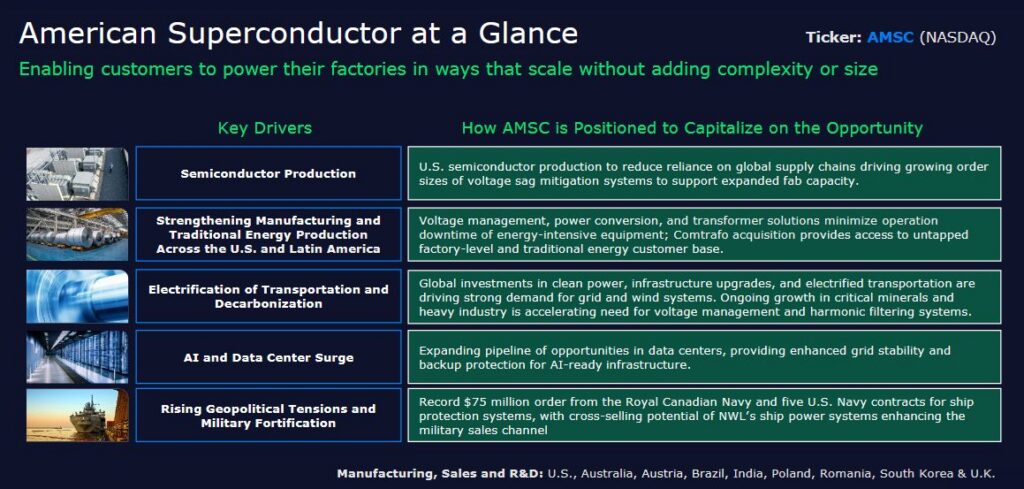
Source: American Semiconductor Investor Presentation, February 2026
1
Current Affairs
American Superconductor was founded in 1987 by MIT professors to commercialize high-temperature superconductor (HTS) technology, initially targeting advanced transmission systems and utility-scale grid applications. For much of its early history, the company focused on superconducting wire and large-scale grid hardware, navigating a capital-intensive path that required long development cycles and close coordination with utilities and government agencies.
While broad HTS adoption proved slower than originally envisioned, that deep technical foundation enabled AMSC to expand into adjacent technologies that could be commercialized more rapidly. Its HTS expertise remains central to its identity – but over the past five years, AMSC has evolved into a more commercially focused grid technology platform, sharpening its emphasis on power electronics, grid interconnection solutions, and resiliency technologies.
A key inflection point came with the expansion of its D-VAR® STATCOM1 systems, designed to regulate voltage and support renewable integration across increasingly strained transmission networks. As solar and wind deployments accelerated across North America, AMSC deepened relationships with utilities and renewable developers seeking faster interconnection timelines and greater grid stability.
In August 2024, AMSC acquired NWL, Inc., a supplier of specialized power electronics for naval, industrial, and military applications. The transaction broadened AMSC’s footprint in mission-critical defense programs and diversified its exposure beyond traditional grid customers. It also deepened the company’s role with the U.S. Navy, where AMSC technologies support advanced ship protection and power management systems.
In parallel, AMSC has leaned into high-growth infrastructure themes – including grid hardening, offshore wind electrical systems, and solutions designed to manage rising power loads from electrification and data center expansion. Strategic collaborations with large engineering and construction contractors, utilities, and defense contractors have expanded its reach into large-scale transmission and defense projects. The result is a company increasingly aligned with long-cycle infrastructure investment and the structural shift toward a more resilient, digitally controlled grid.
—
1 – STATCOM (Static Synchronous Compensator) is a grid device that rapidly injects or absorbs reactive power to stabilize voltage and improve power quality on transmission networks. D-VAR is AMSC’s branded STATCOM platform, engineered for utility-scale applications such as renewable integration, transmission support, and grid resiliency.
—
1
Controlled Surge
American Superconductor operates at the control layer of the electric grid, addressing one of the modern economy’s most critical bottlenecks – moving large amounts of electricity reliably from generation to consumption. It designs and supplies systems that stabilize, regulate, and route power across transmission and distribution networks.
About 85% of revenue comes from its Grid segment, with the remaining 15% from Wind systems. That mix reflects a strategic evolution – AMSC today is primarily a grid modernization company, with renewable controls as a complementary business.
Within Grid, the core revenue engine is voltage regulation and reactive power compensation. Utilities, semiconductor fabs, metals processors, and traditional energy operators deploy AMSC’s D-VAR systems to stabilize transmission networks under rising load variability. As renewables, electrification, and AI-driven data centers increase grid stress, voltage control shifts from optional optimization to infrastructure necessity. These are engineered, project-based systems where performance, certification, and integration expertise outweigh commodity pricing.
The December 2025 acquisition of Comtrafo expanded AMSC into utility and industrial transformers, including large power transformers up to 250 MVA. The move extends AMSC’s participation across the full power chain – generation, transmission, and distribution – while adding manufacturing capacity in Brazil and access to Latin American utilities. Transformer demand is currently outpacing supply as utilities upgrade aging infrastructure and connect new generation. Capacity has not fully caught up, stretching lead times and strengthening pricing dynamics. Meanwhile, grid modernization represents a multi-decade spending cycle measured in tens of billions annually, growing at a double-digit pace. AMSC’s share of that market remains modest, leaving room for expansion.
Defense adds a second long-cycle pillar. AMSC’s ship protection systems are designed into multi-ship naval programs in the U.S. and Canada, embedding the company in fleet modernization efforts with high technical barriers and multi-year program visibility.
Revenue is broadly diversified. Traditional energy accounts for roughly one-third of recent shipments, renewables about one-quarter, military and utilities each above 15%, materials and semiconductors above 10%, and early data center deployments about 5%. AI headlines may dominate sentiment, but the underlying growth story is one of broader electrification.
Superconductors remain strategic leverage. AMSC was founded to commercialize HTS technology, but adoption lagged because utilities move slowly and regulatory cycles stretch for years. Hyperscalers change that dynamic. In February 2026, Microsoft’s Azure blog quoted AMSC’s CEO alongside the CEO of VEIR in discussing HTS for next-generation data center power systems. That inclusion signals technical credibility at the highest infrastructure levels. HTS is not yet a revenue driver, but if hyperscaler-driven power density accelerates deployment, AMSC’s decades of superconducting expertise shift from dormant capability to monetizable advantage. In that scenario, even a modest share of a large and rapidly expanding market could be meaningful.

Source: American Semiconductor Investor Presentation, February 2026
1
Power Curve
AMSC’s recent results read like a company moving from turnaround to acceleration. In the third quarter of fiscal 2025, revenue reached $74.5 million, up 21% year-over-year and above the company’s own revenue outlook. Over the first nine months of fiscal 2025, revenue reached $212.7 million, already nearing the prior full fiscal year’s total – a sign that demand across grid, defense, and industrial markets continues to compound.
Growth was broad-based. Grid revenue increased 21% year-over-year to $63.2 million, while Wind rose 25% to $11.3 million. Early data center deployments contributed roughly 5% of quarterly revenue, adding a new vertical without skewing the overall mix. Execution has been consistent: AMSC has surpassed adjusted EPS consensus in every quarter since Q1 2023 and beat on revenue in seven of the last eight quarters, reinforcing a pattern of disciplined operational execution.
Margins are strengthening alongside the top line. Gross margin reached 31%, the third consecutive quarter above 30%, up from 27% a year earlier. Operating income was $3.4 million, reflecting improving scale. On profitability, AMSC is now in a sustained run – the company recorded its sixth consecutive quarter of GAAP profitability and its tenth consecutive quarter of non-GAAP profitability.
On the surface, GAAP net income surged to $117.8 million, but that figure includes a one-time $113.1 million deferred tax benefit. Excluding that item, normalized quarterly net income was approximately $4.7 million. For comparison, net income in the same quarter last year was $2.5 million. That implies roughly 88% year-over-year growth in underlying earnings – a much clearer signal of operational progress than the headline figure. On a per-share basis, normalized earnings nearly doubled year-over-year, reinforcing that profitability is expanding in step with revenue rather than being driven by accounting adjustments.
Backlog supports forward momentum. Twelve-month backlog exceeded $250 million at quarter-end, supplemented by Comtrafo’s approximately $55 million twelve-month backlog. For the fourth quarter, AMSC guided for revenue above $80 million and non-GAAP net income above $8 million (translating to EPS of at least $0.17, or 42%+ year-over-year growth), implying continued operating leverage at higher revenue scale.
Liquidity remains a growth enabler. Cash, cash equivalents, and restricted cash totaled $147.1 million at quarter-end, up from $85.4 million at fiscal year start. Operating cash flow was positive in the quarter at $3.2 million, capital spending remains modest, and while acquisitions add complexity – including integration and working-capital needs – backlog strength and margin expansion give AMSC room to absorb that risk while still pushing growth.

Source: American Semiconductor Investor Presentation, February 2026
1
The Surge Purge
AMSC belongs to a focused subset of industrial technology companies serving the electric grid, positioned between large diversified electrical OEMs and niche component suppliers. Its closest public peers are firms tied directly to grid modernization, power distribution, and electrification capex cycles. Powell Industries represents the strongest operational comparison, with exposure to custom-engineered power systems for utilities, data centers, and industrial customers. Preformed Line Products offers a size-aligned grid infrastructure benchmark, supplying critical transmission and distribution hardware to utilities. Shoals Technologies adds context from the renewable and electrical balance-of-system side, where project-based revenue, backlog visibility, and margin execution drive valuation. Together, these companies form the most relevant performance and multiple reference frame for AMSC within the grid modernization ecosystem.
Over the past year, AMSC’s share price rose about 13%, trailing its peers by a wide margin as they climbed by high double or even low triple digits. The divergence centers on AMSC’s November earnings reset. After a scorching rally – a nearly 300% gain in seven months – the stock was priced for perfection. When fiscal Q2 delivered solid growth, but a modest revenue miss and measured forward guidance, sentiment cracked. A high-beta, small-cap growth name trading near 10x sales on unrealistic expectations of an immediate earnings surge repriced quickly, shedding more than 40% in the weeks following the report as stretched positioning unwound. Yet the business did not reverse, quite the opposite: AMSC’s fundamentals continued to progress, and Q3’s results and guidance showed that the previous quarter was just a stumble on a stable upward trajectory. The stock began regaining its footing, helped by analyst support as Clear Street named AMSC one of its top picks. On average, analysts see a potential upside of almost 70% for the Strong Buy-rated stock.
November’s forceful re-adjustment to reality pulled down AMSC’s valuations, which now look more compelling relative to peers. Profitability metrics have steadily improved, and on certain measures, are beginning to converge with or even surpass smaller-cap grid names, while revenue growth is by far the strongest in the group. Yet several of AMSC’s key multiples – including trailing and forward GAAP and non-GAAP P/E ratios – sit meaningfully below peer averages.
The apparent contradiction reflects how the market assigns value. On a Price/Sales and EV/Sales basis, AMSC still screens closer to higher-growth infrastructure names like Powell, reflecting expectations for continued scale and margin expansion. However, the stock trades at a discount on earnings-based multiples because net income has only recently begun to scale, and the prior tax benefit distorts trailing comparisons. In other words, revenue is being valued as growth, while earnings are being valued conservatively.
If operating leverage continues to build as backlog converts and transformer capacity ramps, that gap between revenue multiples and earnings multiples narrows organically. The valuation debate, therefore, is not about whether AMSC is expensive or cheap in isolation – it is about how quickly margins mature relative to the growth already underway.

1
To Sum It All Up
American Superconductor is a growth story aligned with the structural rewiring of the global power system. What began as a superconducting science venture has evolved into a grid-control platform positioned at the most critical junction of electrification – stabilizing networks strained by renewables, industrial load, and data center expansion. Its technology is embedded in long-cycle infrastructure programs where reliability and certification create durable competitive advantages. Backlog is building, margins are expanding, and acquisitions have broadened its reach across transformers and grid hardware. Meanwhile, hyperscaler interest in advanced power architecture quietly reactivates the company’s original technical edge. The market still treats AMSC as a volatile small-cap project name. In reality, it is becoming a scaled participant in a multi-decade grid modernization cycle – with operating leverage just beginning to show.
1
1
Smart Growth Portfolio
|
1
Disclaimer
The information contained in this article represents the views and opinions of the writer only, and not the views or opinions of TipRanks or its affiliates and should be considered for informational purposes only. TipRanks makes no warranties about the completeness, accuracy, or reliability of such information. Nothing in this article should be taken as a recommendation or solicitation to purchase or sell securities. Nothing in the article constitutes legal, professional, investment and/or financial advice and/or takes into account the specific needs and/or requirements of an individual, nor does any information in the article constitute a comprehensive or complete statement of the matters or subject discussed therein. TipRanks and its affiliates disclaim all liability or responsibility with respect to the content of the article, and any action taken upon the information in the article is at your own and sole risk. The link to this article does not constitute an endorsement or recommendation by TipRanks or its affiliates. Past performance is not indicative of future results, prices, or performance.
