TipRanks Smart Growth Portfolio #52: The Load Balancer

Dear Investors,
Welcome to the 52nd edition of the Smart Growth Portfolio and Newsletter, where we spotlight the traffic-management layer enabling secure data flow. But first, here are some news and updates.
1
1
Portfolio News
❖ Clear Secure (YOU) shares surged as several analysts increased their price targets following a strong Q4 and full-year 2025 report. Fourth-quarter revenue rose 16.7% to $240.8 million, and full-year revenue increased by 16.9% to $900.8 million, both surpassing expectations. Q4 bookings jumped 25.4% year-over-year to $287.1 million, their highest in two years; full-year bookings of $977.2 million were up 17.2% from 2024. Total Clear members grew to 38.0 million, up 31.5% year-over-year. YOU clocked in record profitability and margin expansion with full-year adjusted EBITDA of $262.2 million and adjusted EBITDA margin of 29.1%.
In 2025, net cash provided by operating activities rose to $372.5 million, and free cash flow was $343.1 million (after $29.3 million in capex), significantly ahead of guidance. The company ended the year with $703.0 million of cash and marketable securities and expects to exit 2026 with over $1.0 billion and no debt. Clear guided full‑year 2026 free cash flow of at least $440.0 million, at least +28% year-over-year. Other guidance was also lifted, with management projecting Q1 2026 revenue at $242-245 million (about +15.2% year-over-year at midpoint) and total bookings to $248-253 million (+20.9% midpoint). The board declared a 20% increase in the regular quarterly dividend to $0.15 per share plus a special dividend of $0.20, while authorizing a $125 million increase to its buyback program.
1
❖ ACM Research (ACMR) dropped post-earnings on mixed results. Q4 2025 revenue rose 9.4% year-over-year to $244 million, and full-year revenue jumped 15% to a record $901 million, both surpassing estimates that were raised after ACMR pre-released revenue results about a month ago.
ACMR announced significant global expansion progress in 2025, including first tool deliveries to a Singapore-based foundry customer and multiple advanced packaging orders from global customers in Singapore and the U.S., with deliveries scheduled for Q1 and the rest of 2026, marking important milestones beyond mainland China. The company also revealed strong technical breakthroughs in new product platforms, positioning it for the next growth phase driven by AI and advanced packaging demand.
The company ended the year with $845 million in net cash, which surged from $259 million a year ago, supported by ACM Shanghai’s $623 million private offering and $111 million from share sales, providing capital flexibility to fund Oregon facility expansion (starting H2 2026), and Lingang capacity expansion to support $3 billion annual output, as well as further global market development.
However, lower gross margins and a miss on Q4 adjusted EPS – driven by product mix pressure on semi-critical products and higher inventory provisions – heavily weighed on investor sentiment, though management expects this to be temporary with improvement from new, higher-margin products ramping in the second half of 2026.
Management maintained its 2026 revenue outlook of $1.08-1.18 billion, implying 21-30% growth, expecting incremental contributions from Tahoe, SPM cleaning, and furnace, continued momentum in advanced packaging, and additional evaluations of emerging platforms. ACMR also reaffirmed its long-term target of $4 billion in revenue.
With no negative analyst reaction to the results and strong institutional ownership, ACM Research looks set to rebound from the dip, as growth appears intact amid temporary profitability pressures. However, execution and timing of new product shipments will determine whether the positives outweigh the near-term challenges, key watchpoints being H1 2026 margins and contributions from Oregon and Singapore facilities.
1
❖ Arlo Technologies (ARLO) revealed blockbuster Q4 and full-year 2025 results, with the reported metrics surpassing analyst consensus across the board.
Q4 revenue rose 16% year-over-year to $141.3 million, as ARR jumped 28.4% year-over-year to $330.5 million and subscriptions and services revenue surged 39.4% to $89.4 million, accounting for 63.3% of total revenues. Non-GAAP subscriptions and services gross margin expanded by 230 basis points to 84.0%, while total company gross margin surged by 1030 basis points to 47.8%, also a record high. Adjusted EBITDA was up 138.2% year-over-year to $23.3 million, with an adjusted EBITDA margin of 16.5%, reflecting surging profitability. This was confirmed by a 120% year-over-year jump in non-GAAP EPS to a record high of $0.22.
Full-year results also revealed record profitability, driven by Arlo’s subscription-first strategy. Subscriptions and services revenue jumped 30.2% year-over-year to $316.4 million, reaching nearly 60% of total revenue, with non-GAAP gross margin expanding by 620 basis points to 84.3%. Total company non-GAAP gross margin rose by 750 basis points to 45.1%. Adjusted EBITDA surged 85.4% year-over-year to $74.7 million, with an adjusted EBITDA margin of 14.1%. Full-year non-GAAP EPS soared 75% to $0.70. Arlo ended the year with free cash flow of $66.9 million with an FCF margin of 12.6%.
The company announced a major partnership with Comcast Xfinity to power home security for millions of U.S. homes, and a strategic partnership with Samsung to power SmartThings Safe Premium service across 425 million users. Both agreements are expected to contribute incrementally in 2026 but ramp significantly in 2027 and beyond, driving end-market expansion and market-share gains alongside the existing ADT partnership. Arlo is also expanding into adjacent markets, including small business and age-in-place segments, while planning to launch its next-gen hardware platform in 2027.
Arlo Technologies provided an upbeat guidance that came in well above the consensus. Q1 2026 revenue is seen at $135-145 million, sailing past expectations of $132.15 million, while adjusted EPS is guided to $0.17-0.23, compared to the consensus of $0.17. Full-year 2026 revenue is guided to $550-580 million, while EPS is expected to come in at $0.75-85, both above the consensus at the midpoint. The board approved an additional $50 million buyback program, reflecting confidence that the stock is substantially undervalued relative to peers.
1
❖ Innodata (INOD) sailed past expectations in Q4 – exceeding analyst consensus across all key metrics, including revenue, adjusted EBITDA, net income, and EPS – but shares are flashing red pre-market as near-term profitability pressures appear to outweigh soaring growth and a slate of new deals.
Q4 revenue rose 22% year-over-year to $72.4 million, while adjusted EBITDA increased 11% to $15.7 million. Adjusted EPS dipped as expected, but came in at $0.25, above the consensus of $0.22. Full-year revenue of $251.7 million reflected a 48% year-over-year growth, while adjusted EBITDA surged 68% to $57.9 million. Adjusted net income expanded slightly year-over-year to $0.92 per share, up from $0.89 in 2024, despite declining in H2 2025 on increased SG&A spending. The company ended 2025 with $82.2 million in cash, up from $46.9 million a year ago, supporting continued investment without debt concerns.
INOD continues to invest heavily in innovation to strengthen its platform, accelerate customer outcomes, and reinforce its position in the AI value chain. Management says that demand across frontier model training, agentic AI, and physical AI is accelerating, and believes that Innodata is evolving from a data supplier to a strategic lifecycle partner across Mag Seven, AI innovation labs, sovereign AI initiatives, and enterprises.
While large-customer concentration remains high, the company highlighted recent wins that include a hyperscaler engagement for intelligent virtual assistant optimization, multiple AI innovation labs exploring their agent optimization system, early-stage cybersecurity engagements, a significant robotics foundational dataset engagement with Palantir, and development of a drone detection AI model exceeding prior benchmarks.
INOD’s guidance calls for 35% or more revenue growth in 2026, with potential upside as programs scale. Management expects early 2026 adjusted gross margins of 35-40% as new programs ramp, normalizing toward 40% or better as innovation-driven workflows expand. Automation, synthetic systems, and evaluation platforms are expected to structurally increase operating leverage and drive margin expansion over time.
1
❖ Vistance Networks (VISN) reported solid Q4 and full-year 2025 results, showcasing robust growth in its continuing core operations, amid a major corporate transformation. The company completed the divestiture of its CCS (cable connectivity solutions) segment to Amphenol in January 2026 for $10 billion, using proceeds to repay all debt, redeem preferred equity, and position for significant shareholder returns. These profound changes make year-over-year comparisons challenging due to the shift from a broader portfolio to a leaner, focused entity post-transformation.
In Q4, VISN emphasized metrics applicable to ongoing operations, such as $514.5 million in net sales, up 24% year-over-year, driven by strong demand in its Aurora and Ruckus businesses focused on intelligent network solutions like broadband amplifiers and Wi-Fi infrastructure. This beat expectations on top-line growth, despite supply chain constraints. Profitability strengthened, with core non-GAAP adjusted EBITDA jumping by 55% to $99 million, reflecting margin leverage in the streamlined business.
Full-year 2025 core net sales soared by nearly 40%, marking a standout year of acceleration and highlighting the massively positive strategic restructuring effects as growth was driven by the remaining operations long before the transformation. Core adjusted EBITDA surged 176% year-over-year, highlighting vastly improved operating leverage. Cash generation was also exceptional, with an operating cash flow of $323 million and $253 million free cash flow for the year. VISN ended the year with $923 million in cash and no debt.
The company’s board plans a special cash distribution of at least $10 per share by the end of April 2026, reflecting excess cash from the CCS divestiture and confidence in the remaining platform’s value creation. This further supports one of the theses for the company’s transformation, unlocking shareholder value.
1
1

1
This Week’s Top Growth Pick: A10 Networks (ATEN)
A10 Networks, Inc. sits at the core of high-performance digital infrastructure, helping enterprises and service providers keep applications secure, available, and running at scale. The company develops networking and cybersecurity platforms that manage traffic, defend against large-scale attacks, and optimize how data moves across complex environments. As cloud adoption deepens, 5G networks expand, and AI-driven workloads strain traditional architectures, performance and protection can no longer be treated separately. A10 operates in that convergence layer – where security, speed, and reliability intersect. Its solutions are built for organizations that cannot afford downtime, latency, or exposure in an increasingly distributed and threat-intensive digital landscape.
Source: A10 Investor Day Presentation, February 2026
1
Ports of Power
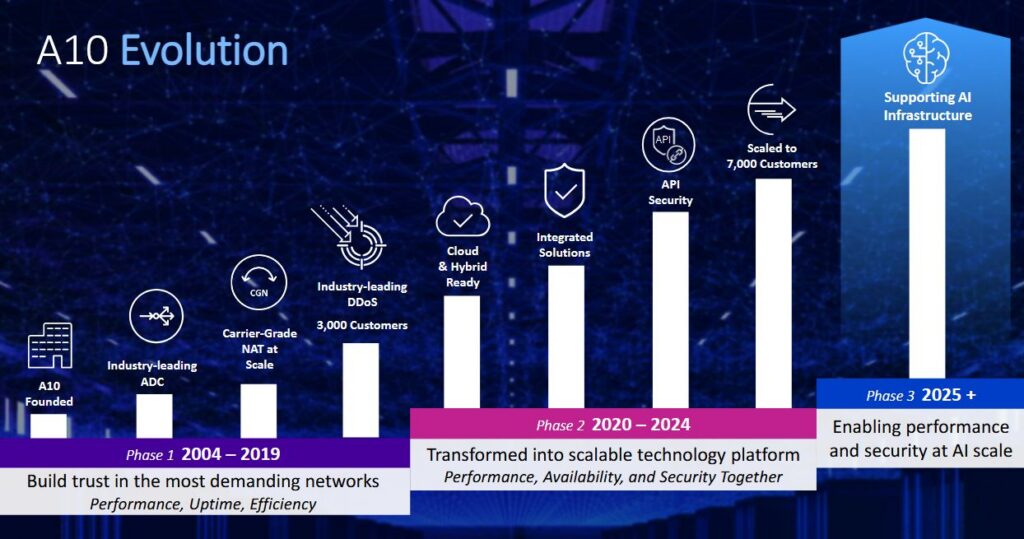
A10 Networks was founded in 2004 with a focus on high-performance application delivery controllers,1 entering a market dominated by larger networking incumbents. In its early years, the company built credibility around performance efficiency and carrier-grade reliability, establishing footholds with telecommunications operators and large enterprises. Though its 2014 IPO marked its transition into a more visible public infrastructure player, a bigger evolution has unfolded more recently.
Over the past five years, A10 has deliberately repositioned itself around security and cloud-era networking. As 5G deployments accelerated and encrypted traffic volumes surged, the company leaned deeper into service provider security – including signaling protection, carrier-grade NAT,2 DNS security, and large-scale DDoS protection. Its Thunder platform evolved beyond traditional load balancing into a broader security and traffic intelligence layer built for hybrid and distributed architectures.
The shift toward cloud-native infrastructure has been central. A10 expanded its software footprint across virtualized, containerized, and public cloud environments, enabling its solutions to run consistently across on-premise, hybrid, and multi-cloud deployments. The introduction and expansion of its Secure Service Edge capabilities reflected a recognition that traffic optimization and security enforcement are converging – particularly as enterprises decentralize access and workloads.
A pivotal step in this transition came in February 2025 with the acquisition of ThreatX, a behavioral web application and API protection company. That move pushed A10 further up the stack, adding application-layer defense and bot mitigation capabilities to complement its network-layer strengths. The deal signaled a clear intent to compete more directly in modern application security, not just infrastructure plumbing.
Strategic integrations with major cloud platforms like AWS and Azure, and orchestration ecosystems including Red Hat OpenShift and Kubernetes, reinforced this trajectory, allowing A10’s software to operate more fluidly inside distributed IT environments. Meanwhile, growing relationships with global telecom operators and public sector organizations positioned the company inside security-sensitive networks where performance and resilience are non-negotiable.
Today, A10 stands as a security-centric networking player embedded in carrier-grade 5G rollouts, large-scale cloud migrations, and increasingly hostile cyber environments. What began as a performance-driven hardware specialist has evolved into a software-enabled infrastructure layer protecting and optimizing some of the most bandwidth-intensive and attack-prone networks in operation.
—
1 – High-performance application delivery controllers are specialized networking systems that manage and optimize traffic between users and applications – balancing loads, accelerating performance, and ensuring reliability across data centers and cloud environments.
2 – Carrier-grade NAT (Network Address Translation) is a large-scale address translation technology used by telecom operators to allow thousands or millions of users to share limited IPv4 addresses – helping preserve address space while maintaining internet connectivity.
—
1
The Flow Authority
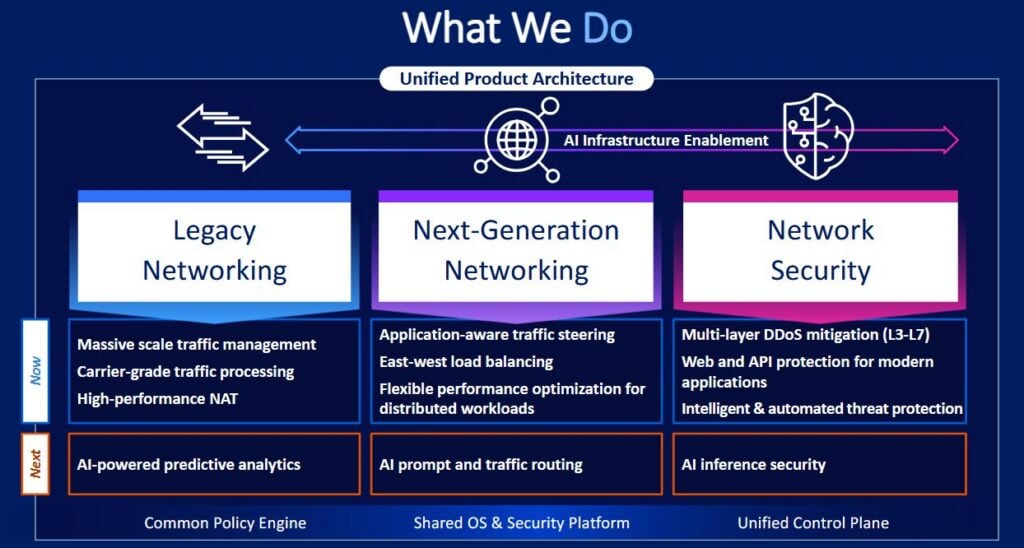
A10 Networks operates inside one of the most performance-sensitive layers of modern digital infrastructure – the point where application delivery, encryption, and security intersect. Its products sit directly in the traffic path of large service providers and enterprises, ensuring that applications remain fast, available, and protected even as network complexity increases. In practical terms, A10 makes money by managing, optimizing, and securing the flow of data across high-demand environments.
The company’s revenue base is split between service providers and enterprises. Service providers account for roughly 58% of revenue and include global telecom operators, cloud infrastructure providers, and hyperscale data center operators. A10 works with 9 of the top 10 telecom operators and 8 of the top 10 cloud providers, embedding its technology directly into the backbone of global traffic infrastructure. Enterprise customers represent about 42% of quarterly revenue and include large organizations operating mission-critical environments such as Comcast, Deutsche Telekom, GE Healthcare, and the U.S. Senate. The company also counts 21 of the top 50 Fortune Global 500 companies and 5 of the top 10 media companies among its customers, reinforcing its presence inside performance-critical and security-sensitive networks.
A10’s portfolio spans application delivery controllers, DDoS protection, carrier-grade networking, and integrated web application security. Security-led solutions now account for roughly 72% of total revenue, reflecting a multi-year pivot toward embedded protection and higher-value workloads. Revenue is generated through a mix of hardware platforms, software licenses, subscriptions, and ongoing service and support contracts, creating a meaningful recurring component tied to installed deployments.
The company differentiates itself through inline architecture. Its appliances and software operate directly within the flow of application traffic, where performance optimization and threat mitigation occur simultaneously. Because the platform is embedded at this control point, customers can scale capacity, inspect encrypted traffic, and activate additional security functions within the same infrastructure layer. That positioning becomes increasingly strategic as AI infrastructure rapidly scales across cloud and enterprise environments.
AI workloads do not simply add compute demand – they multiply internal data center communication, encryption overhead, and inference routing decisions. Servers and models communicate continuously to process requests, placing sustained pressure on load balancing, latency control, and real-time inspection. As organizations build AI capabilities, a new AI orchestration layer is emerging where prompts are routed, models are accessed, and policies are enforced. Since A10 already operates inside the application traffic path for many large service providers and enterprises, customers can extend its footprint to support these AI-specific requirements without rebuilding their core network architecture. As AI traffic scales, capacity and security needs scale with it, creating a structural expansion opportunity within the installed base.
Sovereign AI initiatives and regulated infrastructure buildouts add another dimension to the opportunity. Governments and financial institutions increasingly require secure, high-throughput networking that operates within national borders and meets strict compliance standards. A10’s deployments in public sector and financial environments across North America and allied markets illustrate this positioning, supporting low-latency trading platforms and large-scale government infrastructure where availability and encryption visibility are mandatory.
The markets A10 serves – including application delivery and network security – are expanding at a robust pace as cloud migration continues, encrypted traffic volumes grow, and cyberattacks increase in scale and sophistication. Despite deep relationships at the top tier of global operators and enterprises, the company holds only a modest share of these broader markets. Its growth strategy centers on deepening that footprint as traffic intensity rises, security complexity increases, and AI-driven infrastructure expands across its customer base.
Source: A10 Investor Day Presentation, February 2026
1
Holding the Line
A10 closed 2025 with its strongest quarterly revenue on record, delivering $80.4 million in the fourth quarter and capping a year of robust growth. In 2025, revenue rose 11% year-over-year, reaching $290.6 million – also a record high. The company has beaten analyst consensus on adjusted EPS for eight consecutive quarters and on revenue for six, building a consistent track record of outperformance.
Profitability expanded alongside revenue. Full-year adjusted EBITDA reached $86 million, representing a 29.6% margin, while fourth-quarter adjusted EBITDA margin climbed to 31%. Non-GAAP gross margin held at 80.6% for the year and 80.8% in the fourth quarter, remaining within management’s long-stated 80-82% operating model. Non-GAAP EPS totaled $0.90 for 2025 as operating leverage improved and revenue mix continued shifting toward higher-value security solutions. That expansion occurred despite uneven demand conditions. Enterprise activity strengthened into the fourth quarter, cloud and hyperscale deployments supported growth, non-cloud telecom revenue was flat year-over-year, and Asia-Pacific and Japan (APJ) declined, with weakness concentrated in Japan.
GAAP profitability has been consistent in recent years. The company reported fourth-quarter GAAP net income of $19.1 million, or $0.26 per share, and has maintained GAAP profitability alongside its longer-standing track record of positive non-GAAP earnings – a notable distinction in infrastructure security, where many peers continue to prioritize scale over sustained earnings power.
Cash generation remains solid. Fourth-quarter operating cash flow reached $22.7 million, with $16 million in free cash flow after capital expenditures of $6.7 million. A10 ended the year with $378 million in cash and marketable securities and approximately $219 million in long-term convertible notes due 2030, leaving the company in a net cash position and providing ample flexibility to fund product development and AI-related infrastructure investments without straining its balance sheet.
Management outlined a multi-year financial framework, providing clearer visibility into revenue growth and margin trajectory. For 2026, A10 expects revenue growth of 10-12% year-over-year, non-GAAP gross margin in the 80-82% range, adjusted EBITDA margin of 28-30%, and EPS growth exceeding the revenue growth rate. Longer term, the company targets revenue compounding at 12% or more, with sustained EBITDA margins in the high 20s. Importantly, A10 achieved a Rule of 40 score of 40.6% in 2025 – combining double-digit revenue growth with nearly 30% EBITDA margin – and reaffirmed this framework as a structural operating discipline.
Despite APJ softness, uneven telco spending, and input cost pressures, A10 delivered record revenue, strong cash flow, and improved profitability in 2025. If those headwinds continue to ease, 2026 guidance could prove conservative, as the company’s fundamentals reflect a business scaling profitably into the next phase of global infrastructure expansion.

Source: A10 Investor Day Presentation, February 2026
1
Next Hop
A10 Networks operates in a narrow segment of network infrastructure – focused on application delivery and DDoS security for enterprises and service providers. Its most relevant public peers reflect that niche. Radware is the closest apples-to-apples comp, with similar ADC and application security offerings. NetScout adds a carrier-security benchmark through its Arbor DDoS business, aligning with A10’s service-provider exposure. F5, while much larger, represents the scaled leader in the same category and serves as a valuation reference point. Together, these names provide the most relevant performance and valuation context for A10 within the application delivery and network security space.
Over the past year, the performance divergence within this group has been driven largely by capital flows and earnings momentum. In a 2025 market dominated by large-cap tech and the AI trade, mid-cap networking names needed more than modest beats to attract sustained buying. A10’s stock – under the ATEN ticker – was down roughly 15% heading into its latest earnings report, reflecting cautious positioning, before surging more than 20% in the week that followed – a move that reset sentiment but did not yet translate into full multiple expansion. NetScout’s stronger annual performance reflects a clearer beat-and-raise cycle that supported sustained re-rating, while Radware and F5 largely tracked steady but unexciting growth profiles. Notably, ATEN has outperformed all three peers year-to-date, suggesting the recent earnings reaction may mark the early innings of a broader re-rating.
Meanwhile, A10’s stock trades at valuations that look reasonable relative to peers – despite leading the group on forward revenue and EBITDA growth and posting margins that increasingly approach F5’s scale profile. Gross margins sit near the top tier, operating and net margins are meaningfully stronger than Radware’s and NetScout’s, and free cash flow conversion remains solid. Yet the market has not assigned ATEN a growth premium. Its forward non-GAAP P/E trades broadly in line with Radware and below F5, while only modestly above NetScout, despite superior forward growth expectations. On EV/Sales and EV/EBITDA, ATEN sits in the middle of the comp range. On top of that, its forward PEG of 1.39x – notably below the Tech sector median – supports the view that the stock is trading at a discount. For a company with the strongest projected growth in the group, ATEN’s valuation still looks measured; if execution holds, there is clear room for multiple expansion.
Importantly, A10 is the only dividend payer in the group, which provides downside support. The company has maintained consistent payouts since 2021. While companies in the tech sector have increasingly initiated dividends in recent years, A10’s 1.33% yield – above the sector average of about 1% – is unusual for a small-cap technology company.
If that’s not enough, A10 also performs buybacks. In May 2025, the board approved a $75 million authorization, with $53.4 million remaining at year-end. The company repurchased $69 million worth of shares during the full year 2025. Management continues to highlight buybacks, along with dividends, as a way to return capital, backed by strong free cash flow generation and improving profitability. This focus on shareholder returns alongside growth investments creates a compelling blend of growth and income, widely highlighted in recent analyst coverage. A10 is rated a Strong Buy, with an average price target implying a potential upside of almost 30%.
Taken together, ATEN combines above-peer growth, strengthening margins, disciplined capital returns, and a valuation that has yet to fully reflect that profile. If execution stays on track, the gap between fundamentals and valuation should begin to close. With sentiment already turning year-to-date, the pieces appear to be aligning heading into the next phase of the story.

1
To Sum It All Up
A10 Networks operates at a control point that few companies truly own – directly inside the flow of application traffic where performance, encryption, and security converge. As AI infrastructure scales, encrypted volumes rise, and sovereign networks expand, that position becomes increasingly strategic. The business is scaling profitably, strengthening its security mix, and returning capital while maintaining growth discipline. Unlike the crowded large-cap AI trade, ATEN offers exposure to the infrastructure layer enabling that expansion, without stretched valuations. With momentum improving and structural demand drivers intact, the company enters its next phase from a position of operational strength and balance-sheet flexibility.
1
1
Smart Growth Portfolio
|
1
Disclaimer
The information contained in this article represents the views and opinions of the writer only, and not the views or opinions of TipRanks or its affiliates and should be considered for informational purposes only. TipRanks makes no warranties about the completeness, accuracy, or reliability of such information. Nothing in this article should be taken as a recommendation or solicitation to purchase or sell securities. Nothing in the article constitutes legal, professional, investment and/or financial advice and/or takes into account the specific needs and/or requirements of an individual, nor does any information in the article constitute a comprehensive or complete statement of the matters or subject discussed therein. TipRanks and its affiliates disclaim all liability or responsibility with respect to the content of the article, and any action taken upon the information in the article is at your own and sole risk. The link to this article does not constitute an endorsement or recommendation by TipRanks or its affiliates. Past performance is not indicative of future results, prices, or performance.
