TipRanks Smart Growth Portfolio #58: No Strings Attached

Dear Investors,
Welcome to the 58th edition of the Smart Growth Portfolio and Newsletter, where we spotlight a company replacing copper with cloud. But first, here are some news and updates.
1
1
Under Review
❖ We are keeping Aviat Networks (AVNW) on negative watch following last week’s short report by GlassHouse Research (GHR) and our reassessment of the company’s financial profile. There have been no material updates since, including no formal rebuttal from management – a notable absence, though not uncommon given the source.
While we do not rely on short sellers as primary inputs, several of the report’s claims remain relevant. These include concerns around revenue recognition tied to elevated unbilled receivables, persistently high accounts payable, declining remaining performance obligations (RPOs), and the ongoing NEC1 arbitration, which is confirmed in the company’s filings. RPOs have now declined for six consecutive quarters, and material weaknesses in revenue-recognition controls remain unresolved.
At the same time, recent results showed partial stabilization, including sequential improvement in unbilled receivables, stronger cash flow, and a modest cash build. This leaves the story balanced between improving near-term execution and unresolved structural concerns. Roth Capital continues to push back on the short thesis, calling the sell-off overdone and reiterating its Buy rating.
With no new disclosures or clarifications, the key questions remain open. While the upcoming fiscal Q3 2026 results on May 6 may provide additional clarity, we are not waiting for a single catalyst to drive the decision. AVNW remains Under Review with a negative tilt, and we will reassess as new information becomes available or if the risk-reward shifts meaningfully.
—
1 – Aviat acquired NEC’s Pasolink microwave business in November 2023, making NEC its largest supplier under a long-term Manufacturing Supply Agreement. The current dispute relates to alleged unpaid balances, additional component commitments, and escrow release terms – all disclosed in the company’s 10-Q – and represents one of the more concrete issues raised in the short report.
—
1
❖ We are placing Telos Corporation (TLS) under review as the stock continues to underperform despite solid recent execution, with the market focusing more on near-term concerns than the improving underlying trajectory.
The company delivered a strong Q4, with revenue up 77% year-over-year and continued momentum in Telos ID, while guiding for another year of double-digit growth and improving cash flow. Still, the stock has struggled to hold gains, with post-earnings strength fading quickly.
The pressure is coming from how the next phase of the story is being priced. Growth is expected to normalize in 2026, stepping down from last year’s elevated levels, while near-term margin pressure is creeping in due to mix and timing effects. At the same time, profitability still looks messy on a GAAP basis, with impairment and restructuring charges weighing on earnings optics despite improving underlying trends.
There’s also a lack of clear upside catalysts. Much of the near-term growth is tied to existing programs, while government contract timing remains uncertain, limiting visibility on incremental wins. That dynamic has already shown up in analyst target cuts, even as overall sentiment remains broadly constructive.
Overlay that with broader multiple pressure on small-cap software and government IT names, and the setup becomes clearer: this is no longer a re-rating story, but a “prove it” phase.
We are not exiting the position at this stage, as the core thesis remains intact, but the stock’s lack of confirmation warrants closer monitoring. We will reassess as new information emerges or if the risk-reward shifts meaningfully.
1
1
Portfolio News
❖ Applied Digital (APLD) delivered a blowout fiscal Q3 2026, comfortably beating expectations and reinforcing a clear operational inflection as its AI data center platform begins to monetize at scale. Revenue surged 139% year-over-year to $126.6 million, crushing consensus estimates of roughly $75 million, while adjusted EPS came in at $0.09 versus expectations for a loss of $0.15.
The quarter was driven by the company’s HPC hosting segment, which contributed the majority of growth as Applied recognized its first full quarter of lease revenue from the 100MW Polaris Forge 1 facility. This marks a key transition from construction to cash-generating infrastructure, with management pointing to early signs of the platform’s “earnings power” beginning to emerge.
Beyond Polaris Forge 1, expansion remains on track. Two additional 150MW facilities at the same campus are advancing, while the 200MW Polaris Forge 2 hyperscaler site is progressing toward initial capacity in 2026. During the quarter, Applied also broke ground on Delta Forge 1, a 300MW AI data center campus expected to come online in mid-2027, as the company continues to build out a multi-site pipeline approaching 1GW of potential capacity.
While GAAP results were weighed down by a $59.7 million non-cash write-down tied to the cloud business reclassification and a sharp increase in stock-based compensation, these items obscure what was otherwise a strong underlying quarter. Adjusted EBITDA reached $44.1 million, highlighting improving operating leverage as capacity ramps.
That said, the balance sheet remains a key consideration. Applied ended the quarter with approximately $2.1 billion in cash against roughly $2.7 billion in total debt. While this capital structure is integral to funding large-scale data center buildouts and is expected to normalize as assets begin generating steady lease income, elevated leverage has become a more sensitive issue for investors in recent months, potentially contributing to near-term pressure on the stock.
Looking ahead, management pointed to a “clear acceleration” in demand for AI data center capacity, with hyperscaler capital expenditures rising from roughly $400 billion to nearly $700 billion, reinforcing a supply-constrained environment for power-rich infrastructure.
Shares traded volatile following the release, initially moving higher before fluctuating alongside broader market swings, suggesting macro-driven jitters – alongside debt concerns – shaped the short-term reaction.
Analysts remain constructive. Citizens reiterated a Market Outperform rating with a $40 price target, while Roth Capital called the quarter a “true inflection point” and maintained its view that APLD remains a top pick, recommending investors use weakness to accumulate shares.
1
❖ Micron (MU) staged a strong rally over the past week, driven by rebounding sentiment toward chip stocks, analyst support, and a strategic investment in edge AI startup SiMa.ai, which deepens its LPDDR5X memory ecosystem for robotics and industrial automation.
Gartner’s recent forecast of more than $1.3 trillion in global semiconductor revenue in 2026 – a massive 64% year-over-year jump from 2025 – is supporting the broader industry. Gartner specifically mentioned “memflation” – the sharp inflation in memory chip prices driven by insatiable AI demand – as one of the key reasons for its bullish outlook, adding that meaningful pricing relief is not expected until late 2027. Micron is one of the big three memory makers (alongside Samsung and SK Hynix) and a key supplier in two critical AI memory segments: HBM and data-center DRAM. As such, it stands to benefit significantly from its position in one of the most pressing bottlenecks of the AI buildout.
UBS lifted its price target on Buy-rated MU from $510 to $535, and KeyBanc reiterated a Buy with a $600 price target; the Street’s consensus sees additional upside of over 30% from current levels despite a roughly 420% rally over the past year.
1
❖ Vistance Networks (VISN) announced a $10.00 per share special dividend, returning a sizable chunk of cash to shareholders following the recent sale of its Connectivity and Cable Solutions business. The payout is set for April 27, with April 17 as both the record and ex-dividend date.
Notably, the dividend will be funded entirely from cash on hand, not debt. That’s a meaningful choice in today’s market, where investors have become far less tolerant of leverage. Instead of stretching the balance sheet, VISN is opting for a cleaner capital return.
The move also hints at limited near-term reinvestment opportunities at attractive returns, with management choosing to hand excess cash back rather than redeploy it aggressively. All in all, this is a straightforward cash-return story – and a sign of a more cautious, disciplined approach in a choppier market.
1
1

1
This Week’s Top Growth Pick: Ooma (OOMA)
Ooma, Inc. operates in the shift away from traditional phone systems, delivering cloud-based voice, messaging, and collaboration tools that replace legacy infrastructure with flexible, software-driven solutions. The company builds a unified communications platform that serves small businesses through larger enterprises, while also enabling service providers to develop their own offerings. As copper networks are phased out and work becomes more distributed, communication is no longer tied to physical lines or locations. Ooma positions itself in that transition layer – where aging telecom systems give way to cloud-native connectivity – helping organizations modernize how they communicate and stay connected in increasingly digital environments.

Source: Ooma, Inc. Corporate Website
1
Cloud Nine Calling
Ooma was founded in 2003, setting out to modernize home telephony through internet-based calling. Its early consumer-focused offering gained traction by replacing traditional landlines with a one-time hardware purchase and low-cost service model. That foundation proved durable, but the more consequential shift came around 2013 with the launch of Ooma Office, when the company expanded into business communications – moving from a niche residential solution toward a broader cloud communications provider. The 2015 IPO and subsequent acquisitions that expanded enterprise capabilities accelerated that shift.
The past five years have defined Ooma’s transition into a more scaled and diversified UCaaS (Unified Communications as a Service) platform. As small and mid-sized businesses accelerated their migration away from on-premise phone systems, Ooma continued expanding its feature set beyond voice into messaging, video, and integrations with third-party applications. Its platform evolved to support hybrid and distributed work environments, positioning the company closer to the core communications stack used by modern SMBs.
A key growth vector has been the phase-out of legacy copper infrastructure. Through its AirDial solution, Ooma moved into the replacement of plain old telephone service (POTS) lines – a niche but increasingly urgent market as telecom providers retire their analog networks. This created a new entry point into enterprise environments, particularly in sectors that rely on legacy systems such as fire safety, elevators, and building access, allowing Ooma to expand beyond its traditional SMB base. Partnerships – including a long-standing collaboration with UScellular Business – have facilitated expansion into enterprise and public sector clients.
Strategic expansion accelerated in late 2025 with the acquisitions of FluentStream and Phone.com. These deals broadened Ooma’s UCaaS portfolio across both the mid-market and micro-business segments, adding complementary technology, customer bases, and distribution channels. FluentStream strengthened Ooma’s position in more feature-rich, mid-sized deployments, while Phone.com deepened its reach into smaller businesses and entrepreneurs. Together, the acquisitions extended Ooma’s coverage across a wider spectrum of business customers and reinforced its positioning as a multi-tier communications provider.
Alongside these moves, Ooma has continued to invest in its underlying multi-tenant SaaS platform and partner ecosystem, including enabling service providers to build on its infrastructure. One of the most direct and concrete ways Ooma advanced this strategy was the acquisition of 2600Hz, Inc. – a white-label, API-driven communications platform provider – in October 2023. The acquisition strengthened Ooma’s developer and partner ecosystem while expanding its platform-level capabilities.
Over the past several years, Ooma has steadily evolved from a consumer VoIP provider into a broader communications platform, increasingly aligned with the shift toward cloud-native, software-defined connectivity.
1
Dial O for Oomph
Ooma is a cloud communications provider – delivering voice, messaging, and collaboration tools through a multi-tenant platform that replaces legacy phone systems with software-driven connectivity. Its model is straightforward on the surface but layered underneath – combining subscription-based services with hardware endpoints and a platform infrastructure that serves businesses, consumers, and service providers alike. At its core, Ooma monetizes communication itself, charging recurring fees for access to its cloud-based systems, while using devices, integrations, and premium features to deepen customer relationships and expand revenue per user.
The business today is anchored in a multi-segment structure that spans SMBs, larger enterprise deployments, residential users, and a growing wholesale layer powered by its 2600Hz platform. That platform extends Ooma beyond direct customers, enabling resellers, carriers, and partners to build their own communications solutions on top of its infrastructure. This creates a broader footprint across the communications stack – from end-user services to backend platforms – and allows the company to participate in a larger total addressable market than traditional VoIP providers.
The key growth driver is the structural shift away from legacy copper-based telephony. As telecom operators accelerate the shutdown of plain old telephone service infrastructure – forcing faster migration ahead of shutdowns expected toward the end of the decade – businesses are increasingly forced to migrate to modern alternatives. Ooma’s AirDial product targets this exact transition, replacing analog lines used in critical systems such as fire alarms, elevators, and security infrastructure. Rising costs for legacy lines, in some cases several multiples higher than historical pricing, are turning this shift from optional upgrade into economic necessity. That dynamic is creating a durable, multi-year demand cycle, and Ooma is positioning itself to capture a meaningful share of it.
Execution around AirDial is reinforced by a partner-led distribution model. Rather than scaling purely through direct sales, Ooma relies heavily on resellers and channel partners who carry much of the sales and marketing burden. This approach allows the company to expand faster and more efficiently, while embedding its solutions within existing customer relationships. The growing partner ecosystem, alongside increasing adoption across verticals such as hospitality and multi-site enterprises, suggests that Ooma is gaining traction in segments where scale and reliability matter.
Acquisitions have become the second pillar of growth. The additions of FluentStream and Phone.com expanded Ooma’s reach across both mid-market and micro-business customers, while adding new distribution channels and cross-selling opportunities. More importantly, they signal a broader strategy: Ooma is positioning itself as a consolidator in a fragmented UCaaS market, targeting smaller providers that can be integrated into its platform. With capital flexibility in place and a steady pipeline of potential targets, inorganic growth is likely to remain a recurring feature of the story.
Innovation is increasingly centered on monetization rather than experimentation. The company is layering AI-driven capabilities into its platform – from call transcription to virtual receptionists – with a clear goal of driving upgrades into higher-tier plans and expanding average revenue per user. At the same time, its residential segment, long seen as a declining legacy business, is showing signs of stabilization, supported by niche demand such as family-oriented communication products and the unbundling of home internet services.
The opportunity set is broad: UCaaS remains a growing global market, the POTS replacement cycle is still in its early innings, and the wholesale communications layer adds further expansion potential. Ooma’s current share of these markets remains modest, leaving room to grow through both organic adoption and acquisitions. The trade-off is execution complexity. Growth now depends on multiple moving parts – scaling AirDial, integrating acquisitions, expanding partnerships, and successfully monetizing new features. But for a company aligned with a clear industry transition and building multiple avenues for expansion, the upside continues to outweigh the risks.

Source: Ooma, Inc. Investor Presentation, March 2026
1
Ring in the Goods
Ooma’s financials reflect a company in transition – shifting from steady, low-growth telephony into a scalable, recurring revenue-driven model, with improving profitability layered on top. Fiscal 2026 revenue reached $273.6 million, rising 7% year-over-year, while fourth-quarter revenue came in at $74.6 million, up 15%. That headline acceleration, however, needs context: organic growth remains in the mid-single digits, with acquisitions contributing a meaningful portion of the uplift. Still, the underlying direction is clear, with total users reaching approximately 1.4 million including acquisitions.
Execution has been consistent over time. Ooma has now beaten adjusted earnings expectations in virtually every quarter over the past several years, including six consecutive recent quarters with double-digit earnings growth, alongside revenue beats in seven of the last eight quarters. In Q4, adjusted earnings per share came in above consensus at $0.34, while revenue and EBITDA also exceeded expectations, reinforcing a pattern of conservative guidance and steady outperformance.
Profitability is improving at a faster pace than revenue. Non-GAAP net income rose 62% year-over-year in fiscal 2026, while adjusted EBITDA reached $33.9 million, representing a margin of roughly 12%. Fourth-quarter EBITDA came in at $11.5 million, or about 15% of revenue, marking a clear step-up in operating leverage. This expansion is being driven by a combination of scale and cost discipline, particularly in sales and marketing and research and development, and it is not solely acquisition-driven – margin improvement was already underway prior to the latest deals.
The margin structure reflects a mix dynamic. The core subscription business carries gross margins of roughly 72%, while hardware – particularly AirDial deployments – remains a drag, with product margins still negative. As AirDial scales, this creates short-term pressure on consolidated margins, but over time, the recurring revenue attached to those installations is expected to offset the initial hardware impact. That shift is already beginning to take shape, with AirDial driving record hardware installations and strong bookings in Q4, which more than doubled year-over-year. Meanwhile, growth and profitability remain driven by the business segment. Subscription revenue in this segment has been steadily gaining a larger share in the mix, reaching 67% of total in fiscal Q4 as it expanded by 23% year-over-year.
On the cash side, the picture is equally constructive. Ooma produced approximately $27.7 million in operating cash flow over the past twelve months, with free cash flow of about $22 million. The company ended the year with roughly $20 million in cash, while actively reducing acquisition-related debt, which declined to about $58.5 million after repayments. That balance sheet now reflects a more leveraged profile than in prior years, but remains manageable, supported by consistent cash flow and a disciplined capital allocation approach that balances debt reduction, reinvestment, and selective buybacks.
Looking ahead, management guided fiscal 2027 revenue to $321-325 million, implying roughly 17-19% year-over-year growth at the midpoint. The outlook assumes strong expansion in the business segment, supported by AirDial and recent acquisitions, while residential revenue is expected to decline slightly. Adjusted EBITDA is projected to reach $43-44.5 million, suggesting continued margin expansion, though at a more moderate pace. Notably, guidance does not include potential synergies from recent acquisitions, leaving room for upside if integration executes as planned.
None of this comes without friction. Organic growth remains modest, margins are partially diluted by hardware mix, and the increased reliance on acquisitions introduces execution risk. But these pressures are offset by improving profitability, strong cash generation, and a recurring revenue base that continues to scale. Ooma is not yet a fully mature earnings story, but the trajectory is moving in the right direction. For growth investors, that progression matters more than the starting point.
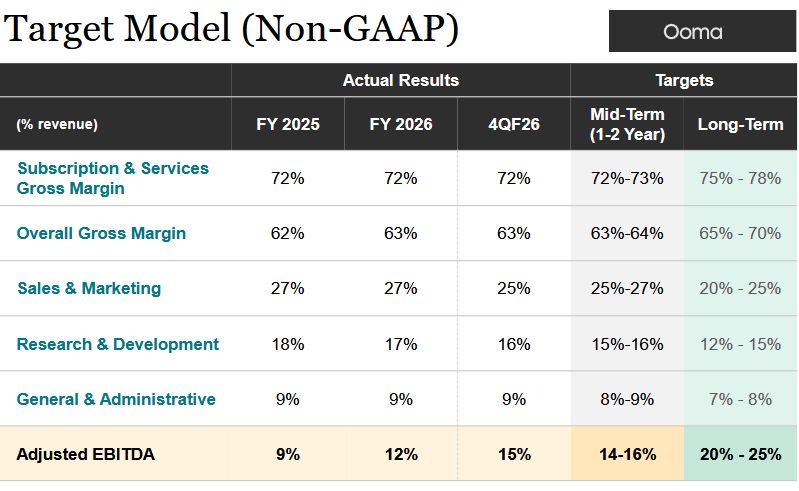
Source: Ooma, Inc. Investor Presentation, March 2026
1
Return of the Ring
Ooma sits within a focused group of publicly traded cloud communications providers that span different stages of scale and execution. Its closest direct comparison is 8×8, which shares a similar SMB-focused UCaaS model and transition toward profitability. Bandwidth offers a complementary benchmark, reflecting the platform and wholesale layer that Ooma is increasingly building through 2600Hz. RingCentral anchors the upper end of the spectrum as a scaled category leader. Together, these peers frame Ooma’s position – a smaller, earlier-stage player bridging toward a more mature, platform-driven communications model.
The past year highlights how strongly market returns in this group have been driven by shifting expectations and narrative credibility. Ooma’s roughly 18% gain reflects steady execution – consistent earnings beats, improving margins, and growing cash flow – with investors beginning to recognize that progress, even if a broader re-rating has yet to fully materialize. In contrast, RNG surged as profitability and capital returns reframed it as a scaled, cash-generative platform, while BAND benefited from a clearer growth and margin acceleration story that exceeded muted expectations. At the other end, EGHT lagged as doubts around growth durability and competitive positioning persisted. The pattern is clear: the market is rewarding visible inflection points – and Ooma is increasingly moving in that direction.
Ooma’s valuation sits at a premium to most peers across key metrics, but that premium is not arbitrary. Compared with EGHT and BAND in particular, OOMA combines stronger growth, positive earnings, and expanding margins, while those peers still face profitability gaps or weaker momentum. Its revenue growth, EBITDA expansion, and forward earnings trajectory all trend ahead of the group, supporting higher EV/Sales and EV/EBITDA multiples. That said, the premium is not yet stretched relative to RNG, which still commands higher valuation levels. At the same time, Ooma’s forward PEG of roughly 0.35x remains low in absolute terms, pointing to a growth profile that is not fully priced in and aligning the stock more closely with a GARP-type (growth at a reasonable price) setup. The key question is durability – whether Ooma can sustain its current growth and margin trajectory organically. If execution continues at the current pace, the setup supports further multiple expansion rather than contraction, with the stock still early in its re-rating cycle. Analysts appear constructive on the stock’s outlook, rating it a “Strong Buy” and forecasting nearly 32% upside from current levels.
Another factor supporting the stock’s upside potential is that Ooma’s improving EBITDA and strong cash generation allow it to fund share buybacks while simultaneously investing in growth and repaying debt. The company maintains an ongoing share repurchase program, which was expanded to $24 million in December 2024 (fiscal Q3 2025). Ooma has been actively utilizing the program, spending $11.6 million on open-market repurchases during fiscal 2026 (alongside approximately $5.2 million in net share settlements related to RSU vesting). Over the past three fiscal years, the company has repurchased approximately $20.6 million worth of stock on the open market, reducing the public float by roughly 7%, reinforcing per-share value as operating performance continues to improve.

1
To Sum It All Up
Ooma is positioning itself at the intersection of a long-overdue infrastructure shift and the steady migration toward cloud-based communications. As legacy telephony systems are phased out and businesses look for flexible, software-driven alternatives, the company is building a platform that spans small businesses, enterprise deployments, and wholesale communications layers. Its combination of recurring revenue, expanding feature set, and targeted acquisitions reflects a strategy focused on deepening customer relationships while widening its addressable market. The opportunity is not explosive, but it is durable – driven by necessity rather than hype. As execution continues, margins expand, and the platform scales, Ooma is increasingly aligning itself with the characteristics that the market rewards. If that trajectory holds, the gap between current positioning and future perception could continue to narrow.
1
1
Smart Growth Portfolio
|
1
Disclaimer
The information contained in this article represents the views and opinions of the writer only, and not the views or opinions of TipRanks or its affiliates and should be considered for informational purposes only. TipRanks makes no warranties about the completeness, accuracy, or reliability of such information. Nothing in this article should be taken as a recommendation or solicitation to purchase or sell securities. Nothing in the article constitutes legal, professional, investment and/or financial advice and/or takes into account the specific needs and/or requirements of an individual, nor does any information in the article constitute a comprehensive or complete statement of the matters or subject discussed therein. TipRanks and its affiliates disclaim all liability or responsibility with respect to the content of the article, and any action taken upon the information in the article is at your own and sole risk. The link to this article does not constitute an endorsement or recommendation by TipRanks or its affiliates. Past performance is not indicative of future results, prices, or performance.
