TipRanks Smart Growth Portfolio #62: The Purity Layer

Dear Investors,
Welcome to the 62nd edition of the Smart Growth Portfolio and Newsletter, where we spotlight a company helping build the clean rooms behind the AI boom. But first, some news and updates.
1
1
Portfolio Changes
❖ We are closing our position in Aviat Networks (AVNW) following a disappointing fiscal Q3 report that, in our view, failed to restore confidence after the April short-seller allegations. While some concerns raised in the report may ultimately prove overstated, the company did not deliver the kind of operational execution or investor communication needed to decisively move the discussion forward.
The quarter itself was weak. Revenue fell 11% year-over-year, gross margin declined sharply to 29.3% from 34.9% a year earlier, and adjusted EBITDA dropped from $14.9 million to $4.4 million. Management also lowered full-year guidance materially, with fiscal 2026 now expected to look broadly similar to fiscal 2025 from a revenue and profitability standpoint. That is not the profile we want from a Growth portfolio holding.
To management’s credit, there were some encouraging balance-sheet developments. Unbilled receivables declined for a second consecutive quarter, inventories improved, and accounts payable were reduced substantially. These are meaningful positives given the concerns raised earlier this year around working capital and revenue quality.
However, the bigger issue now is credibility and narrative direction. Following a short report that questioned revenue recognition, controls, and balance-sheet dynamics, investors were looking for sharper explanations, more direct engagement, and clearer evidence that the underlying business remains as strong as previously believed. Instead, the call leaned heavily on future opportunities such as MDU deployments, utility demand tied to AI-related power infrastructure, and the eventual BEAD broadband rollout.
Those opportunities may very well materialize. But at this stage, the market appears increasingly unwilling to underwrite future growth narratives while current execution remains uneven and key concerns remain unresolved. Analyst reactions also reflected growing caution, with Northland downgrading AVNW from Buy to Hold and cutting its price target to $20 from $30, following price-target reductions by Citizens JMP, Roth MKM, and Lake Street.
We believe investor communication has become part of the problem. The company’s messaging felt overly optimistic relative to the seriousness of the situation, with repeated references to “timing” issues and future growth vectors instead of directly addressing the confidence gap that now surrounds the stock.
AVNW may still recover operationally over time, and the stock could remain volatile in both directions given its small-cap profile. However, the strong rally over the past couple of days appears to reflect the resurgence of broad optimism throughout the market, not restored investor confidence in the company specifically. We believe that the debate around what valuation Aviat deserves is only beginning, and will likely result in a lower multiple than the stock previously commanded. As such, we no longer believe it cleanly fits the mandate of a Growth portfolio.
1
1
Under Review
❖ We are keeping Telos Corporation (TLS) under review, as the stock appears to be moving out of sync with the company’s fundamentals.
Fundamentally, the story remains broadly intact, though this week brought a mix of incremental positives as well as some new uncertainties. Telos continues to expand its TSA PreCheck enrollment footprint, but more notably, the company now expects first-quarter revenue and adjusted EBITDA to come in above the high end of prior guidance, while reaffirming its full-year outlook. This is a clear signal that underlying demand and execution are tracking better than expected in the near term, even if the market has yet to fully reflect it.
At the same time, the announcement that CEO John Wood has taken a medical leave of absence, with no clear timeline for return, introduces a new overhang. While interim leadership has been put in place and the company does not expect operational disruption, the situation adds uncertainty at a time when the story is still in a “prove it” phase.
The broader backdrop still points to improving execution, with growth anchored in durable government programs and incremental upside from newer offerings like Xacta AI. However, visibility remains largely tied to existing contracts, while clear evidence of accelerating new business momentum has yet to emerge.
With limited visibility on leadership stability and no major updates on new contract wins, we see little reason to shift our stance at this stage. We would want to see more consistent execution, clearer new business momentum, and signs that profitability is stabilizing before turning more constructive. As such, we are maintaining the Under Review status and will reassess around the upcoming earnings release on May 11, which should provide a more definitive update on both growth visibility and margin trajectory.
1
1
Portfolio News
❖ Clear Secure (YOU) delivered another strong quarter, with Q1 2026 results comfortably ahead of expectations. Revenue rose nearly 20% year-over-year to $253 million, above analyst estimates of $244.4 million, while adjusted EPS of $0.38 topped consensus expectations of $0.31. Total bookings increased 40.8% year-over-year to a record $291.7 million, while adjusted EBITDA climbed 54% to $80.6 million, with adjusted EBITDA margin expanding 720 bps year-over-year to 31.9%.
Profitability and cash generation were especially impressive. Operating cash flow nearly doubled year-over-year to $190.4 million, while free cash flow more than doubled year-over-year to $185.5 million. Deferred revenue rose to $554.9 million, reflecting continued subscription and prepayment growth, while cash and marketable securities reached approximately $800 million.
The company continued to show strong member and platform growth. Total CLEAR Members rose 31.3% year-over-year to 41 million, while Active CLEAR+ Members increased 13% to 8.2 million. Management attributed the momentum to continued improvements in member experience, higher retention, eGate rollout expansion, and rising adoption of CLEAR Concierge, the company’s premium airport service now available at 32 airports.
CLEAR1 also appears to be emerging as a meaningful second growth engine. Management said CLEAR1 bookings increased approximately fivefold year-over-year during the quarter, driven by record enterprise contract activity and growing demand for identity verification solutions across healthcare, workforce, consumer, and government verticals. The company also pointed to rising AI-driven fraud risks and digital identity security needs as key long-term tailwinds.
Guidance was another highlight. CLEAR expects Q2 revenue of $268-271 million and total bookings of $280-285 million, implying year-over-year growth of about 22.8% and 26.7%, respectively, at the midpoint. The company also raised full-year 2026 free cash flow guidance from a minimum of $440 million to at least $465 million, implying 35.5%+ year-over-year growth.
1
❖ MKS (MKSI) delivered a blowout Q1 earnings beat and guided well above expectations, as accelerating AI-related demand continued to drive broad-based growth across its semiconductor and electronics businesses. Revenue rose 15% year-over-year to $1.08 billion, above consensus expectations of roughly $1.05 billion, while non-GAAP EPS climbed 35% year-over-year to $2.30, surging past estimates near $2.05. Adjusted EBITDA increased 17% year-over-year to $277 million, while adjusted EBITDA margin expanded to 25.7%.
Growth was broad-based across all three business segments. Semiconductor revenue increased 13% year-over-year to $466 million, driven by strong demand across DRAM, NAND, and foundry/logic applications. Electronics & Packaging revenue surged 27% year-over-year to $321 million, supported by AI-related advanced PCB manufacturing, chemistry equipment demand, and laser drilling systems tied to high-end smartphones and wearables. Specialty Industrial revenue rose 8% year-over-year to $291 million, benefiting from datacom and defense demand.
Management repeatedly emphasized accelerating AI infrastructure investment as a key growth catalyst. The company highlighted especially strong bookings activity in remote plasma, microwave, dissolved gas, chemistry equipment, and advanced PCB applications, while noting that rising complexity and layer counts in AI-related manufacturing are increasing demand for MKS’ products.
Guidance was another major highlight. MKS expects Q2 revenue of approximately $1.2 billion and non-GAAP EPS of about $2.90 at the midpoint, implying year-over-year growth of roughly 28% and 46%, respectively. Adjusted EBITDA guidance of approximately $328 million implies growth of nearly 39% year-over-year.
The strong quarter and upbeat outlook triggered a wave of analyst price-target increases following the report, as Wall Street pointed to accelerating AI infrastructure demand, improving visibility, and strong bookings momentum across the company’s core end markets.
1
❖ ACM Research (ACMR) delivered a stellar Q1 report, beating both Street expectations and even its own preliminary results issued less than two weeks ago. Revenue jumped 34.2% year-over-year to $231.3 million, above ACM’s April 27 preannouncement range of $225-230 million, while total shipments climbed 53.6% year-over-year to $240.7 million, also ahead of the company’s forecast. Adjusted EPS of $0.34 flew past analyst consensus of roughly $0.26 per share.
Growth was driven by accelerating demand in electroplating, advanced packaging, and other AI-related semiconductor applications. Revenue from ECP, furnace, and other technologies surged 205% year-over-year to $84.2 million, while advanced packaging revenue climbed 62% year-over-year. Management repeatedly pointed to growing demand tied to HBM memory, 2.5D and 3D packaging, AI infrastructure, and increasingly complex semiconductor manufacturing requirements.
While the core cleaning segment revenue declined 6% year-over-year, management framed the weakness as temporary, tied largely to qualification timing and customer transitions toward ACM’s newer single-wafer SPM cleaning systems. The company expects a significant production ramp later this year, with 15-20 SPM systems expected to be delivered by year-end. Management also emphasized that shipments in the cleaning category still rose 32%, pointing to underlying demand strength.
Operationally, ACM remained highly profitable while continuing to invest aggressively in expansion. Gross margin remained strong at 46.5%, operating income increased 40% year-over-year, and the company ended the quarter with $1.25 billion in cash, restricted cash, and time deposits.
Importantly, management maintained its full-year 2026 revenue guidance of $1.08-1.175 billion, implying roughly 25% year-over-year growth at the midpoint. The company’s tone remained notably disciplined despite the strong quarter, with management repeatedly highlighting trade-policy uncertainty, customer spending variability, and qualification timing risks alongside the accelerating momentum in AI and advanced packaging demand.
1
❖ Atlanticus Holdings (ATLC) delivered an exceptional quarter, with Q1 diluted EPS rising nearly 50% year-over-year to $2.23 – surging past the consensus of $1.69 – while return on average equity reached a robust 26.8%. Total operating revenue and other income nearly doubled year-over-year to $680 million, driven largely by the Mercury Financial acquisition completed two quarters ago.
While revenue came in slightly below Street expectations, investors appeared unconcerned given the strength of the underlying business trends. Management emphasized that the Mercury integration continues to run ahead of plan across multiple dimensions, including faster-than-expected repricing execution, stronger consumer retention and adoption, and earlier realization of operational synergies. The company reaffirmed confidence in its previously issued 2026 and 2027 financial targets.
Importantly, legacy growth also remained strong. Excluding Mercury, managed receivables increased nearly 35% year-over-year, supported by broad-based growth across both private-label and general-purpose credit products, increased customer acquisition, and market share gains with retail partners. ATLC also reported continued competitive strength within the near-prime consumer lending market, including portfolio acquisitions from competitors and expanding relationships with existing merchants.
Credit performance was another key focus. Management said payment rates, delinquency trends, first-pay defaults, and overall consumer behavior remained stable, with no material deterioration observed across the portfolio despite ongoing macro uncertainty and higher gas prices. The company also pointed to stronger-than-expected performance from newer customer cohorts and favorable assumption updates tied to improving portfolio seasoning.
Atlanticus ended the quarter with approximately $650 million in unrestricted cash and total assets of $7.5 billion. Looking ahead, management reiterated its expectation to continue delivering earnings growth and returns on equity at or above 20%, while emphasizing disciplined growth and ongoing optimization of the Mercury portfolio.
1
❖ Arlo Technologies (ARLO) delivered a standout Q1 2026, reinforcing our long-term thesis behind the stock. The report revealed accelerating subscription growth, expanding margins, and improving profitability, suggesting that Arlo’s transition toward a higher-quality recurring-revenue model remains firmly on track. The stock surged in pre-market trading following the release, with some short covering likely contributing given the somewhat elevated short interest coming into earnings.
Revenue rose 26% year-over-year to a record $150.4 million, while subscriptions and services revenue climbed nearly 31% to a record $90.1 million and accounted for roughly 60% of total revenue. Annual recurring revenue (ARR) increased 29% year-over-year to $357 million, supported by strong subscriber additions and continued ARPU expansion driven by AI-enabled premium service plans.
Subscriber metrics remained exceptionally strong. Arlo added 318,000 paid accounts during the quarter, far above its own target range, bringing total paid accounts above 6 million earlier than expected. Meanwhile, customer retention remained among the best in subscription services, with monthly churn below 1%.
Importantly, growth was not limited to subscriptions alone. Product revenue increased 20% year-over-year, benefiting from strong partner demand and improving retail execution. Management highlighted especially strong momentum with strategic partners including Verisure, while commercial launches with ADT and Samsung now appear close to rollout. Comcast integration efforts also remain on track, with management expecting a material contribution beginning in 2027.
Profitability continued to scale rapidly. Non-GAAP gross margin reached a record 50.1%, expanding 460 basis points year-over-year despite a 430-basis-point tariff headwind. Adjusted EBITDA surged more than 85% year-over-year to $30.4 million, while non-GAAP EPS rose to a record $0.28, well above the high end of management’s guidance range. Free cash flow reached $25.4 million.
Management maintained its full-year 2026 outlook and struck an increasingly confident tone around AI-powered services, strategic partnerships, and expansion into adjacent markets following the Aloe Care acquisition, which marks Arlo’s entry into the rapidly growing aging-in-place healthcare market.
1
❖ Innodata (INOD) delivered a perception-changing report in Q1, crushing entrenched negativity around the stock and rewarding our patience during the recent rough patch. The stock is surging pre-market, as investors are rethinking bearish views and short positions are being covered.
Revenue rose 54% year-over-year to $90.1 million, smashing expectations, while adjusted EBITDA nearly doubled to $25 million, with margins and operating leverage far beyond what most investors expected. Adjusted EPS soared 90% to $0.42, vastly exceeding the consensus of $0.13. The company ended the quarter with $117.4 million in cash and no debt.
Just as importantly, the company raised guidance only ten weeks after previously increasing it, while still describing the outlook as prudent because several large opportunities are not yet included in forecasts. INOD now expects FY 2026 revenue growth of at least 40%, compared to prior guidance of 35% or more.
The bigger story, however, may be diversification. For months, skeptics argued that Innodata was overly dependent on one major customer. That argument now looks increasingly outdated. A customer that generated zero revenue a year ago is expected to become the company’s second-largest account this year, while revenue from other Big Tech customers collectively grew 453% year-over-year. Meanwhile, Innodata continues expanding into trust and safety, evaluation infrastructure, enterprise AI, and agent observability.
Still, investors should remain careful not to let expectations become detached from reality. After a report this strong, the market may begin pricing INOD as though hypergrowth and elevated margins are guaranteed indefinitely. That creates risk. If execution slows even modestly, or if large programs ramp more slowly than expected, sentiment could reverse sharply.
At the same time, the bearish case appears materially weaker after this quarter. Much of the prior pessimism centered on customer concentration, scalability concerns, and doubts about margin durability. This report directly challenged all three narratives. If Innodata continues executing at anything close to this level, the stock could continue rallying even after today’s step-up move.
1
1

1
This Week’s Top Growth Pick: Ultra Clean Holdings (UCTT)
Ultra Clean Holdings, Inc. operates deep inside the semiconductor manufacturing ecosystem, supplying the critical subsystems, components, and ultra-high-purity infrastructure used to build advanced chips. The company works across the highly technical layers of wafer fabrication and semiconductor capital equipment, supporting the tools and processes that enable increasingly complex chip production. As AI, cloud computing, advanced memory, and high-performance electronics drive demand for more sophisticated semiconductors, the manufacturing environment behind those chips is becoming more precise, automated, and contamination sensitive. Ultra Clean is positioned within that operational backbone – where engineering complexity, supply-chain reliability, and manufacturing precision converge – helping semiconductor equipment makers scale next-generation production across some of the industry’s most demanding applications.

Source: Ultra Clean Holdings, Inc. Investor Presentation, April 2026
1
Clean Room Boom
Ultra Clean Holdings traces its roots back to 1991, when the company began supplying ultra-high-purity gas and fluid delivery systems to semiconductor manufacturers. Over time, UCTT expanded beyond individual components into complex subsystems, precision manufacturing, contamination control, and wafer-fab support services, gradually embedding itself deeper into the semiconductor production chain. That evolution became increasingly important as chip manufacturing shifted toward more advanced process nodes, where contamination tolerance, engineering precision, and supply-chain reliability became mission-critical.
The past five years have significantly reshaped the company. As chip manufacturers accelerated investment in AI infrastructure, advanced memory, and high-performance computing, UCTT expanded its role from a specialized supplier into a broader manufacturing and process partner for semiconductor equipment makers and chip fabs. The company increased capacity across the U.S., Taiwan, Singapore, and other Asian manufacturing hubs to align itself more closely with leading-edge semiconductor production.
A major strategic priority has been expanding UCTT’s higher-value subsystem capabilities. The company continued investing in integrated gas delivery systems, precision robotics, process modules, and contamination-sensitive assemblies used in advanced wafer fabrication equipment. These capabilities became increasingly relevant as chipmakers pushed toward more complex architectures, including gate-all-around designs, advanced packaging, EUV-driven manufacturing, and high-bandwidth memory production tied to AI workloads.
Strategic acquisitions reinforced that expansion. In 2021, UCTT acquired Ham-Let’s Ultra High Purity division, strengthening its exposure to high-purity fluid delivery components and expanding its portfolio of valves, fittings, and flow-control technologies. The deal also broadened the company’s manufacturing and engineering footprint across critical semiconductor supply-chain infrastructure. In 2023, UCTT acquired HIS Innovations Group, adding expertise in precision welding, complex metal fabrication, and advanced manufacturing capabilities used in semiconductor capital equipment. Together, these acquisitions deepened UCTT’s ability to support increasingly sophisticated subsystem requirements across advanced chip production.
UCTT also broadened its services business, which focuses on ultra-high-purity cleaning, coatings, and micro-contamination analysis for semiconductor fabs. As process geometries shrank and yield sensitivity increased, cleaning and contamination control became more technically demanding and operationally critical. This shift strengthened the strategic importance of UCTT’s recurring service operations inside customer fabrication environments.
At the same time, the company strengthened relationships with major semiconductor equipment manufacturers and leading chipmakers operating across AI, memory, and advanced logic markets. Combined with ongoing investments in automation, regional manufacturing expansion, and advanced contamination-control technologies, those moves positioned Ultra Clean as a more deeply integrated player inside the semiconductor manufacturing ecosystem supporting the next wave of compute-intensive infrastructure.
1
Cleaning Up AI
Ultra Clean operates inside one of the most technically demanding layers of the semiconductor industry: the infrastructure surrounding wafer fabrication. The company does not manufacture chips, nor the lithography machines that produce them. Instead, it supplies the precision subsystems, ultra-high-purity gas and fluid delivery systems, contamination-control infrastructure, and manufacturing services that allow advanced semiconductor equipment to function reliably at increasingly complex process nodes.
That positioning places UCTT deep inside the “picks-and-shovels” side of the AI infrastructure buildout. Its largest customers are major wafer-fab equipment manufacturers such as Lam Research and Applied Materials, whose tools are used across advanced foundry, memory, and packaging facilities worldwide. Once qualified inside semiconductor production flows, suppliers tend to remain deeply embedded due to the cost, complexity, and risk of replacing contamination-sensitive systems inside advanced fabs. That creates unusually sticky customer relationships and high technical barriers to entry.
The opportunity set has expanded sharply alongside the AI-driven semiconductor spending cycle. Generative AI, hyperscale data centers, high-bandwidth memory, and advanced packaging are driving a new wave of fab construction and equipment intensity. At the same time, chip architectures are becoming far more complex – including gate-all-around designs, hybrid bonding, backside power delivery, and increasingly dense NAND and HBM stacks. Those transitions require more process steps, harsher chemistries, tighter contamination tolerances, and more sophisticated gas-delivery and subsystem infrastructure, directly increasing the importance of UCTT’s products and services.
That complexity is particularly beneficial for UCTT because it participates across multiple layers of the manufacturing process. Its Products division supplies integrated subsystems and precision assemblies used inside semiconductor capital equipment, while its Services segment provides ultra-high-purity cleaning, coatings, recycling, and contamination-analysis services tied to wafer starts and fab utilization. The services business carries materially higher margins and creates recurring exposure to semiconductor production volumes beyond initial tool shipments.
Growth is increasingly tied to execution speed. Through its “UCT 3.0” strategy, the company is positioning itself as a manufacturing and engineering partner capable of helping customers accelerate new product introductions and production ramps during the current AI infrastructure cycle. Management has focused heavily on “ramp readiness,” regional manufacturing alignment, automation, and digital transformation to shorten lead times and improve scalability. Importantly, UCTT’s existing footprint already supports roughly $3 billion in annual revenue capacity, versus a current run-rate closer to the low-$2 billion range, while management believes expansion toward roughly $4 billion is achievable with relatively modest incremental capital investment.
The broader semiconductor backdrop remains favorable. Industry forecasts for wafer-fab equipment spending continue moving higher as memory makers, foundries, and advanced-packaging providers expand AI-related capacity across the U.S., Taiwan, Korea, Singapore, and Japan. UCTT’s addressable market spans tens of billions of dollars across semiconductor subsystems, precision manufacturing, and fab services, while its current market share remains relatively modest. That leaves meaningful room for expansion if the company continues gaining share within existing OEM relationships and broadening its role across increasingly complex semiconductor production flows.
The risks are real. Customer concentration remains high, semiconductor demand cycles can shift quickly, and rapid scaling creates execution pressure across inventory, supply chains, and margins. Still, UCTT appears increasingly aligned with a structural industry transition instead of a short-lived cyclical rebound. As AI pushes semiconductor manufacturing toward higher complexity, tighter tolerances, and larger global fab footprints, the infrastructure layer supporting that ecosystem is becoming more valuable – and UCTT is positioning itself directly inside that expansion.
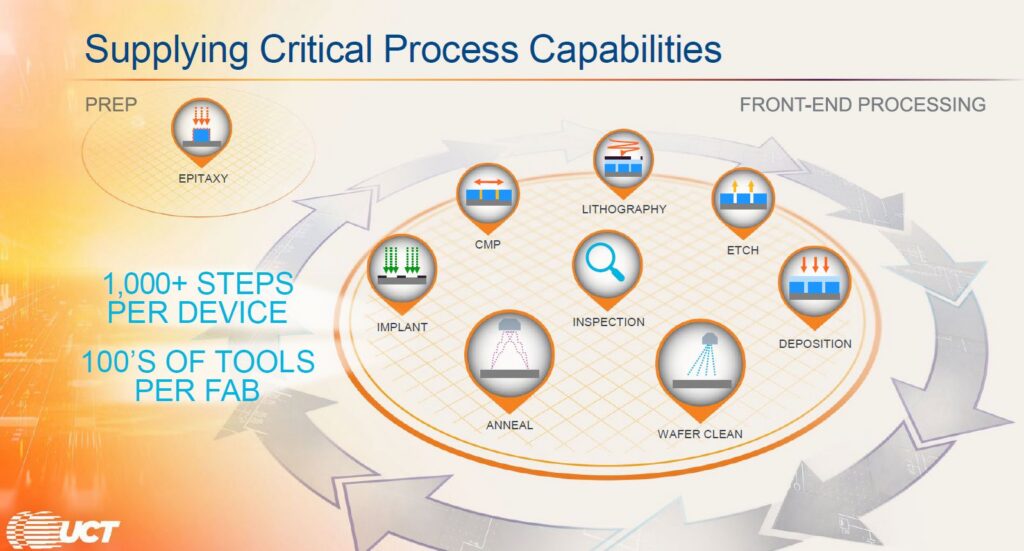
Source: Ultra Clean Holdings, Inc. Investor Presentation, April 2026
1
Dust to Dollars
Ultra Clean’s financial profile is beginning to reflect the shift unfolding across the semiconductor industry itself – moving from cyclical stabilization into a higher-intensity AI infrastructure expansion. After several uneven quarters tied to inventory digestion and softer wafer-fab spending, the company entered 2026 with visibly improving momentum across revenue, margins, and earnings power.
First-quarter revenue reached $533.7 million, up sequentially from $506.6 million in Q4 and above both management’s guidance midpoint and analyst expectations near $525 million. Non-GAAP EPS came in at $0.31, also ahead of consensus around $0.27, extending a strong execution pattern: UCTT has now surpassed adjusted EPS estimates in eight of the past ten quarters and delivered four consecutive revenue beats. Importantly, the improvement was not driven by a single customer or temporary project spike. Product revenue climbed to $465.7 million while Services revenue rose to $68.0 million, reflecting broader momentum across advanced semiconductor manufacturing programs.
Margins are beginning to move in the right direction as utilization improves. Gross margin expanded to 16.5% from 16.1% in Q4, supported by higher factory loading, stronger mix, and operational efficiencies. The Services segment continues to stand out structurally, generating approximately 30% gross margin versus mid-teens margins in Products. Operating margin improved to 5.1%, while non-GAAP net income climbed to $14.5 million. GAAP profitability remains more volatile due to tax items, amortization, and cycle sensitivity, but underlying profitability trends are clearly improving as AI-related demand ramps.
The bigger story may be operating leverage. UCTT’s current annualized revenue run-rate remains well below the roughly $3 billion capacity already supported by its existing global footprint, leaving substantial room for margin expansion as volumes scale. Management believes the company can support roughly $4 billion in annual revenue with relatively modest additional capital investment – a potentially powerful setup if wafer-fab equipment demand continues climbing into 2027.
Guidance reinforces that acceleration narrative. UCTT expects Q2 revenue between $565-605 million and non-GAAP EPS of $0.44-0.60, both materially ahead of Wall Street expectations entering the quarter. At the midpoint, the revenue outlook implies roughly 10% sequential growth and approximately 28% year-over-year growth, with management expecting gross margins to continue improving through the second half of 2026 as AI-driven fab utilization ramps further.
Cash generation remains the primary near-term watchpoint. Operating cash flow was negative $33.3 million in Q1 as inventory expanded sharply to support anticipated customer ramps. That inventory build pushed free cash flow lower and temporarily pressured working capital. However, the buildup appears more tied to preparation for expected demand acceleration than to weakening end markets. UCTT still ended the quarter with a healthy $323.5 million cash position.
At the same time, the balance sheet improved meaningfully. The company issued $600 million in zero-coupon convertible notes, repaid its Term Loan B, refinanced and expanded its revolving credit facility, and reduced its expected weighted-average borrowing cost from roughly 6.2% to approximately 1.4%. That financing reset materially lowers future interest expense and increases flexibility entering what management believes is a multi-year semiconductor infrastructure expansion.
Risks remain. Customer concentration is high, margins can fluctuate with mix and factory loading, and aggressive inventory builds raise execution pressure if AI-related capex slows unexpectedly. But with revenue growth reaccelerating, margins improving, financing costs collapsing, and existing manufacturing capacity still underutilized, UCTT increasingly looks like a company entering the stronger phase of its cycle rather than peaking at the top of one.

Source: Ultra Clean Holdings, Inc. Investor Presentation, April 2026
1
Clean Yield
Ultra Clean sits alongside a group of semiconductor infrastructure suppliers positioned beneath the AI hardware boom – companies enabling advanced chip manufacturing through precision subsystems, process infrastructure, and highly specialized manufacturing capabilities. Ichor represents the closest direct comparison, sharing UCTT’s exposure to gas and fluid delivery systems inside wafer-fab equipment and a similar dependence on major OEM customers like Lam Research and Applied Materials. MKS Inc., a Smart Growth Portfolio holding, provides a broader benchmark for semiconductor process infrastructure and contamination-sensitive manufacturing, while Advanced Energy reflects the higher-value subsystem layer tied to advanced-node complexity and AI-driven equipment intensity. FormFactor adds a useful comparison around AI, HBM, and advanced packaging exposure, highlighting how increasing semiconductor complexity is benefiting the broader ecosystem of precision manufacturing suppliers embedded deep inside the semiconductor production chain.
All stocks in this cohort performed exceptionally well over the past year, with triple-digit gains driven by the accelerating AI infrastructure buildout, rising wafer-fab equipment spending, and growing investor recognition that increasingly complex semiconductor manufacturing requires far more precision infrastructure, subsystem content, and process intensity than previous chip cycles. The key question is now how much upside remains as the AI-driven semiconductor expansion continues to unfold – at least based on current assumptions and before accounting for the possibility of further upward re-ratings, which remain very plausible for several names in the group. On that front, UCTT stands out.
Despite the stock’s massive run, analysts still see more than 30% upside on average for the Strong Buy-rated name, suggesting investors may still view the company as earlier in its AI infrastructure expansion story than some of its peers. Moreover, UCTT’s potential upside appears to be a moving target: a few days ago, UBS initiated coverage with a Buy rating and a Street-high price target of $130, – implying an upside of nearly 63% from current levels – saying that Ultra Clean is a direct beneficiary of an AI-fueled wafer fab equipment supercycle it expects to persist for several years.
This additional upside is supported by a valuation profile that appears relatively moderate for a company positioned inside one of the strongest infrastructure buildouts in technology. UCTT trades at roughly 1.7x forward EV/Sales and under 20x forward EV/EBITDA – materially below peers such as MKS Inc., Advanced Energy, and FormFactor despite comparable or, in some cases, stronger forward EPS growth expectations. Forward non-GAAP EPS growth is projected above 100%, while the stock still trades at a forward PEG ratio near 1.1, suggesting valuation has not fully caught up with the company’s earnings acceleration potential. The discount partly reflects UCTT’s lower current margins and higher customer concentration, but those are also areas where operating leverage could materially improve if AI-driven wafer-fab spending continues ramping. In that sense, the stock still appears valued more like a cyclical supplier than a company increasingly leveraged to a multi-year semiconductor infrastructure expansion.

1
To Sum It All Up
Ultra Clean operates inside one of the most important bottlenecks in the AI hardware expansion – the increasingly complex process of manufacturing advanced semiconductors at scale. As chip architectures become more demanding and wafer-fab intensity rises, contamination control, precision subsystems, and high-purity manufacturing are becoming more critical across the semiconductor production chain. UCTT is positioned directly inside that infrastructure layer, supplying the systems and manufacturing capabilities that help leading equipment makers support next-generation fabs. The company remains cyclical and execution-sensitive, but it is also entering this phase with expanding capacity, improving operating leverage, and deeper exposure to AI-driven wafer-fab investment. As semiconductor manufacturing complexity continues increasing, the need for specialized suppliers embedded deep within the production ecosystem should grow alongside it. If UCTT continues executing through the current ramp, it could evolve from a cyclical supplier into a more strategic semiconductor infrastructure player.
1
1
Smart Growth Portfolio
|
1
Disclaimer
The information contained in this article represents the views and opinions of the writer only, and not the views or opinions of TipRanks or its affiliates and should be considered for informational purposes only. TipRanks makes no warranties about the completeness, accuracy, or reliability of such information. Nothing in this article should be taken as a recommendation or solicitation to purchase or sell securities. Nothing in the article constitutes legal, professional, investment and/or financial advice and/or takes into account the specific needs and/or requirements of an individual, nor does any information in the article constitute a comprehensive or complete statement of the matters or subject discussed therein. TipRanks and its affiliates disclaim all liability or responsibility with respect to the content of the article, and any action taken upon the information in the article is at your own and sole risk. The link to this article does not constitute an endorsement or recommendation by TipRanks or its affiliates. Past performance is not indicative of future results, prices, or performance.
