TipRanks Smart Growth Portfolio #64: Needle Mover

Dear Investors,
In this edition of the Smart Growth Portfolio and Newsletter, we spotlight a fintech growth story fueled by patient affordability. But first, some news and updates.
1
Portfolio News
❖ Applied Digital (APLD) announced that it has entered into a 15-year lease agreement with a U.S.-based high investment-grade hyperscaler for its Polaris Forge 3 campus. The new campus spans over 600 acres and is purpose-built for high-density AI workloads, incorporating APLD’s proprietary waterless cooling technology, high-density power delivery systems, and advanced liquid-cooling architecture to meet the demands of next-generation AI infrastructure. Initial operations at Polaris Forge 3 are expected to begin in August 2027.
This is the second deal with the same undisclosed hyperscaler, following a prior deal at the Delta Forge 1 campus. The new lease covers 300 MW of critical IT load for large-scale AI training and inference workloads, and is valued at approximately $7.5 billion in base contracted revenue, which could expand to $18.2 billion if all options are exercised. With this addition, Applied’s total contracted lease revenue across its four AI Factory campuses stands at $31 billion, or $73 billion if all renewal options are exercised.
Roughly 65% of APLD’s contracted revenue is signed up by U.S. investment-grade hyperscalers. With the new deal, the company’s total portfolio has reached 1.2 GW of contracted load capacity and about 1.7 GW of grid-connected utility power across both newly added and existing sites.
❖ Ambarella (AMBA) is scheduled to report its fiscal Q1 2027 results on May 28. AMBA has beaten top- and bottom-line consensus estimates in each of the last eight consecutive quarters, making its outperformance streak a key point of focus heading into this report. Meanwhile, the AI vision chipmaker is drawing institutional interest, with several funds and investment firms reporting substantial increase to their stakes.
1
1

1
This Week’s Top Growth Pick: PaySign (PAYS)
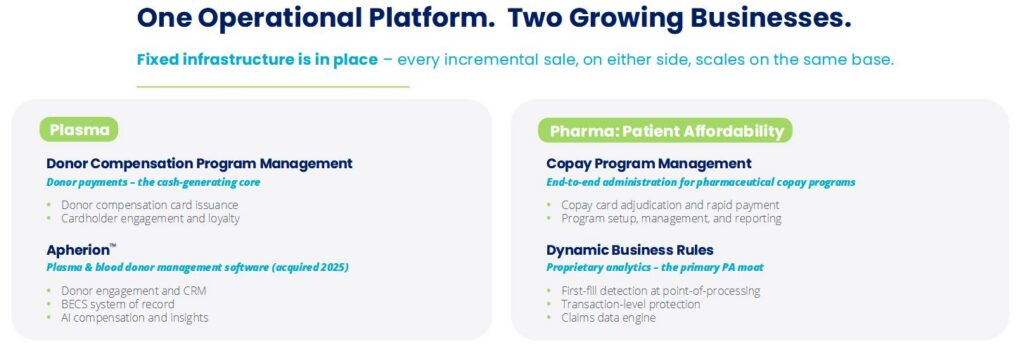
PaySign, Inc. operates in one of the less glamorous but fastest-growing corners of healthcare fintech, powering payments in highly regulated life sciences environments that remain fragmented and operationally complex. The company built its foundation in plasma donation networks with prepaid donor compensation cards, but it is now rapidly expanding into pharmaceutical patient affordability and copay assistance programs, which recently became its largest revenue segment. Its platform helps pharmaceutical manufacturers, plasma operators, and healthcare providers manage disbursements, patient support, and engagement through specialized, compliant financial infrastructure tailored for healthcare workflows. As healthcare digitizes and the need for better patient access grows, PaySign is positioning itself as embedded infrastructure within recurring life sciences activity, combining fintech-style scalability with long-term healthcare growth tailwinds.
Source: PaySign Investor Deck, May 2026
1
Scripts and Swipes
PaySign traces its roots to prepaid debit card programs, but its modern identity was forged by a strategic focus on healthcare and life sciences payments. The company first established a strong position in the plasma donation industry, powering donor compensation programs for collection centers and gaining deep compliance expertise, recurring transaction volume, and broad operational relationships across the plasma ecosystem.
A transformative shift began around 2020-2021, as management aggressively expanded into pharmaceutical patient affordability and copay assistance programs. These solutions help patients access high-cost medications while enabling drug manufacturers to navigate complex insurance and reimbursement dynamics. PAYS invested in specialized software infrastructure, claims processing capabilities, program management tools, and compliance systems tailored for pharma.
This strategy accelerated quickly over the past few years. PaySign launched dozens of new programs, deepened relationships with major pharmaceutical manufacturers, and developed proprietary technology – most notably its “Dynamic Business Rules” engine – to help protect patient assistance funds from copay maximizers. This capability has become a key differentiator as pharmaceutical manufacturers look for more adaptive affordability infrastructure.
At the same time, PAYS continued expanding its plasma business through new center wins and platform upgrades, steadily growing its U.S. market share. The evolution accelerated in March 2025 with the acquisition of Gamma Innovation, adding donor engagement, resource management, and operational software solutions that broadened PaySign’s offering beyond payments into integrated workflow tools.
Over the past five years, PaySign has successfully evolved from a niche prepaid card processor into a broader healthcare fintech platform serving recurring life sciences payments, patient affordability, and specialized operational ecosystems.
1
Plassing Up
PaySign operates at the intersection of healthcare payments, reimbursement infrastructure, and operational workflow management. At its core, the company monetizes recurring financial activity tied to two highly specialized healthcare ecosystems: plasma donation networks and pharmaceutical patient affordability programs. In practice, PAYS manages and processes payments, claims workflows, reimbursement logic, and engagement systems that help plasma operators and drug manufacturers manage highly regulated financial workflows more efficiently.
The plasma business remains the company’s operational foundation. PaySign powers donor compensation programs for 573 plasma collection centers across the U.S., giving it a roughly 45% share of the domestic plasma-center market. Every donation drives recurring transaction revenue and creates operational stickiness, as plasma centers rely heavily on reliable, seamless donor payments for retention and collection volume.
That installed base is increasingly becoming the launchpad for broader workflow and operational offerings. The acquisition of Gamma Innovation expanded PAYS beyond payments into donor engagement tools, CRM systems, operational workflow software, and resource-management platforms for plasma operators. PaySign is integrating these systems with plasmapheresis hardware and advancing an FDA-reviewed donor-management platform (BECS), which could further deepen customer retention and monetization over time.
The larger growth story now centers on pharmaceutical patient affordability programs. This business has rapidly evolved into PaySign’s primary growth engine, surpassing plasma as the company’s largest revenue contributor in Q1 2026. The platform helps pharmaceutical manufacturers manage copay assistance, claims adjudication, reimbursement workflows, and patient-support programs – especially for high-cost specialty drugs. The opportunity set is significant: rising drug prices, complex insurance structures, and aggressive PBM accumulator/maximizer tactics continue to drive demand for sophisticated affordability infrastructure.
PAYS’ key differentiator is its proprietary Dynamic Business Rules engine, which adapts reimbursement logic in real time and has protected more than $325 million in copay assistance dollars in 2025 alone, while continuing to scale rapidly in 2026. The company currently works with 6 of the top 10 U.S. pharmaceutical manufacturers and exited Q1 2026 with 135 active programs, on track for 147-150 by end of Q2. Management still views the business as being in the “early innings,” with growth coming from both new wins and deeper penetration of existing relationships.
PaySign is pragmatically integrating AI and LLM-driven tools into its operations, primarily to enhance claims intelligence, maximizer detection, Dynamic Business Rules effectiveness, and operational efficiency. Given the highly regulated nature of the workflows – requiring compliance, auditability, payer integration, and operational trust – AI is more likely to strengthen PAYS’ moat than to disrupt its business model.
Risks remain material, particularly around customer concentration, regulatory or reimbursement policy changes, plasma market cyclicality, and potential competition. Nevertheless, PaySign is increasingly well-aligned with structural shifts toward digitized, patient-centric affordability solutions in a fragmented and complex healthcare payments landscape.

Source: PaySign Investor Deck, May 2026
1
Copay Day
PaySign’s latest numbers reflect a small-cap growth story crossing into self-funded scale. Q1 2026 revenue rose 50.8% year-over-year to $28.0 million, beating the company’s $27.0-27.5 million guidance and marking its eighth straight revenue beat. That was not just top-line performance: net income more than doubled to $5.4 million, diluted EPS reached $0.09 – up 80% year-over-year and well above consensus – while adjusted EBITDA surged 113.4% to $10.6 million.
The mix shift drives the acceleration. Pharma (i.e., patient affordability) revenue rose 81.9% year-over-year to $15.7 million, overtaking plasma as the largest revenue contributor for the first time. Plasma revenue grew a solid 24.9% to $11.7 million, but its role is now different, serving as the stable, cash-generating base supporting the scaling of the higher-margin growth engine, pharma. This shift lifted gross margin to 65.0% from 62.9% and operating margin to 23.8% from 13.4%. Operating expenses grew only 25.5%, far slower than revenue, demonstrating clear operating leverage.
This builds on a strong 2025, when full-year revenue increased 40.5% to $82.0 million, adjusted EBITDA more than doubled to $19.94 million, gross margin reached 59.4%, and SG&A leverage improved as the business absorbed higher volume without matching cost growth.
Unlike many small-cap growth names, PAYS is not funding the story with balance-sheet risk: the company exited Q1 with $20.5 million in unrestricted cash, roughly $159 million in restricted cash tied mainly to customer deposits and program activity, positive operating cash flow of $18.8 million, and zero bank debt.
Guidance keeps the story forward-looking. Management reiterated 2026 revenue guidance of $106.5-110.5 million, implying 30-35% growth. Full-year adjusted EBITDA is seen at $30-33 million, reflecting year-over-year growth of roughly 58% at the midpoint, while net income guidance of $13-16 million implies more than 90% growth at the midpoint, reinforcing the company’s accelerating profitability profile.
The company also expects pharma and plasma to contribute roughly equal revenue this year, a clear sign that the higher-margin pharma segment is catching up quickly. Management formally left guidance unchanged, but commentary pointed toward growing confidence in the upper half of the range.
Risks include customer concentration, especially in pharma, along with plasma cyclicality and working-capital swings from reimbursement timing. However, the overall financial profile shows fast revenue growth alongside expanding margins, strong cash flow, and GAAP profitability that appears increasingly sustainable.

Source: PaySign Investor Deck, May 2026
1
Claim to Fame
PaySign is best compared to a niche group of healthcare-focused payment and workflow infrastructure companies – businesses that monetize recurring financial flows inside specialized, operationally complex verticals. Usio provides the closest overlap on the prepaid-card and disbursement-processing side, where both companies manage embedded payment programs for enterprise customers. Repay Holdings offers a useful comparison for vertically integrated payment infrastructure and scaling operating leverage across specialized industries. Flywire captures the healthcare-fintech and reimbursement-workflow angle, particularly around embedded payment flows tied to healthcare systems. Meanwhile, OptimizeRx reflects PAYS’ growing exposure to pharmaceutical workflow and patient-affordability infrastructure, where recurring pharma relationships and operational complexity increasingly drive growth and margin expansion.
While the group shares broad similarities in payments and healthcare infrastructure, the stocks have diverged sharply over the past year due to differences in growth quality, margin expansion, and execution credibility. OptimizeRx has collapsed almost 60% as weaker pharma spending, guidance cuts, and execution concerns severely damaged investor confidence. Repay fell over 20% as revenue deceleration and acquisition concerns undermined its higher-growth positioning. Usio ended nearly flat, reflecting steady transaction volume growth but limited margin expansion and few visible catalysts. Flywire’s roughly 40% gain was driven by solid execution, accelerating profitability, and durable growth. PaySign outperformed all peers with a surge of over 75%, as markets rewarded its high-margin mix shift, which produced a combination of rapid revenue growth, accelerating profitability, and sharp margin expansion. That helps explain why analysts still see more than 45% average upside for the Strong Buy-rated PAYS shares.
This additional upside is supported by a valuation profile that appears reasonable for a company delivering accelerating growth alongside rapidly improving profitability. PAYS trades at roughly 3.0x forward EV/Sales and about 10x forward EV/EBITDA despite guiding for 30-35% revenue growth this year alongside EBITDA growth above 60%. While it commands a notable premium over slower or structurally weaker peers such as Usio, Repay, and OptimizeRx, that premium is supported by PAYS’ superior growth, expanding margins, strong balance sheet, and consistent execution. At the same time, the premium over Flywire has compressed to almost nothing, although PaySign continues to outperform it in both historical and expected growth while also delivering stronger margin expansion. That leaves the stock in an unusual position: already rerated higher, yet still supported by fundamentals that continue improving faster than the valuation itself.
PaySign also makes buybacks, though its programs are relatively modest and opportunistic compared to larger fintechs, with less than $600,000 in repurchases in 2025 and none so far this year. However, the company has approved its second repurchase authorization in May 2026, after the previous one expired. The new $5 million program allows flexible execution over 36 months in open market or privately negotiated transactions.
PAYS has a relatively low public float – at about 67% of all shares issued – mainly due to high insider ownership. As a result, if the program is executed in full, it would take over 2.5% off the market. However, at this stage it’s largely a symbolic number reflecting PaySign’s confidence in continued high-margin business expansion and cash generation, as management continues to treat buybacks opportunistically while prioritizing growth investments.

1
To Sum It All Up
PaySign is increasingly positioning itself inside one of the more complex and underpenetrated corners of healthcare finance – where reimbursement workflows, patient affordability, and recurring payment infrastructure intersect. What began primarily as a plasma-payment platform is evolving into a broader healthcare-fintech ecosystem spanning pharmaceutical affordability programs, operational workflow tools, and embedded financial infrastructure. As specialty-drug costs rise and reimbursement systems become more fragmented, the need for adaptive affordability and claims-management solutions continues expanding. PaySign’s growing pharma relationships, improving margins, and proprietary Dynamic Business Rules technology are steadily deepening its role inside those workflows. At the same time, the company’s strong balance sheet and increasingly self-funded growth profile provide flexibility to continue scaling. If execution remains strong, PAYS appears positioned to keep gaining share in a niche where operational complexity itself is becoming a long-term growth driver.
1
1
Smart Growth Portfolio
|
1
Disclaimer
The information contained in this article represents the views and opinions of the writer only, and not the views or opinions of TipRanks or its affiliates and should be considered for informational purposes only. TipRanks makes no warranties about the completeness, accuracy, or reliability of such information. Nothing in this article should be taken as a recommendation or solicitation to purchase or sell securities. Nothing in the article constitutes legal, professional, investment and/or financial advice and/or takes into account the specific needs and/or requirements of an individual, nor does any information in the article constitute a comprehensive or complete statement of the matters or subject discussed therein. TipRanks and its affiliates disclaim all liability or responsibility with respect to the content of the article, and any action taken upon the information in the article is at your own and sole risk. The link to this article does not constitute an endorsement or recommendation by TipRanks or its affiliates. Past performance is not indicative of future results, prices, or performance.
