TipRanks Smart Growth Portfolio #72: Profile Prophets

Dear Investors,
In this edition of the Smart Growth Portfolio and Newsletter, we spotlight a company that sells foresight. But first, some news and updates.
1
Portfolio News
❖ Micron (MU) dropped by more than 8% over the past week, extending its slide from June 25 ATH to nearly 30%. The decline is driven by both sector-wide selloff in semiconductor stocks, and MU-specific aggressive profit-taking after a scorching rally. The broader chip trade is facing growing investor uneasiness over high valuations, and memory stocks are a prime example of soaring metrics. Micron’s memory peers are also dropping in Asian markets, with SK Hynix and Samsung down about 37% and 28%, respectively, from June 25 peaks. Despite the volatility in Micron’s shares, the stock has notched a gain of more than 597% since its purchase for the Smart Growth Portfolio a year ago.
Meanwhile, MU’s operations continue to expand. The memory chipmaker has signed strategic customer agreements (SCAs) with seven Tier 1 automotive technology suppliers, including Qualcomm and Hyundai Mobis. Micron will supply memory and storage components used in ADAS, digital cockpits, connectivity platforms, and other software-driven vehicle features. Although data center demand is expected to remain by far the main growth driver, the automotive deals help broaden MU’s exposure beyond AI spending and provide additional, highly visible revenue streams.
1
Under Review
❖ We are placing Ondas (ONDS) under review. The stock has lost almost 50% since entering the Portfolio, hit by a double whammy of tech-sector jitters and deteriorating investor sentiment following its acquisition spree.
Ondas has recently acquired two companies and plans to add another. The Omnisys and DZYNE buyouts introduce substantial dilution and a growing share overhang, while the pending Cyberhawk purchase adds another business to an already demanding integration workload.
As with many hardware-focused small-cap growth companies, profitability remains a distant target for ONDS, with operating expenses running high. Meanwhile, the company must prove that its expanding collection of assets can turn acquisition-driven headline growth into per-share value. Adding to the pressure on the stock, short interest is above one-third of the float – reflecting investor concerns about execution and future dilution. The next key catalyst – ONDS’ earnings report – remains about a month away.
Still, Ondas is strongly supported by Wall Street: all seven analyst ratings on the stock are Buy. The stock decline drove only one moderate price-target decrease – Needham cut its PT from $23 to $19 – while in parallel, Maxim Group hiked its target from $15.28 to $22. Overall, analysts see a potential upside of over 170% for the stock.
ONDS’ opportunity is massive, underpinning the Growth Investor’s decision to hold onto the stock despite a heavy loss. ONDS is directly exposed to structural demand for autonomous defense systems, with recent federal initiatives – including the Drone Dominance program and the Defense Autonomous Warfare Group (DAWG) – providing strong policy and funding tailwinds.
Against this backdrop, Ondas’ acquisitions appear strategically sensible, expanding the company into high-demand areas. After incorporating DZYNE and Omnisys, Ondas raised its 2026 revenue target by 35% to at least $525 million – and that’s excluding any Cyberhawk contribution.
DZYNE is expected to be EBITDA-positive while adding long-endurance ISR, counter-drone, and autonomous-effects capabilities. Omnisys adds a profitable, high-margin, combat-proven AI software layer that can coordinate mission planning and battlefield resources across Ondas’ expanding systems portfolio. Meanwhile, Cyberhawk – if the deal closes as expected – brings recurring software revenue and critical-infrastructure exposure, further supporting ONDS’ push into higher-margin software systems.
Recent sizable orders and the Lockheed Martin collaboration further strengthen Ondas’ defense credibility and industry standing, while the company’s large and fast-growing backlog provides increasing revenue visibility. Finally, ONDS’ unusually high liquidity for a growth small cap gives it the flexibility to fund acquisitions without taking on debt, supporting its financial strength.
Despite legitimate concerns surrounding these large-scale acquisitions, the central questions are execution and per-share value creation – both of which Ondas must prove. We plan to keep ONDS under review until its next earnings report in mid-August, or until another meaningful catalyst shifts the risk-reward picture in either direction.
1
1

1
This Week’s Top Growth Pick: Klaviyo (KVYO)
Klaviyo, Inc. operates at the layer where consumer brands actually meet their customers – the place where every click, cart, purchase, and support ticket either turns into a relationship or disappears into the noise. Its AI-first CRM pulls customer data, marketing, service, and analytics into a single operating system built specifically for B2C, translating real-time behavioral and transaction signals into personalized experiences across email, SMS, push, and other digital channels. What sets the platform apart is that it no longer just informs the marketer – it acts. Klaviyo’s agents can audit accounts, build and optimize campaigns, and resolve service requests on their own, drawing on the same unified customer context that powers the rest of the system. As B2C brands move away from stitching together point solutions and toward a unified, AI-driven view of the customer, Klaviyo is positioning itself as the layer where that consolidation happens – and where customer data stops being a reporting exercise and starts being a growth engine.
1
Opening Rates
Klaviyo was founded in Boston in 2012 by Andrew Bialecki and Ed Hallen, who noticed the same uncomfortable pattern across consumer brands: businesses were sitting on mountains of customer data with no practical way to turn any of it into a relevant message. The pair started with email – the least glamorous channel available – but the choice was deliberate. What they were really building underneath was the customer profile, with behavioral, transaction, and engagement data attached to it. Email was the first thing you could do with that profile, not the point of it. Every channel and capability that followed simply plugged into a foundation that was already there.
Once that foundation was laid, the expansion followed its own logic. Text messaging, mobile push, WhatsApp, analytics, and customer data management arrived over the past five years, alongside operations in Australia, Ireland, France, Singapore, and Canada – each addition doing more for the profile rather than sitting beside it. The turning point in distribution came in 2022, when a strategic partnership made Klaviyo the recommended email solution for Shopify Plus merchants worldwide and brought a strategic investment from Shopify itself. That relationship dropped Klaviyo directly into the workflows of the merchants it most wanted to reach, though the company kept building connections to other commerce platforms rather than pinning its future to one ecosystem.
The pieces came together quickly after that. Klaviyo acquired developer-tool provider Napkin.io in 2022 and launched its customer data platform in 2023 – the same year it completed its NYSE debut. In 2024, Klaviyo AI and Portfolio extended the intelligence layer and gave global, multi-brand organizations a reason to take the platform seriously at enterprise scale.
The most consequential transformation came in 2025, when Klaviyo stopped describing itself as marketing automation and formally became a unified B2C CRM spanning marketing, service, data, and analytics. That was not a rebrand – it arrived with product. Customer Hub and Helpdesk pushed the company into service, Customer Agent reached broad release, and Marketing Agent was unveiled. The Gatsby acquisition added social-engagement and user-generated-content capabilities that later became part of Klaviyo Social Marketing. Leadership evolved to match the ambition: Chano Fernández, a former Workday co-CEO, joined Bialecki as co-CEO at the start of 2026, separating the operational machinery of a scaling business from Bialecki’s focus on AI and product development.
The push since then has been toward something more ambitious still – an autonomous B2C CRM, where the platform does the work rather than merely enabling it. Composer, a new agentic experience that turns a single prompt into a launch-ready campaign, entered private beta in March, Customer Agent gained Custom Skills in April, and Social Marketing became generally available at the end of June. Expanded integrations with Shopify, Google, Anthropic, Canva, and ChatGPT place Klaviyo’s customer data inside more of the discovery, creative, commerce, and AI workflows where B2C decisions actually get made. The July appointment of former CyberArk CFO Erica Smith closed out the leadership question created by Amanda Whalen’s planned departure – the last piece of scaffolding to come down before the next phase.

Source: Klaviyo, Inc. Q1 2026 Investor Presentation
1
Signals and Noise
Klaviyo earns revenue from subscriptions to its unified B2C CRM – a platform constructed for businesses catering to multitudes of individuals. Plans scale mainly with the number of consumer profiles stored on the platform and the volume moving through it – emails, texts, WhatsApp messages, service tickets, agent conversations. That usage-linked structure creates a natural land-and-expand model: revenue rises as customers add contacts, increase engagement, enter new markets, and adopt more channels or products. It also sidesteps the seat compression now facing vendors that charge per seat – as AI thins out headcount, their revenue thins with it. Klaviyo charges for usage, not headcount.
The platform combines three layers. The data foundation unifies real-time profiles, purchase histories, browsing behavior, consent, and service interactions into a single record. The intelligence layer reads those signals and determines the next action. The execution layer delivers it across email, text, WhatsApp, mobile push, RCS, social, websites, and other connected surfaces. The scale underneath is what makes the intelligence layer credible: roughly 3.7 billion daily events across more than 8 billion consumer profiles, with more than 350 integrations supplying context and performance history that a newer entrant cannot easily replicate. Customers include Mattel, TaylorMade, Glossier, Liquid Death, and Daily Harvest.
That shared context is the foundation of the AI thesis. Marketing Agent operates autonomously, learning a brand’s voice and catalog, then planning, writing, and launching campaigns within guardrails the marketer sets. Composer operates conversationally: describe a campaign in plain language and it builds one, ranks the revenue opportunities, and identifies where an existing flow is losing customers. Customer Agent works the same profile from the service side, handling questions, recommendations, and tasks such as returns, while Custom Skills lets brands define its logic in plain language and connect it to other systems in their stack. Every interaction enriches the record that Social Marketing also feeds with comments, creator content, and consent data. The resulting loop – action produces data, data sharpens intelligence, intelligence drives better action – should deepen switching costs and increase usage as agents handle more of the work.
Management estimates that opportunity expands from about $68 billion in marketing automation to roughly $160 billion across B2C CRM, a market Klaviyo has penetrated by only about 1%. The largest growth vectors are enterprise customers, international markets, service products, additional channels, and industries beyond retail and e-commerce. Recent traction supports that path: customers generating more than $50,000 in annual recurring revenue rose 38% year-over-year in Q1, while revenue outside the Americas grew 39%, with EMEA excluding the UK up 51%.
Competition remains intense across marketing, CRM, service, and AI, and new agents could make basic campaign creation easier to replicate. Klaviyo’s defense rests on the quality of its first-party data, real-time infrastructure, deliverability, integrations, and the closed loop between action and measurable outcomes.
Shopify is both a major advantage and a concentration risk. Klaviyo does not rely on Shopify to find customers: only 7.4% of new annual recurring revenue in 2025 arrived through its app store, with most customers coming through word-of-mouth, agencies, and search. What the partnership provides is preferred standing as the recommended email solution for Shopify Plus merchants globally, along with a continuous feed of first-party purchase and browsing data that would otherwise be costly to assemble. That is why roughly 78% of annual recurring revenue at year-end 2025 came from customers who also run Shopify – and it is also where the exposure sits, because that feed is what makes the unified profile work. A merchant who lost the integration would face a choice between migrating an entire storefront and replacing its marketing platform, and the second is far easier. The current term runs through 2029, and as Shopify builds out its own AI-driven marketing capabilities, it has room to narrow API access or compete directly.
But the relationship has deepened rather than frayed across four years. Shopify remains a 10% owner and is still exercising warrants that vest through 2027 – it is buying more of Klaviyo even as its own AI ambitions grow. Klaviyo has meanwhile been widening its integrations well beyond any single platform, while Composer and Customer Agent – although still early in monetization – point toward a product that earns its position on capability rather than placement.
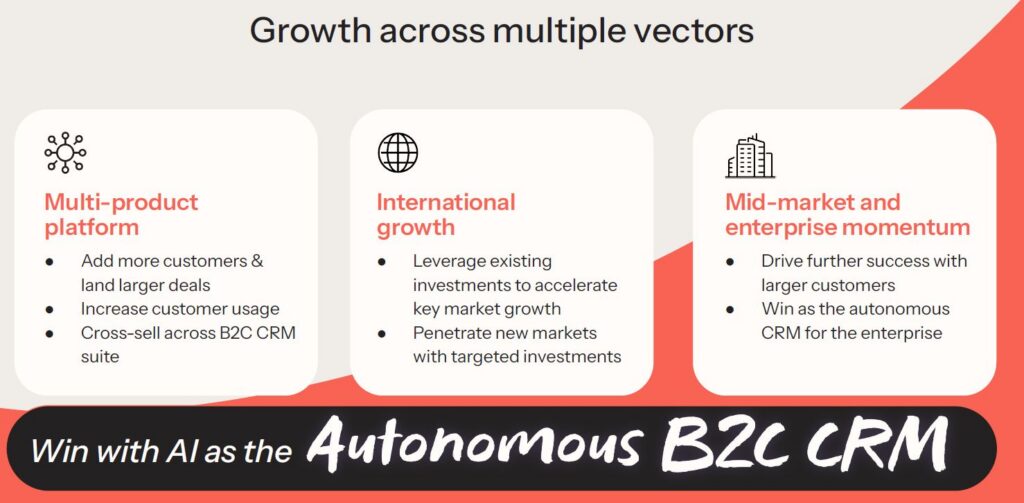
Source: Klaviyo, Inc. Q1 2026 Investor Presentation
1
Beat Rate
Klaviyo has established an unusually consistent record of outperformance. Revenue has exceeded consensus for at least eight consecutive quarters, and non-GAAP earnings per share have beaten every quarterly estimate available since late 2023. The scale behind it keeps growing: revenue rose 34% to $937.5 million in 2024, then another 32% to $1.234 billion in 2025, with the growth rate barely yielding even as the revenue base grew by a third.
The first quarter of 2026 extended that pattern. Revenue increased 28% year-over-year to $358.0 million, clearing both Wall Street’s roughly $349 million estimate and management’s own $346-350 million guidance, while non-GAAP EPS reached $0.22 against consensus near $0.20. What matters underneath the beat is where the growth came from: 56% of the year-over-year increase from newer customers and 44% from expansion among existing ones – close enough to an even split to suggest neither engine is carrying the other. Total customers rose 16% to more than 196,000, net revenue retention improved two points to 110%, and the company closed a record number of multimillion-dollar annual recurring revenue deals, including a single expansion worth more than $6 million.
Operating leverage is where the story gets more interesting. Non-GAAP gross margin held at 76% while non-GAAP operating margin expanded nearly 5 percentage points to a post-IPO record of 16.4%, as operating expenses fell to 59.4% of revenue – down 5.6 percentage points year-over-year. The quarter also delivered the company’s first positive GAAP operating margin as a public company, with GAAP net income of $9.0 million – achieved despite $41.8 million in stock-based compensation.
That leverage is showing up as cash. Trailing-12-month free cash flow reached $219.5 million, a margin of nearly 17%, even though Q1’s own figure of $18.6 million looked thin on seasonality and annual bonus timing. Klaviyo ended the quarter with $984.6 million in cash and no conventional funded debt, providing substantial liquidity and financial flexibility to invest through a slower environment.
Management raised full-year 2026 revenue guidance by $13 million at the midpoint to $1.514-1.522 billion, implying roughly 23% growth, and lifted non-GAAP operating income to $222-228 million. Q2 guidance calls for $359-363 million in revenue, or 23-24% growth, and a 13-14% non-GAAP operating margin. The implied deceleration deserves attention, though a track record of conservative guidance followed by overdelivery suggests reading it carefully: Klaviyo opened 2024 projecting about 27% growth and delivered 34%, then started 2025 near 23% and finished at 32%.
The near-term risks are real – growth moderation, carrier fees the company is largely absorbing, gross-margin pressure from faster-growing messaging channels, and uncertain monetization timing for AI products. But each of those is a cost of expansion rather than a symptom of weakness: the messaging channels compressing margin are the ones customers are adopting fastest, and the AI products with unproven monetization are the ones driving usage. Klaviyo has spent two years proving it can outgrow its own spending, and Q1 was the clearest evidence yet.

Source: Klaviyo, Inc. Q1 2026 Investor Presentation
1
Read Receipts
Klaviyo sits among three useful public reference points. Braze is the closest product peer, working the same problem of real-time customer engagement and cross-channel orchestration at a similar stage of growth. Zeta Global offers another AI-driven marketing platform at comparable revenue scale, though its media exposure gives it a different margin structure. HubSpot supplies the broader CRM benchmark – the mature platform that has already made the extension across marketing, sales, and service that Klaviyo is attempting now. This group frames Klaviyo as a fast-growing, B2C-focused platform moving upmarket and into a larger product opportunity.
Stock performance across that group has diverged sharply over the past year. While Zeta notched a strong rally on repeated beat-and-raise results, all others are sitting at losses of different magnitudes: Braze proved comparatively resilient, HubSpot tumbled nearly 60%, and Klaviyo dropped by about 44%, with most of the loss occurring in 2026. Despite several attempts at a rebound, shaky investor sentiment toward software pulled attention to perceived negatives. Thus, the stock sold off after a beat-and-raise quarter, as investors looked past the numbers to the CFO transition and the guided moderation.
Both of those concerns have since softened – CFO appointment closed the leadership question, product launches have continued, and Klaviyo’s guidance history argues the moderation is more conservative than real. Wall Street appears to agree: Klaviyo holds a unanimous Strong Buy from all 18 analysts following the stock, with the average target implying nearly 64% upside.
The selloff in the stock has left Klaviyo with a persuasive growth-adjusted setup. Klaviyo trades at 2.94x forward EV/Sales – roughly level with Braze and Zeta, and modestly above HubSpot – while its forecast revenue growth of 24.7% trails only Zeta. The forward non-GAAP earnings multiple of 20.99x compresses to 17.22x in FY2 and 13.95x in FY3 as Klaviyo’s earnings are expected to grow ahead of all peers but Braze.
Meanwhile, a forward PEG of 0.70x – low even in absolute terms – captures the imbalance between Klaviyo’s growth and what the market is paying for it. Among peers, only a slower-growth HubSpot carries a lower PEG. That growth also arrives with a 74.6% gross margin and an 18.4% levered free-cash-flow margin behind it. In short, while each peer brings one distinct strength – Zeta’s fastest revenue growth, HubSpot’s mature economics, Braze’s expected earnings ramp – Klaviyo is the only name in the group combining robust growth, strong cash conversion, and moderate forward multiples in a single package.
Management is buying into that gap. The board authorized a $500 million repurchase program, and Klaviyo completed the initial $100 million accelerated repurchase in April, retiring 4.3 million shares – roughly 1.4% of the quarter-end count – with $400 million still available. That capacity offsets dilution while the company continues funding product development and international expansion, and the timing says something in its own right: the buyback began while the stock sat near its lows, not after a recovery.
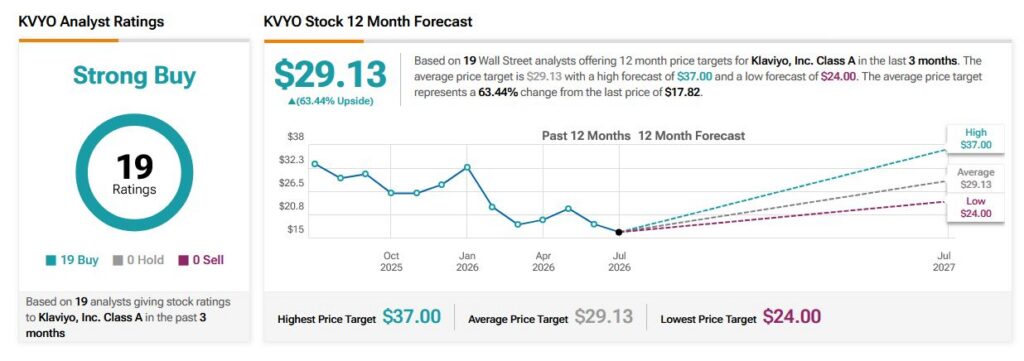
1
To Sum It All Up
Klaviyo is evolving from a marketing platform into an autonomous B2C CRM built around a unified, real-time customer record. That foundation gives its agents the context to build campaigns, resolve service requests, and improve with every interaction – capabilities that should deepen adoption as brands consolidate fragmented tools. Enterprise wins, international expansion, new channels, and service cross-selling provide several ways to sustain growth, while rising operating leverage and strong cash generation reduce the execution burden. Shopify concentration, carrier costs, and early AI monetization are genuine risks, but each looks like a cost of expansion rather than a crack in the model. Meanwhile, the reasons for the selloff have quietly resolved: the finance seat is filled, the product cadence has accelerated, and history suggests the guidance reset was conservatism, not deceleration. The skepticism remains priced in. The opportunity does not.
1
1
Smart Growth Portfolio
|
—-
***Vistance Networks (VISN) apparent stock-price decline is not a real economic loss. Shares plunged roughly 50% on April 27 because they began trading ex-dividend after a $10 special cash distribution, meaning value was mechanically transferred from the stock price to shareholders as cash. Since then, VISN is up roughly 22%, reflecting strong investor confidence in the remaining business. Another similar value-transfer event is expected within the next two months, as Vistance is set to distribute most of the roughly $1.7 billion in net proceeds from its already-closed $1.846 billion RUCKUS sale to Belden.
1
1
Disclaimer
The information contained in this article represents the views and opinions of the writer only, and not the views or opinions of TipRanks or its affiliates and should be considered for informational purposes only. TipRanks makes no warranties about the completeness, accuracy, or reliability of such information. Nothing in this article should be taken as a recommendation or solicitation to purchase or sell securities. Nothing in the article constitutes legal, professional, investment and/or financial advice and/or takes into account the specific needs and/or requirements of an individual, nor does any information in the article constitute a comprehensive or complete statement of the matters or subject discussed therein. TipRanks and its affiliates disclaim all liability or responsibility with respect to the content of the article, and any action taken upon the information in the article is at your own and sole risk. The link to this article does not constitute an endorsement or recommendation by TipRanks or its affiliates. Past performance is not indicative of future results, prices, or performance.
