TipRanks Smart Growth Portfolio #71: Orbital Ops

Dear Investors,
In this edition of the Smart Growth Portfolio and Newsletter, we spotlight a company bringing space back to Earth. But first, some news and updates.
1
Portfolio News
❖ Micron (MU) surged on Thursday after announcing it would spend $3 billion on boosting the U.S. semiconductor supply chain as the company works to keep up with skyrocketing AI-driven memory demand. The strategic investment includes accelerating U.S. manufacturing investments to over $250 billion through 2035, up from $200 billion announced in June. Central to this strategy is the planned New York DRAM megafab, where Micron poured the first concrete ahead of schedule. Additionally, construction is underway on two new fabs in Idaho. The company reiterated its goal of producing 40% of its DRAM in the U.S.
Another key part of the plan is securing key materials for future memory manufacturing. Micron revealed a $500 million funding deal for Taiwanese-headquartered GlobalWafers to expand its wafer development and manufacturing in its Texas facilities. The investment also comes with a 10-year supply agreement for raw silicon wafer capacity and collaboration on next-generation wafer technologies. GlobalWafers is currently the only vendor approved by the CHIPS for America Program that is capable of fabricating advanced 300mm wafers on U.S. soil.
Beyond domestic production, global capacity expansion is also underway. Last week, MU broke ground on the expansion of its factory in Japan. The facility is meant to make chips for AI processors, with delivery and installation of manufacturing equipment set to begin in the second half of 2028.
1
❖ Mizuho raised its price target on MKS (MKSI) to $415 from $400, reconfirming its Buy rating on the stock, citing accelerating demand for wafer fabrication equipment (WFE). The firm raised its estimates for global WFE spending in 2027 to $192 billion, expecting it to rise 25% after an expected 23% increase in 2026. Mizuho introduced 2028 and 2029 estimates at $221 billion and $214 billion, respectively. Morgan Stanley echoed this sentiment, raising its WFE projections to $202 billion from $191 billion in 2027, and to $227 billion from $215 billion in 2028. The firm boosted its MKS price target from $374 to $442.
1
❖ Ondas (ONDS) has acquired U.S.-based DZYNE Technologies in a cash-and-stock deal valued at $875.8 million. The deal significantly strengthens what was already one of the industry’s leading autonomous defense portfolios, adding new and complementary long-endurance ISR, precision strike and counter-UAS capabilities to an already robust end-to-end unmanned platform. The transaction also adds a $1.5 billion in a three-year pipeline, significantly expanding Ondas’ growth opportunities.
Ondas is riding the wave of financial and regulatory support for full domestic production of modern warfare systems. The U.S. drone policy is undergoing fundamental shifts, including a ban on new foreign-made drone models, the establishment of a domestic-manufacturer-only procurement regime, and the submission of the FY2027 budget request, which allocates more than $75 billion to drones and counter-drone systems.
1
1

1
This Week’s Top Growth Pick: Redwire (RDW)
Redwire Corporation operates at the intersection of two of the most ambitious long-term trends in science and technology – building the infrastructure for the expanding space economy and enabling research that can only be performed in microgravity. Through a growing portfolio of space systems, platforms, and specialized technologies, the company supports government agencies, defense customers, and commercial partners working to make space a permanent domain for industry, exploration, and innovation. At the same time, Redwire is helping unlock new possibilities in biotechnology, where the unique conditions of orbit could accelerate the development of advanced medicines and materials. It is a bold bet on the future of technology and medicine – one that carries significant risk, but also unusually large long-term potential if these emerging markets continue to mature.
1
Zero-G Genesis
Redwire’s roots trace back to 2020, when private equity firm AE Industrial Partners brought together several specialized aerospace businesses into one integrated space infrastructure company. Instead of starting with a single product, RDW entered the public markets in 2021 with a toolkit of flight-proven technologies across spacecraft components, deployable structures, in-space manufacturing, sensors, robotics, and mission engineering.
Over the past five years, the company has turned that toolkit into a broader platform. Redwire expanded through acquisitions that added microgravity biotech, European spacecraft expertise, and national-security satellite capabilities, helping the company move beyond niche hardware and into larger, more complex mission roles. Redwire gained strong 3D printing and in-space manufacturing capabilities through its 2020 acquisition of Made In Space, but its 2021 acquisition of Techshot was especially important, providing the foundation for its space biotech push, including payloads and research systems used aboard the International Space Station (ISS).
At the same time, Redwire deepened its work with NASA across the ISS, lunar exploration, on-orbit servicing, biotechnology, and future commercial space station initiatives. Its technologies have flown on missions supported by SpaceX launch services and have been incorporated into programs involving major aerospace players such as Boeing, Blue Origin, Sierra Space, Axiom Space, Airbus, and other government and commercial partners. These ties increasingly position RDW at the industrial chokepoints of space exploration: power, structures, docking, navigation, manufacturing, research, and autonomous operations. Meanwhile, defense work has continued to grow through contracts with the U.S. Department of Defense, DARPA, and allied government agencies, diversifying Redwire’s customer base beyond civil space exploration.
The company’s biggest recent shift came in 2025 with the acquisition of Edge Autonomy, which expanded Redwire into autonomous airborne systems and pushed it deeper into defense technology. The deal broadened RDW from space infrastructure into a multi-domain platform serving civil, commercial, and national-security customers. That same period also brought greater momentum in space biotech, including NASA-supported pharmaceutical research on the ISS and the launch of SpaceMD – Redwire’s subsidiary focused on space-based pharmaceutical and biotech development.
Redwire is still early, volatile, and deeply unprofitable, so this is not a clean execution story yet. What makes it compelling is the combination: hard-tech infrastructure that is already flying, already needed, and already generating revenue, plus cutting-edge applications that could open much larger markets over time. Redwire is betting on both sides of the emerging space economy – helping build the systems that make activity in orbit possible, then using that environment to create value back on Earth through biotech, in-space manufacturing, and advanced research. That dual exposure is exactly what makes the stock risky, but also unusually interesting for growth investors willing to look past today’s income statement.

Source: Redwire 101, May 2026
1
Solar Pillbox
Redwire is becoming part of the operating system of the emerging space economy – powering spacecraft, guiding missions, enabling docking, supporting orbital research, and extending what customers can do in orbit, on the Moon, and across contested defense environments.
RDW’s strongest advantage is that much of this is already flight-proven. Its IROSA solar arrays are a major power upgrade for the ISS, its cameras and sun sensors support NASA’s Artemis II program, its avionics and spacecraft work run through ESA missions, and its docking systems are tied to Europe’s next generation of commercial capsules. For a small space company, that is a rare credibility base: customers are already trusting its hardware in places where failure is out of the question.
Space is moving from launch-and-explore toward operate-and-defend. As orbit becomes more crowded and commercially useful, demand is rising for the systems that keep spacecraft powered, aware, maneuverable, dockable, and productive after launch. Redwire is expanding into that operating layer, providing “picks and shovels” for the space economy: solar arrays, docking systems, avionics, optical navigation, cameras, sensors, payload facilities, spacecraft platforms, deployable structures, and mission hardware.
RDW is embedded in the next phase of the space economy through ultra-low-orbit spacecraft for sharper sensing, higher-orbit platforms built to monitor activity around strategically important satellites, European quantum-secure communications, national-security spacecraft, lunar robotics, and rendezvous-and-docking technologies for the next generation of orbital infrastructure. Andromeda gives that ambition a concrete form: Redwire was selected for a U.S. military program to build spacecraft that monitor activity around critical satellites, moving the company beyond mission hardware and into larger orbital-surveillance roles, while opening access to a large government contract vehicle.
Beyond defense-through-space, Redwire has gained another near-term growth engine – Defense Tech – through the Edge Autonomy deal, which added small military drones and intelligence payloads to the portfolio, tying RDW to one of the fastest-moving areas of defense spending. Massive demand for lower-cost, agile systems that can scout, surveil, relay data, and operate in contested environments is already showing up across U.S. military training, Marine Corps modernization, NATO procurement, Ukraine-tested drone warfare, and Taiwan maritime security, alongside other deals. Moreover, RDW was selected as one of the vendors for SHIELD – a massive, multi-year missile defense IDIQ. The selection doesn’t guarantee contracts, but it opens the door to competing for future task orders under the vehicle.
Redwire combines hard space infrastructure already generating revenue with cutting-edge applications that could create much larger upside later. One of these futuristic layers is orbital data centers. As power and cooling bottlenecks limit data-center buildout on Earth, Elon Musk’s idea of moving them into orbit is gaining attention, though it remains speculative. Meanwhile, RDW is positioning its power, deployable structures, and thermal-management heritage around future orbital compute architectures.
The second, currently more practical major futuristic trend is microgravity: through its subsidiary SpaceMD, RDW is turning orbit into a drug-development environment, using PIL-BOX – small automated pharmaceutical labs that fly on the ISS – to grow seed crystals in microgravity. The work is still early, but since its launch at the end of 2023, Redwire has flown 54 PIL-BOX systems to the ISS, successfully crystallizing 45 unique compounds, including insulin and molecules relevant to cancer, cardiovascular disease, obesity, and diabetes. NASA appears to be increasingly interested, having recently added $4 million in PIL-BOX funding to the existing $25 million five-year IDIQ.
Redwire’s BioFabrication Facility (BFF) – a 3D bioprinter operating on the ISS – may sound like science fiction, but it is one of the most advanced pieces of hardware in Redwire’s space biotech portfolio. A permanent commercial facility owned and operated by Redwire, it has already successfully pioneered space 3D printing of human knee meniscus, along with heart tissue and other biological materials. The system aims to enable tissue engineering, regenerative medicine, and eventually full organ printing for medical use, with microgravity potentially allowing the creation of higher-quality tissues than is possible on Earth.
These multiple short- and long-term growth drivers create the kind of upside that makes RDW unusual: it helps build the space economy, then applies its space capabilities to create value back on Earth. While most of the commercialization potential remains several years into the future, Redwire’s business increasingly appears to be bringing that future closer to home.
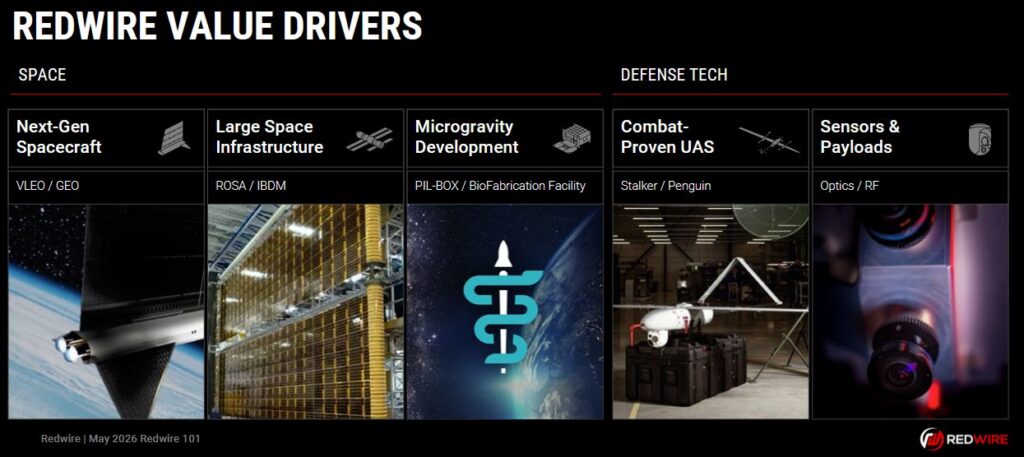
Source: Redwire 101, May 2026
1
Building Delta-V
Redwire’s financials are still early-stage, but Q1 2026 showed the business scaling in the right direction. Revenue rose 57.9% year-over-year to $97.0 million, extending a step-change in the second half of 2025. The top-line surge was driven by the broader platform that came together once Edge Autonomy joined the business. Space remained the larger business at $52.7 million, while Defense Tech contributed $44.3 million, up from just $9.3 million a year ago. The business-mix change is giving RDW a more balanced base between orbital infrastructure, advanced spacecraft, microgravity platforms, drones, sensors, and defense systems.
The more important shift was margin. Gross margin reached 26.6%, up from 14.7% a year earlier and 9.6% in Q4 2025 – a sharp improvement that suggests mix, execution, and contract quality are all moving up with scale. This matters because Redwire’s growth isn’t only about winning more work: it needs to show that larger programs, defense production, and space-infrastructure contracts can translate into healthier economics rather than just higher revenue.
The order book supports that direction, reflecting accelerating demand. Q1 bookings reached $186.5 million, producing a 1.92x book-to-bill ratio, while contracted backlog climbed to a record $498.1 million, up roughly 71% year-over-year. Space accounted for $359.7 million of backlog and Defense Tech for $138.4 million. The recent contract flow adds weight to those numbers: repeat Stalker1 orders from U.S. military customers, a high-eight-figure NATO Penguin Mk32 award, the first ELSA solar-array sale to Moog, an eight-figure docking-system deal with The Exploration Company, and additional NASA funding for PIL-BOX all point to demand spreading across the portfolio rather than clustering in one program.
Redwire is still investing ahead of profitability, which is not among its near-term benchmarks at this stage. R&D and internal development spending rose from under $1 million in Q1 2025 to $12.6 million, funding areas such as ultra-low-orbit spacecraft, quantum-secure communications, lunar infrastructure, Andromeda, and next-generation defense systems. That investment-heavy setup helps explain why profitability remains distant, while Q1 GAAP results were further distorted by acquisition-related accounting. Net loss was $76.5 million, including more than $44 million of non-recurring activity tied mostly to Edge Autonomy incentive-unit vesting. Adjusted EBITDA remained negative at $9.2 million, worse year-over-year but improved from negative $18.1 million in Q4 2025.
Meanwhile, the cash trend is increasingly encouraging. Operating cash burn narrowed to $6.7 million from $45.1 million a year earlier, while free cash flow improved to negative $12.7 million from negative $49.1 million. RDW ended the quarter with record liquidity of $175.2 million, up sharply from $46.5 million at year-end 2024. Debt remains part of the structure, but Redwire has been actively reshaping it: during Q1, the company amended its remaining credit agreement, extended maturity to May 2029, and lowered the interest-rate spread. After quarter-end, it expanded revolving commitments to $50 million and prepaid $40 million of term loans, reducing term-loan principal to $50 million.
Management reaffirmed 2026 revenue guidance of $450-500 million, implying 41.6% growth at the midpoint, supported by more than $350 million of bookings over the past two quarters and record backlog.
Redwire’s fundamentals are improving quickly, but this is still a scale-before-profitability story: the key is whether revenue, backlog, and margins keep moving in the right direction while cash burn remains manageable.
—
1 – Stalker is Redwire’s small tactical drone platform for reconnaissance, surveillance, communications relay, and contested-environment operations.
2 – Penguin Mk3 is Redwire’s tactical uncrewed aircraft platform for longer-range intelligence, surveillance, and reconnaissance missions.
—
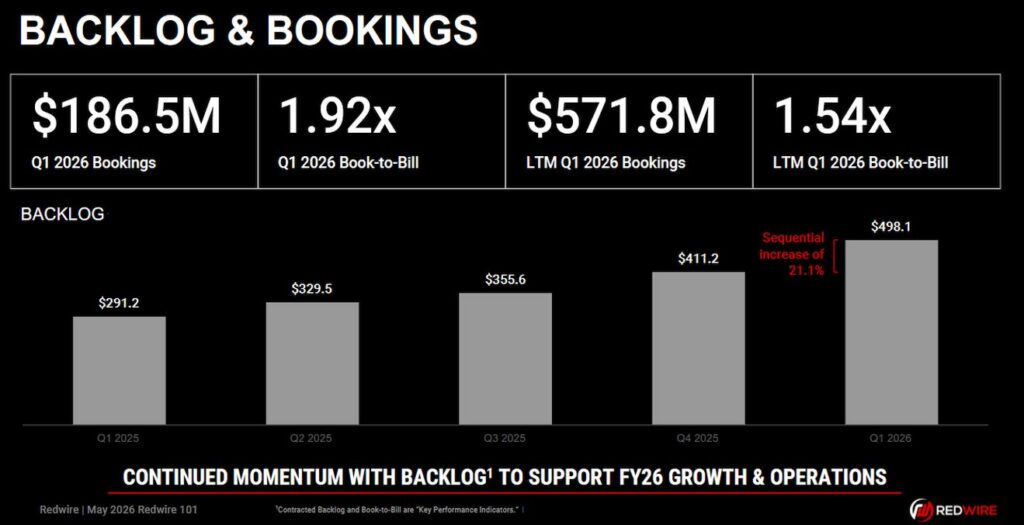
Source: Redwire 101, May 2026
1
Moonshot Material
RDW is best framed against a mixed group of public space, defense-tech, and aerospace hardware companies, because its model now spans more than one bucket. Intuitive Machines is the closest space-infrastructure comp, with NASA-heavy programs, contract-driven growth, and a similar early-stage profitability profile. Voyager Technologies adds another space-and-national-security platform comparison, with a backlog-led model and defense-oriented expansion path. AeroVironment frames the Defense Tech side, especially after Edge Autonomy added tactical drones, sensors, and ISR payloads to RDW’s portfolio. Astronics is more traditional, but useful as an aerospace/defense hardware benchmark for mission-critical systems, backlog execution, and margin maturity. This peer set positions Redwire as a hybrid space-infrastructure and defense-tech challenger still building scale.
The space-and-defense trade has been extremely volatile over the past year, with performance shaped by timing, catalysts, and confidence in execution as much as by broader sector trends. However, these trends also matter: most of the pack rallied through late May as investors piled into space-related names ahead of SpaceX’s historic IPO – and gave up most of the gains when the dust settled. Looking at the details, Astronics has led the annual gains, as its story is more traditional aerospace recovery than speculative space growth, with clearer margin momentum and backlog execution. Intuitive Machines had already enjoyed a major space-infrastructure rerating before 2026, leaving its year-to-date performance more muted, while Voyager has followed the newer space-defense platform trade with less intensity. AeroVironment, despite strong drone exposure, has lagged on program and margin concerns.
Redwire sits in the middle of those forces: its one-year chart still reflects a weaker 2025, dilution worries, and the spring pullback – but its year-to-date performance leadership shows investors beginning to recognize the Edge Autonomy reset, revenue acceleration, margin recovery, record backlog, and stronger liquidity. These factors contribute to Wall Street’s positive stance toward the stock, with the average price target implying potential upside of over 65%.
Another factor supporting the optimism is that the stock’s drop from May’s bubble-like levels has removed much of the froth from its valuation. Its trailing and forward price-to-sales and EV/Sales multiples now sit below the peer-group average, while price-to-book looks even more favorable: on both trailing and forward measures, RDW is the second-cheapest name in the group, behind only AeroVironment. The comparison with Intuitive Machines, the closest peer, is the most telling: RDW has already achieved a much wider gross margin, and its strong delivery is expected to drive a much narrower FY2 non-GAAP loss per share. Despite that, RDW is trading at just a slightly higher forward EV/Sales and at roughly half Intuitive Machines’ forward price-to-book.
That does not make RDW cheap in an absolute sense – this is still a high-growth, loss-making space-and-defense stock priced on future execution. But relative to the peer set, the setup looks more interesting after the pullback: Redwire is scaling faster than the mature aerospace names, carries a broader infrastructure-and-defense platform than most pure space peers, and is beginning to show the margin and backlog signals investors need to underwrite the next stage. If management keeps converting demand into revenue, pushing gross margin higher, and narrowing cash burn, today’s valuation could prove to be less a premium for distant dreams than an entry point into a company moving from speculative space story toward operating scale.

1
To Sum It All Up
Redwire is increasingly positioned at the intersection of space infrastructure, defense autonomy, and microgravity-enabled science. As orbit becomes more crowded, contested, and commercially useful, customers need the systems that make spacecraft more powerful, aware, maneuverable, and productive after launch. RDW is building into that need through flight-proven power systems, spacecraft platforms, docking technologies, defense drones, sensors, and orbital research hardware. The company remains early-stage, unprofitable, and volatile, but the direction is improving: revenue is scaling, margins are improving, backlog is expanding, liquidity is stronger, and Defense Tech is adding a more immediate demand engine. The larger upside sits in what comes next – space medicine, in-space manufacturing, orbital computing, and national-security space infrastructure. If execution holds, Redwire could evolve from a speculative space stock into a core supplier to the industrial space economy.
1
1
Smart Growth Portfolio
|
—-
***Vistance Networks (VISN) apparent stock-price decline is not a real economic loss. Shares plunged roughly 50% on April 27 because they began trading ex-dividend after a $10 special cash distribution, meaning value was mechanically transferred from the stock price to shareholders as cash. Since then, VISN is up roughly 27%, reflecting strong investor confidence in the remaining business. Another similar value-transfer event is expected within the next two months, as Vistance is set to distribute most of the roughly $1.7 billion in net proceeds from its already-closed $1.846 billion RUCKUS sale to Belden.
1
1
Disclaimer
The information contained in this article represents the views and opinions of the writer only, and not the views or opinions of TipRanks or its affiliates and should be considered for informational purposes only. TipRanks makes no warranties about the completeness, accuracy, or reliability of such information. Nothing in this article should be taken as a recommendation or solicitation to purchase or sell securities. Nothing in the article constitutes legal, professional, investment and/or financial advice and/or takes into account the specific needs and/or requirements of an individual, nor does any information in the article constitute a comprehensive or complete statement of the matters or subject discussed therein. TipRanks and its affiliates disclaim all liability or responsibility with respect to the content of the article, and any action taken upon the information in the article is at your own and sole risk. The link to this article does not constitute an endorsement or recommendation by TipRanks or its affiliates. Past performance is not indicative of future results, prices, or performance.
